Cable Lateral Squat
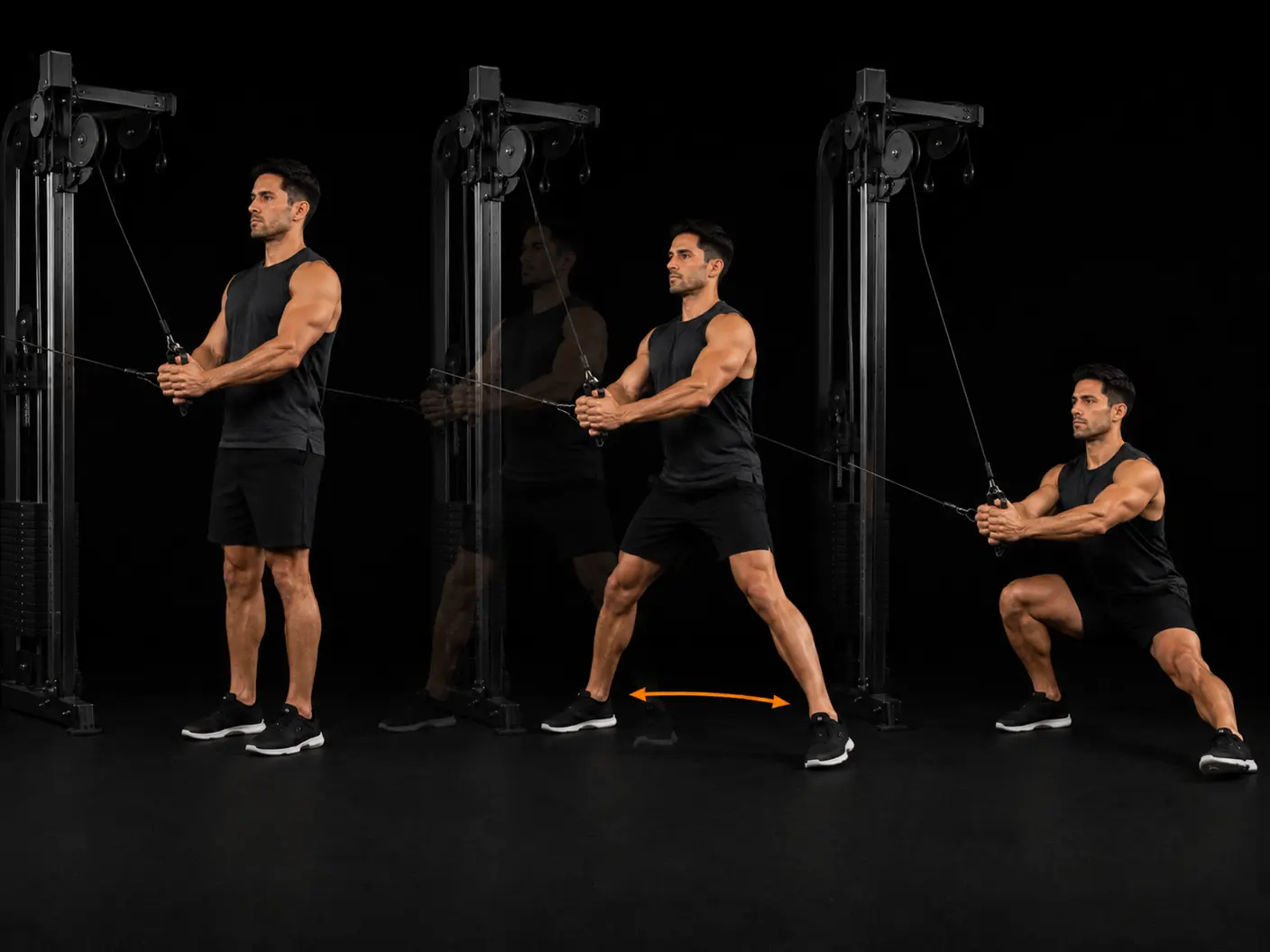
The cable lateral squat is a compound lower-body movement that trains the lateral lunge pattern under constant cable tension, loading the adductors, quadriceps, and glutes through a frontal-plane range of motion that most conventional exercises overlook. An ankle cuff attaches one leg to the cable stack, adding resistance as you shift your weight laterally into a single-leg squat while the opposite leg remains straight. It suits intermediate trainees looking to develop hip strength, frontal-plane stability, and the kind of multi-directional capacity that underpins athletic performance.
How to do it
Attach a cable to one ankle via an ankle cuff. Stand side-on to the stack, feet wide. Shift your weight to the side away from the cable, bending that knee into a lateral squat while keeping the other leg straight. The cable provides additional resistance as you shift. Drive through the squatting foot to return to centre.
Coaching cues
- Wide stance
- Shift and squat to one side
- Opposite leg stays straight
- Drive through the heel
Why train it
- The frontal-plane loading targets the adductors directly, filling a gap left by sagittal-plane staples such as squats and deadlifts.
- Keeping the non-squatting leg straight while the cable pulls at the ankle demands significant core and hip stability throughout the movement.
- The constant tension provided by the cable increases the mechanical demand at both the bottom of the squat and during the return drive, making the glutes and quadriceps work across the full range.
- Its specificity to lateral movement patterns makes it a practical choice for athletes in sports that require cutting, shuffling, or change-of-direction mechanics.
Common mistakes
- Allowing the squatting knee to collapse inward — focus on tracking the knee over the toes throughout the entire descent and drive.
- Setting the feet too narrow — establish a genuinely wide stance before you begin so the lateral shift produces a meaningful squat depth rather than a small side-step.
- Leaning the torso excessively forward — keep the chest up and the spine tall so the hips and legs do the work rather than momentum from the upper body.
- Rushing the return to centre — drive deliberately through the heel of the squatting foot so the glutes and quadriceps complete the movement rather than the cable pulling you back passively.
Primary: Adductors, Quadriceps, Gluteus Maximus.
Secondary: Hamstrings, Rectus Abdominis.
Equipment
Good for
Easier variation
Bodyweight lateral squat — same pattern without cable resistance.
Similar movements
Frequently asked
- What muscles does the cable lateral squat work?
- The primary muscles are the adductors, quadriceps, and glutes. The hamstrings and core work as secondary stabilisers throughout the movement.
- How many sets and reps should I do for the cable lateral squat?
- For general fitness, three to four sets of eight to twelve reps per side is a practical starting point. Athletes targeting lateral power and strength may work in the five to eight rep range with heavier load, while higher rep sets of twelve to fifteen suit those prioritising muscular endurance.
- What are good alternatives to the cable lateral squat?
- The bodyweight or dumbbell lateral squat trains the same frontal-plane pattern without cable equipment. The Copenhagen adductor exercise and lateral band walks can complement it if you want to isolate adductor or hip abductor strength specifically.
- Is the cable lateral squat suitable for beginners?
- It is rated as an intermediate movement because it requires adequate hip mobility, ankle stability, and the coordination to manage cable tension while controlling a lateral squat. Beginners would benefit from building comfort with the bodyweight lateral squat first before adding cable resistance.
- Which side should the cable be attached to?
- The cuff attaches to the ankle of the leg you intend to squat onto — that is, the leg facing away from the cable stack. The cable then provides resistance as you shift your weight toward that side, and you work both legs by turning around and repeating on the opposite side.
Want this movement in a plan built for you?
Adaptiv programmes the right exercises for your goal, equipment and experience — then adapts them as you train.
Build my programme