90/90 Hip Switch
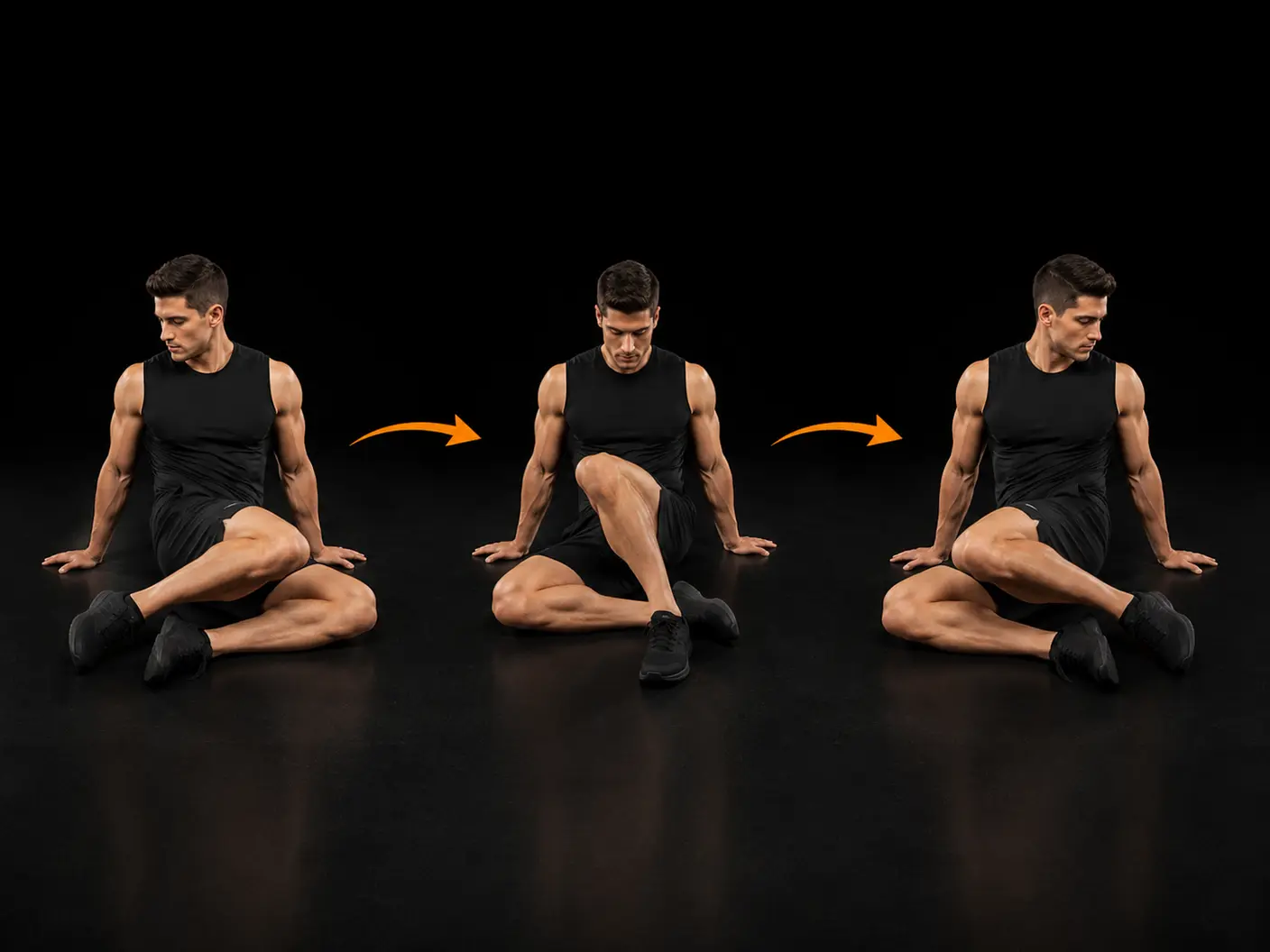
The 90/90 hip switch is a floor-based mobility drill that trains active control through both hip internal and external rotation. Starting from the 90/90 position — one shin parallel to the body, one behind — you rotate the hips to rebuild the position on the opposite side, moving through the full rotational range rather than passively sitting in it. It suits anyone looking to improve hip mobility for sport, general movement quality, or as part of a warm-up routine.
How to do it
Sit on the floor with one leg in front, knee bent at 90°, shin parallel to body. Other leg out to the side, knee bent at 90°, shin behind the body. Both knees on the floor. Switch sides by rotating the hips; the knees fall together and rebuild the 90/90 on the opposite side.
Coaching cues
- Both knees on the floor
- Tall torso
- Rotate through the hips
- Control the switch
Why train it
- Develops active control through both hip internal and external rotation, addressing a range of motion that is frequently undertrained.
- Improves the ability to transition between rotational positions, which underpins athletic movements such as change of direction, kicking, and ground-based sport skills.
- Reinforces a tall, stable torso during hip movement, encouraging dissociation between the pelvis and spine.
- Works as an effective warm-up drill or cooldown movement, requiring no equipment and minimal space.
Common mistakes
- Lifting the knees off the floor — keep both knees in contact with the ground throughout the switch to ensure the rotation is driven by the hips rather than compensated at the knee.
- Leaning the torso sideways as you rotate — maintain a tall, upright spine so the movement stays at the hip joint where it is intended.
- Using momentum to flop between sides — control the transition in both directions to build genuine active range rather than passive flexibility.
- Allowing the feet to shift position — keep the feet relatively still and let the legs follow the hip rotation, which confirms the movement is originating correctly.
Primary: Hip External Rotators.
Secondary: Gluteus Maximus, Rectus Abdominis.
Equipment
Good for
Easier variation
Static 90/90 holds — remove the switch to groove the positions.
Similar movements
Frequently asked
- What muscles does the 90/90 hip switch work?
- The primary muscles trained are the hip external and internal rotators, which control the rotation of the femur within the hip socket. The glutes and core work as secondary stabilisers to maintain position and support the torso throughout the movement.
- How many sets and reps should I do?
- For a warm-up context, two to three sets of five to eight controlled switches per side is a practical starting point. If using the drill within a dedicated mobility session, you can increase volume or add a pause at each end position to build greater control.
- Is the 90/90 hip switch suitable for beginners?
- Yes — it is classified as a foundational movement, making it appropriate for those new to structured mobility work. The main challenge initially is keeping both knees on the floor, so move at a pace that allows you to maintain that contact rather than rushing the transition.
- Can I use this exercise as a warm-up before lower body training?
- It is well suited to this purpose, as it primes the hip rotators and encourages pelvic mobility before squatting, hinging, or lateral movements. Two to three minutes of controlled switching is typically sufficient to prepare the hips for more loaded work.
- Are there alternatives if I find the 90/90 switch too difficult?
- If maintaining both knees on the floor is a significant challenge, you can start by simply holding the static 90/90 position on each side and focusing on sitting tall before introducing the rotational switch. This builds familiarity with the end ranges before asking the hips to move actively between them.
Want this movement in a plan built for you?
Adaptiv programmes the right exercises for your goal, equipment and experience — then adapts them as you train.
Build my programme