Kettlebell Windmill
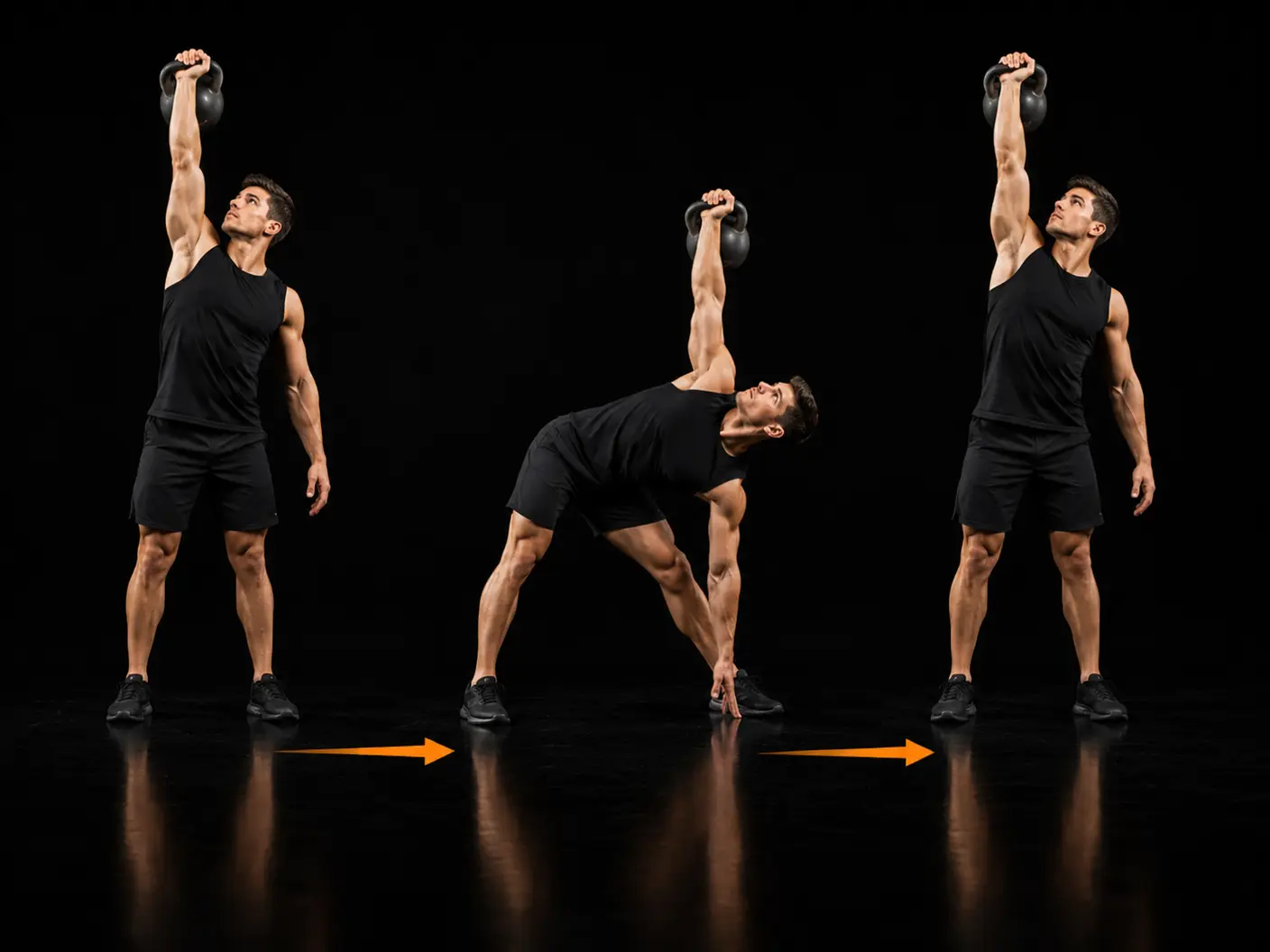
The kettlebell windmill is a unilateral mobility drill that combines an overhead lockout with a lateral hip hinge, training the body to move through a large range of motion under load. It develops rotational stability through the trunk, demands active flexibility through the hamstrings and adductors, and reinforces shoulder packing throughout the descent and ascent. It suits intermediate trainees who have a solid overhead position and want to bridge the gap between raw strength and functional range of motion.
How to do it
Press a kettlebell overhead with one arm. Feet wide, toe of opposite foot turned out 45°. Push the weighted hip out to the side. Hinge down toward the front foot, reaching the free hand to the floor; eyes on the bell. Return to standing.
Coaching cues
- Eyes on the bell
- Hip out and back
- Reach long
- Smooth ascent
Why train it
- Trains the obliques and glutes to work in concert during a loaded lateral hinge, building rotational control that transfers to sport and compound lifting.
- The overhead kettlebell demands continuous shoulder stability throughout the movement, reinforcing the rotator cuff's role as a dynamic stabiliser under load.
- Moving through a full lateral hip hinge lengthens the hamstrings and adductors under tension, developing active rather than passive flexibility.
- The single-arm overhead position exposes and addresses asymmetries between sides, making it a useful diagnostic tool within a general fitness or athletic performance programme.
Common mistakes
- Losing the hip push — drive the weighted hip firmly out to the side before hinging down, as this is the mechanism that creates the range of motion.
- Taking the eyes off the bell — keep your gaze fixed on the kettlebell throughout the movement to maintain shoulder position and spatial awareness overhead.
- Rushing the descent — control the hinge smoothly and reach long with the free hand rather than collapsing quickly toward the floor.
- Allowing the front knee to bend excessively — keep both legs relatively straight to ensure the hamstrings and adductors are doing the work rather than the movement becoming a squat pattern.
Primary: Obliques, Gluteus Maximus, Hamstrings.
Secondary: Anterior Deltoid, Adductors, Rectus Abdominis.
Equipment
Good for
Easier variation
Bodyweight windmill — learn the pattern.
Similar movements
Frequently asked
- What muscles does the kettlebell windmill work?
- The primary muscles are the obliques, glutes, and hamstrings, which drive and control the lateral hinge. The shoulders, adductors, and broader core musculature work as secondary stabilisers, particularly to maintain the overhead lockout throughout the movement.
- How many sets and reps should I do for the kettlebell windmill?
- For mobility and movement quality, two to three sets of four to six controlled repetitions per side is a practical starting point. Quality of range and overhead position matters far more than volume here, so keep sets low enough that you can maintain form throughout.
- What weight should I use for a kettlebell windmill?
- Start lighter than you think necessary — a weight you can press overhead comfortably and hold locked out for the full duration of each set. Many coaches recommend beginning with a load around half your typical overhead press weight while you learn the movement pattern.
- Is the kettlebell windmill suitable for improving hip mobility?
- Yes, the lateral hip hinge pattern specifically targets hip mobility alongside hamstring and adductor flexibility. Because the range is achieved under load with active muscle engagement, it tends to produce more durable improvements in usable mobility than passive stretching alone.
- What are good alternatives to the kettlebell windmill?
- The bodyweight windmill removes the overhead load and is the natural regression for those still developing the movement pattern. The Turkish get-up shares similar demands — overhead stability, lateral hinging, and rotational control — and is often programmed alongside the windmill in mobility-focused sessions.
Want this movement in a plan built for you?
Adaptiv programmes the right exercises for your goal, equipment and experience — then adapts them as you train.
Build my programme