Turkish Get-Up
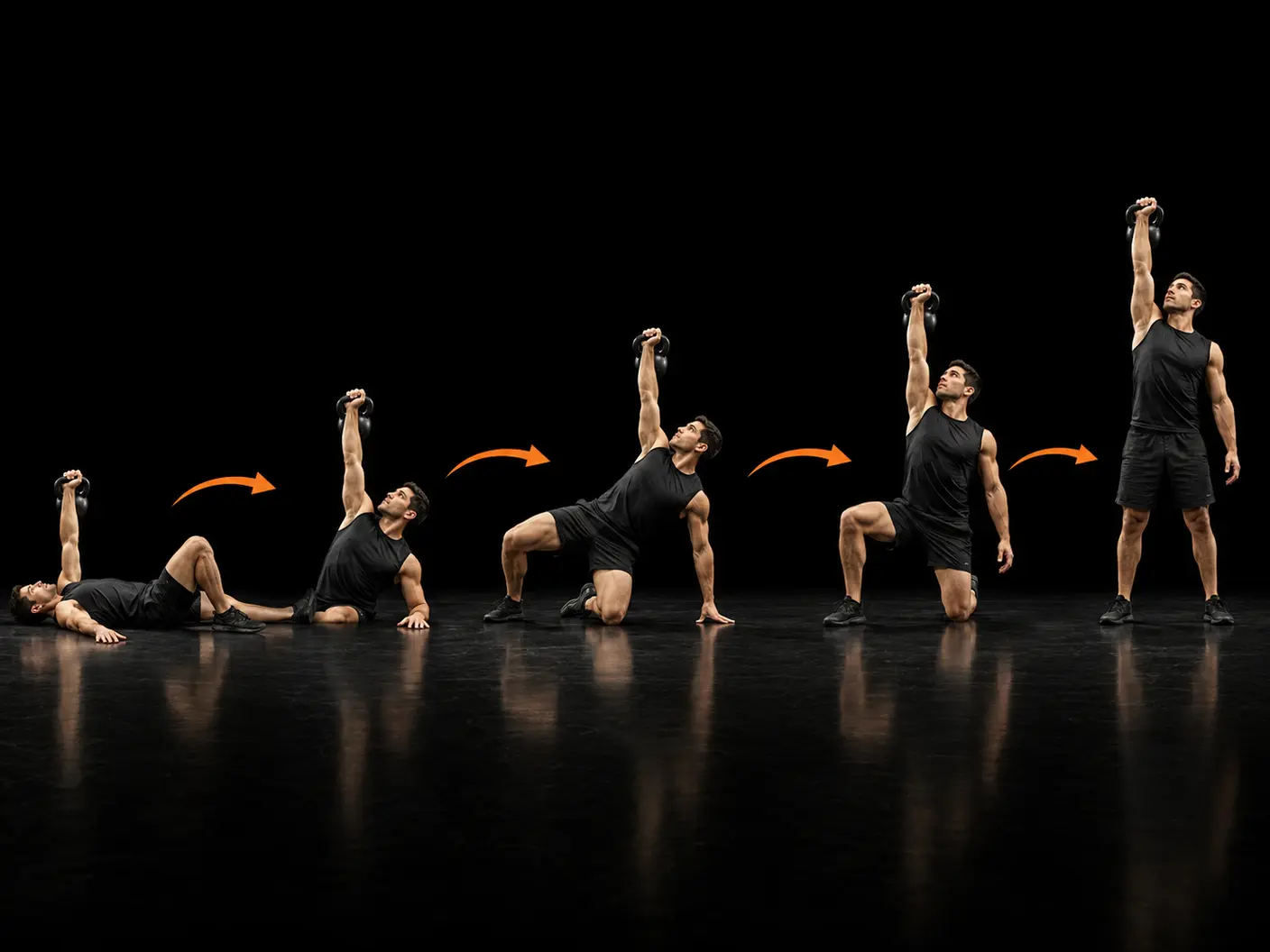
The Turkish get-up is a full-body compound movement that takes you from lying flat on the floor to a standing position while maintaining a weight pressed overhead throughout. It trains the carry pattern in its most demanding form, requiring coordinated control of the shoulders, core, and hips across multiple transitional positions. It suits intermediate-to-advanced lifters looking to develop integrated strength, body awareness, and shoulder stability under load.
How to do it
Lie on your back with a kettlebell pressed overhead in one hand. Same-side leg bent, foot flat. Opposite arm out at 45°. Roll up onto the opposite elbow. Press up onto the hand. Lift the hips high. Sweep the straight leg back into a half-kneeling position. Stand. Reverse the sequence to return.
Coaching cues
- Eyes on the bell
- Stacked shoulder
- Move through each step
- Control every inch
Why train it
- Develops overhead shoulder stability through a full range of positions, demanding that the working shoulder remains stacked and active from floor to standing.
- Trains the core and obliques to resist rotation and lateral flexion simultaneously, building the kind of functional trunk strength that transfers to athletic and everyday demands.
- Reinforces hip extension and glute engagement through the bridge and half-kneeling phases, making it a useful complement to more conventional lower-body work.
- Improves proprioception and movement quality by requiring deliberate, controlled transitions rather than the momentum-driven patterns common to many loaded exercises.
Common mistakes
- Breaking eye contact with the bell — keep your gaze fixed on the weight throughout every phase, as this cue reinforces shoulder position and helps you detect any instability early.
- Allowing the shoulder to shrug or collapse rather than staying packed — actively press the shoulder blade down and keep the joint stacked under the load before initiating each transition.
- Rushing through the phases — each position should be held with full control before you move to the next; treating them as separate movements rather than one continuous flow prevents form breakdown.
- Letting the hips sag during the bridge — drive them high and squeeze the glutes firmly before sweeping the leg back, ensuring you create genuine clearance rather than compensating with spinal extension.
Primary: Anterior Deltoid, Rectus Abdominis, Gluteus Maximus.
Secondary: Trapezius, Quadriceps, Hamstrings, Triceps Brachii.
Equipment
Good for
Easier variation
Bodyweight get-up — learn the pattern before loading.
Similar movements
Frequently asked
- What muscles does the Turkish get-up work?
- The primary muscles are the shoulders, core, and glutes, with meaningful secondary contribution from the hip flexors, triceps, and obliques. Because the movement travels through several distinct positions, nearly every major muscle group is involved to some degree in stabilising or producing force.
- How many sets and reps should I do for the Turkish get-up?
- For most purposes, 2–4 sets of 2–5 repetitions per side is appropriate, prioritising quality over volume. This is a technically demanding movement where accumulated fatigue compromises form quickly, so keeping rep counts low and resting adequately between sides is advisable.
- Can I use a dumbbell instead of a kettlebell?
- Yes — a dumbbell is a practical alternative and suits lifters who find the kettlebell's offset load difficult to manage initially. The mechanics of the movement remain identical; focus on maintaining a stacked shoulder and steady grip regardless of the implement.
- Is the Turkish get-up suitable for building athletic performance?
- It is well suited to athletic performance goals because it develops the integrated shoulder stability, trunk control, and hip strength that underpin many sport movements. Coaches frequently programme it as a supplementary lift alongside more specific athletic work rather than as a primary strength exercise.
- What are good alternatives to the Turkish get-up if I find it too difficult?
- Breaking the movement into its component phases — such as the floor press, the hip bridge, and the half-kneeling press — allows you to build the prerequisite strength and coordination before attempting the full sequence. Practising the get-up with no weight at all, focusing purely on the transitions, is also a sound starting point.
Want this movement in a plan built for you?
Adaptiv programmes the right exercises for your goal, equipment and experience — then adapts them as you train.
Build my programme