Single-Arm Dumbbell Press
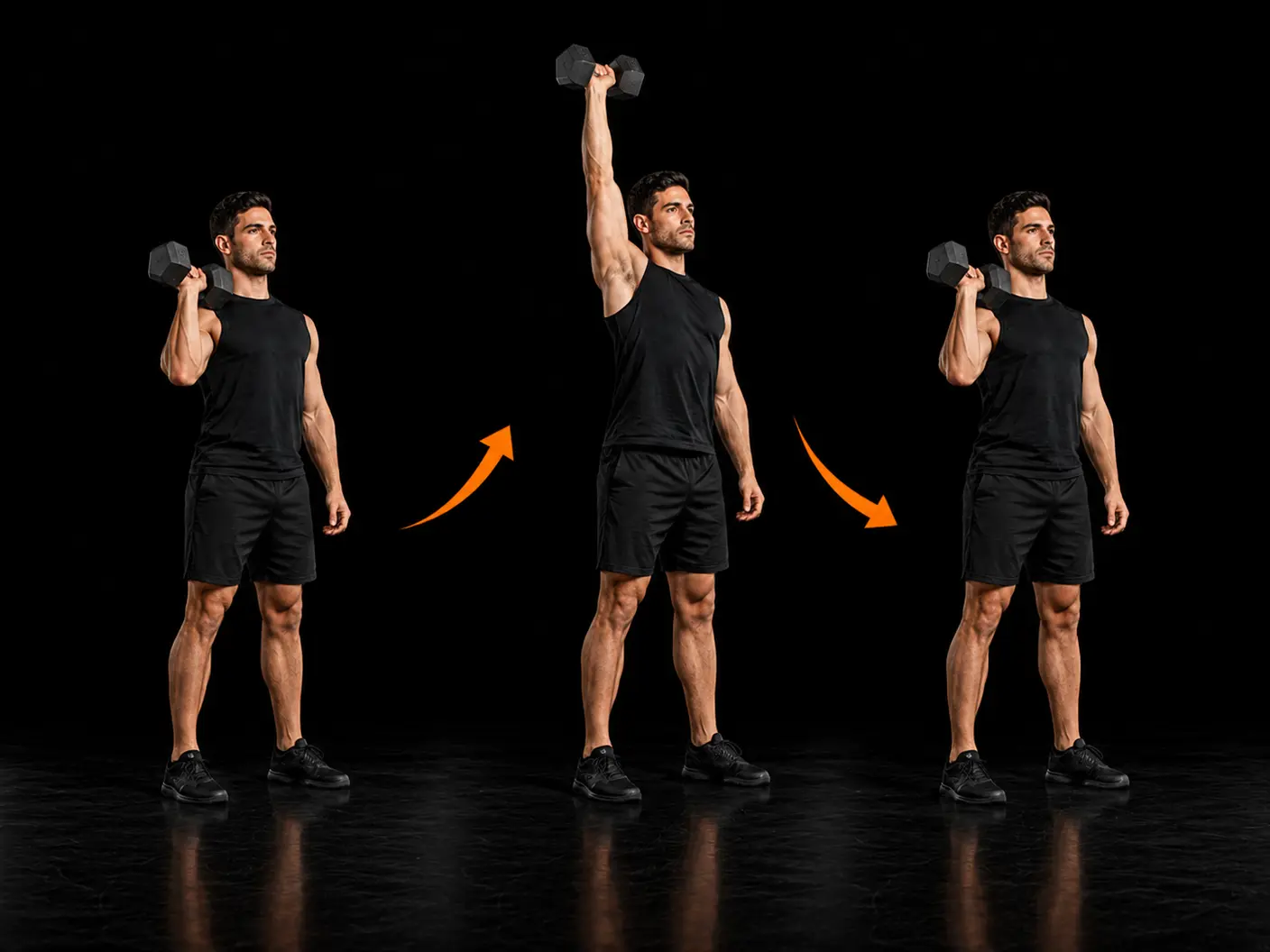
The single-arm dumbbell press is a unilateral overhead pressing movement that trains the anterior and medial deltoids while simultaneously demanding significant anti-rotational core stability. Because only one side is loaded, the body must resist lateral trunk flexion and rotation throughout every rep, making it a more demanding variation than its bilateral counterpart. It suits intermediate lifters looking to address shoulder strength imbalances, build overhead pressing capacity, or add a core stability element to their upper-body programming.
How to do it
Stand or sit. Hold one dumbbell at the shoulder, palm facing forward. Brace the core hard — the asymmetric load creates a rotational challenge. Press the dumbbell overhead until the elbow is fully extended, bicep by the ear. Lower under control back to the shoulder. Complete all reps on one side before switching.
Coaching cues
- Brace against rotation
- Press tall
- Bicep by the ear
- Slow descent
Why train it
- Training one side at a time exposes and corrects strength asymmetries between shoulders that a barbell or dual-dumbbell press can mask indefinitely.
- The asymmetric load forces the core musculature to resist rotation under real compressive load, developing functional anti-rotational stability that carries over to sport and compound lifts.
- A single dumbbell allows each shoulder to move through its natural pressing arc, reducing the positional constraints imposed by a fixed barbell path.
- Because the movement can be performed seated or standing, it fits easily into programmes across a range of training environments without requiring specialised equipment.
Common mistakes
- Allowing the torso to lean away from the working arm — brace the core firmly before the rep begins and maintain a tall, upright position throughout the press.
- Letting the elbow flare excessively wide at the bottom — position the upper arm at roughly a 45-to-60-degree angle from the torso to keep the shoulder in a mechanically sound start position.
- Rushing the descent — lower the dumbbell under control back to the shoulder, as a slow eccentric increases muscular demand and reduces the risk of losing positional integrity.
- Finishing the rep with the dumbbell drifting forward rather than directly overhead — press tall so the bicep finishes by the ear, confirming the load is stacked over the joint rather than in front of it.
Primary: Anterior Deltoid, Lateral Deltoid.
Secondary: Triceps Brachii, Pectoralis Major, Obliques.
Equipment
Good for
Easier variation
Seated DB shoulder press — seated position removes the anti-rotation demand.
Similar movements
Frequently asked
- What muscles does the single-arm dumbbell press work?
- The primary muscles are the anterior and medial deltoids. The triceps and upper pec contribute meaningfully as secondary movers, and the core — particularly the muscles responsible for resisting rotation — works isometrically throughout each set.
- Should I do the single-arm press standing or seated?
- Standing increases the anti-rotational and lateral stability demand because there is no bench to brace against, making it the harder variation and the better choice for athletic performance goals. Seated removes most of the trunk stability challenge, which can be useful when the priority is isolating shoulder hypertrophy or when lower-body fatigue is a limiting factor.
- How many sets and reps should I do for hypertrophy?
- For hypertrophy, three to four sets of eight to twelve reps per side works well, with a controlled tempo on the way down. Rest long enough between sets that shoulder and triceps fatigue does not prevent you from maintaining form on the following set — typically ninety seconds to two minutes.
- How does the single-arm dumbbell press compare to the barbell overhead press?
- The barbell press allows heavier absolute loads and trains bilateral pressing strength directly, but it locks both arms into a shared path and masks side-to-side discrepancies. The single-arm dumbbell variation addresses imbalances, adds a core stability element, and gives each shoulder freedom to move through its natural arc, making the two movements complementary rather than interchangeable.
- Is the single-arm dumbbell press suitable for beginners?
- It is classified as an intermediate movement because it requires sufficient core bracing ability and shoulder stability to manage the asymmetric load safely. Beginners would generally benefit from establishing a base of strength through bilateral pressing variations first, then progressing to single-arm work once they can maintain a neutral spine under load.
Want this movement in a plan built for you?
Adaptiv programmes the right exercises for your goal, equipment and experience — then adapts them as you train.
Build my programme