Standing Barbell Overhead Press
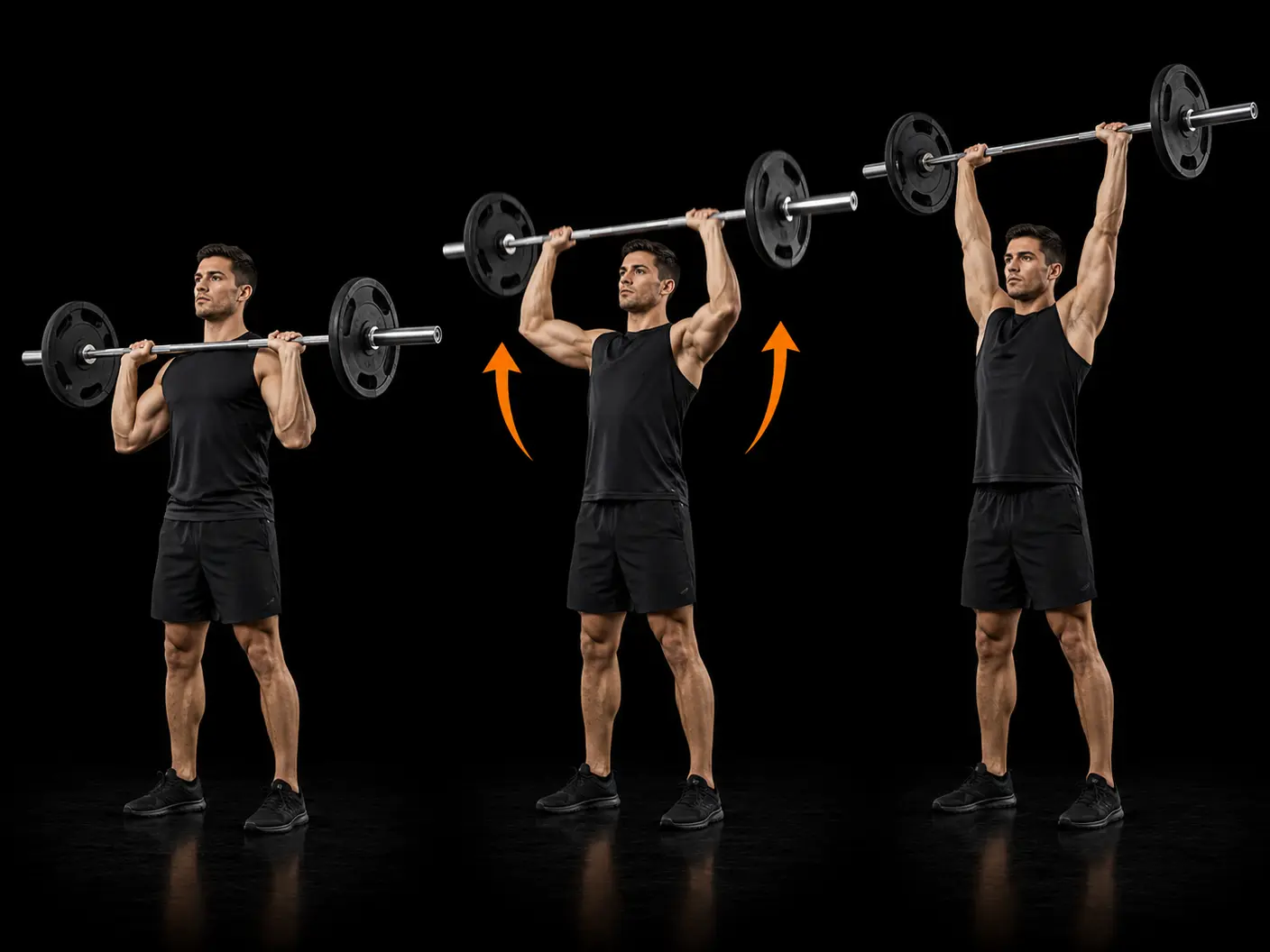
The standing barbell overhead press is a compound vertical push movement in which a barbell is driven from shoulder height to full lockout overhead while the lifter stands unsupported. It trains the anterior and medial deltoids and triceps as prime movers, while demanding genuine full-body tension across the core, glutes, and traps to stabilise the load. It suits intermediate to advanced lifters pursuing upper-body strength, hypertrophy, or athletic performance who are already comfortable managing a barbell under load.
How to do it
Set the bar in a rack at collarbone height. Grip just outside shoulder-width, elbows slightly in front of the bar. Unrack and step back; feet hip-width. Brace hard — glutes and abs. Press the bar straight up; pull the head out of the way, then push the head through at the top. Finish with the bar over the mid-foot and biceps next to the ears.
Coaching cues
- Squeeze glutes
- Head through at the top
- Bar over mid-foot
- Brace hard
Why train it
- It develops pressing strength across the anterior and medial deltoids and triceps simultaneously, making it one of the most efficient upper-body strength movements available.
- Because it is performed standing without a bench to offload the trunk, it requires the core and glutes to stabilise the spine throughout the lift, building functional full-body tension.
- The standing position closely mirrors the overhead demands of sport and physical labour, making it a practical choice for athletes prioritising functional pressing strength.
- Progressive overload on this movement transfers well to other upper-body pressing patterns, supporting broader hypertrophy and strength goals across the shoulder girdle.
Common mistakes
- Allowing the lower back to hyperextend as the bar rises — brace the abs and squeeze the glutes hard before the press begins and maintain that tension to the lockout.
- Pressing the bar around the head rather than moving the head out of the way — pull the chin back to clear the bar on the way up, then push the head through so the ears finish beside the biceps.
- Letting the bar drift forward of the mid-foot at the top — the bar should finish directly over the mid-foot, which keeps the load in a mechanically efficient vertical path and reduces shoulder strain.
- Gripping too wide and flaring the elbows out excessively — position the hands just outside shoulder-width with the elbows slightly in front of the bar at the start to allow a cleaner, stronger pressing path.
Primary: Anterior Deltoid, Lateral Deltoid, Triceps Brachii.
Secondary: Pectoralis Major, Trapezius, Rectus Abdominis.
Equipment
Good for
Easier variation
Seated DB shoulder press — removes core and leg stability demand.
Similar movements
Frequently asked
- What muscles does the standing barbell overhead press work?
- The primary muscles are the anterior deltoid, medial deltoid, and triceps. The upper pectorals, traps, and core act as secondary contributors, stabilising the trunk and transferring force from the floor to the bar.
- How many sets and reps should I do for strength versus hypertrophy?
- For strength, three to five sets of three to six reps with heavier loading and full recovery between sets is a sound framework. For hypertrophy, three to four sets of six to twelve reps at a moderate load, with controlled technique throughout, is more appropriate.
- What is a good alternative to the standing barbell overhead press?
- The seated dumbbell shoulder press removes the balance and core stability demand, making it a useful regression for those building towards the standing version. The push press uses leg drive to handle heavier loads and suits those with an athletic performance focus.
- Is the standing barbell overhead press suitable for beginners?
- This movement is classed as advanced due to the coordination, core stability, and shoulder mobility it requires; beginners are generally better served starting with a seated or dumbbell variant before progressing to the standing barbell version.
- Where should the bar be positioned at the top of the lift?
- At lockout, the bar should be directly over the mid-foot with the biceps beside the ears. This position confirms a vertical bar path and places the load efficiently over the lifter's base of support.
Want this movement in a plan built for you?
Adaptiv programmes the right exercises for your goal, equipment and experience — then adapts them as you train.
Build my programme