Push Press
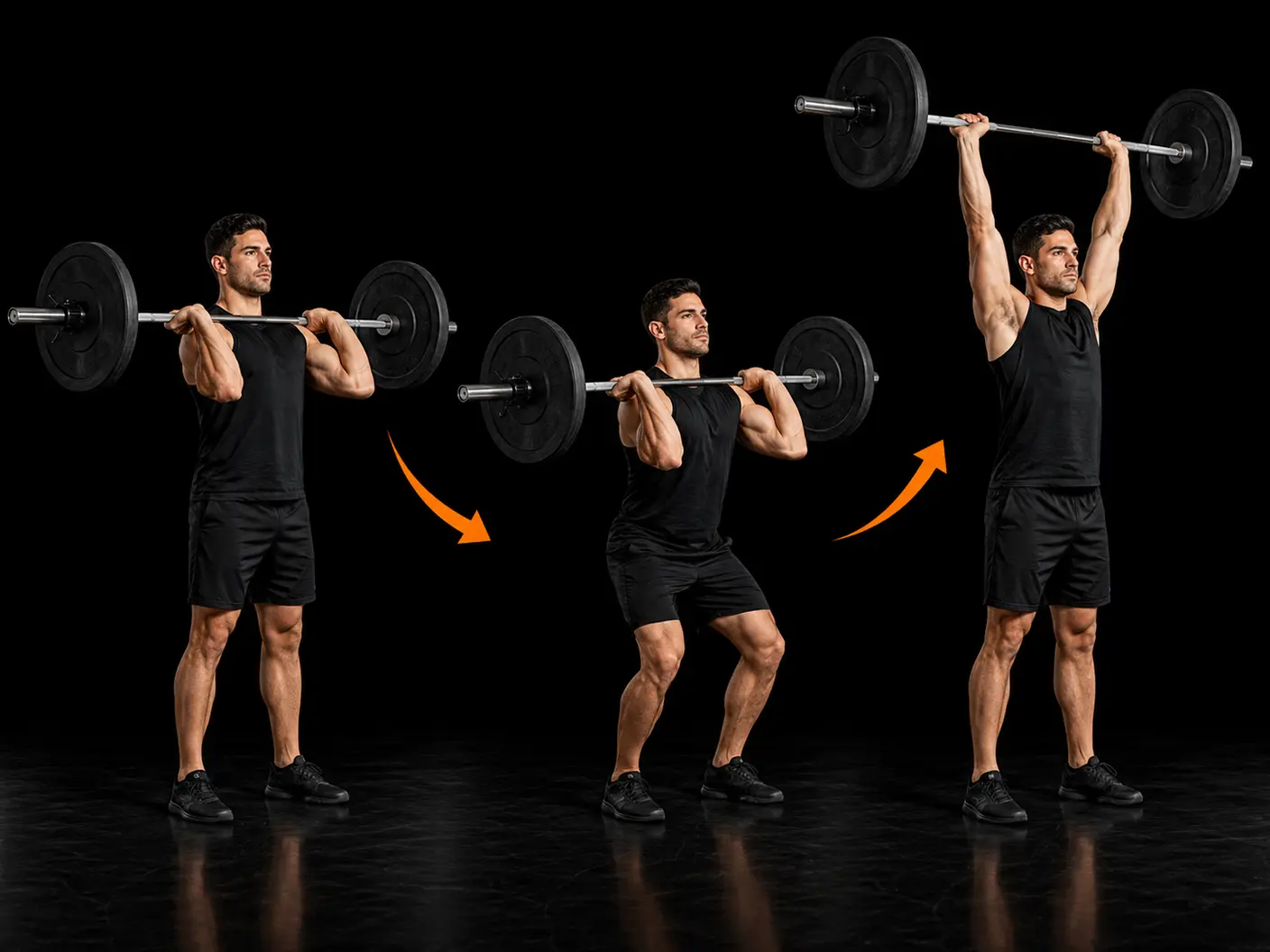
The push press is a compound vertical pushing movement that uses a brief leg drive to project a barbell from the front rack to an overhead lockout. Unlike the strict overhead press, it recruits the lower body as a force amplifier, allowing heavier loads and greater power output through the same pressing pattern. It suits intermediate to advanced lifters developing overhead strength, athletic power, or upper-body hypertrophy under load.
How to do it
Set up as a strict OHP. Dip by bending the knees ~15–20° — vertical torso, not a squat. Immediately drive up explosively through the legs, transferring force into the bar. Finish overhead with biceps by the ears. Lower under control.
Coaching cues
- Vertical dip
- Explosive leg drive
- Bar over mid-foot
- Finish tall
Why train it
- The leg drive allows you to handle loads beyond your strict pressing capacity, creating a stronger stimulus for deltoid and triceps hypertrophy.
- It trains the ability to generate and transfer force from the lower body to the upper body, a quality with direct carryover to sport and athletic performance.
- The controlled descent from lockout builds eccentric shoulder and triceps strength that strict pressing alone does not replicate at the same load.
- Programming the push press alongside the strict overhead press develops both power expression and raw pressing strength within a single movement category.
Common mistakes
- Leaning back during the dip — keep the torso vertical by bending only at the knees, not the hips, to ensure leg drive goes directly into the bar rather than pitching it forward.
- Using too deep a dip — a knee bend of roughly 15–20° is sufficient; squatting lower wastes time under the bar and disrupts the elastic rebound needed for an explosive drive.
- Pressing the bar forward off the chest — the bar should travel in a vertical line over the mid-foot, so tuck the chin back as the bar passes the face rather than pushing it out in an arc.
- Failing to finish tall — lock the elbows fully at the top with the biceps by the ears and the bar stacked over the shoulders, hips, and heels before lowering under control.
Primary: Anterior Deltoid, Lateral Deltoid, Triceps Brachii.
Secondary: Quadriceps, Gluteus Maximus, Rectus Abdominis, Trapezius.
Equipment
Good for
Easier variation
Strict press — isolates the upper body without leg drive.
Similar movements
Frequently asked
- What muscles does the push press work?
- The primary muscles are the anterior deltoid, medial deltoid, and triceps. The quadriceps and glutes initiate the drive phase, while the core and traps contribute to stability and force transfer throughout the lift.
- How many sets and reps should I do for the push press?
- For strength, 3–5 sets of 3–5 reps at high relative intensity works well. For hypertrophy or power development, 3–4 sets of 5–8 reps with controlled lowering phases is a practical starting point. Rest periods of 2–3 minutes are appropriate given the compound demand of the movement.
- What is the difference between the push press and the strict overhead press?
- The strict overhead press is performed without any leg involvement, making it a pure upper-body strength test. The push press uses a short, explosive dip-and-drive to transfer force from the legs into the bar, typically allowing 10–30% more load to be pressed overhead.
- Is the push press suitable for beginners?
- It is classified as an advanced movement because it demands solid front rack mechanics, overhead stability, and the coordination to sequence the dip and drive correctly under load. Beginners are better served by developing the strict overhead press first before introducing leg drive.
- What are good alternatives if I cannot perform the push press?
- The strict barbell overhead press is the most direct regression, removing the leg drive component entirely. Dumbbell shoulder press variants can also be used if barbell front rack positioning is a limiting factor, allowing each side to be trained independently while overhead strength is developed.
Want this movement in a plan built for you?
Adaptiv programmes the right exercises for your goal, equipment and experience — then adapts them as you train.
Build my programme