Push Jerk
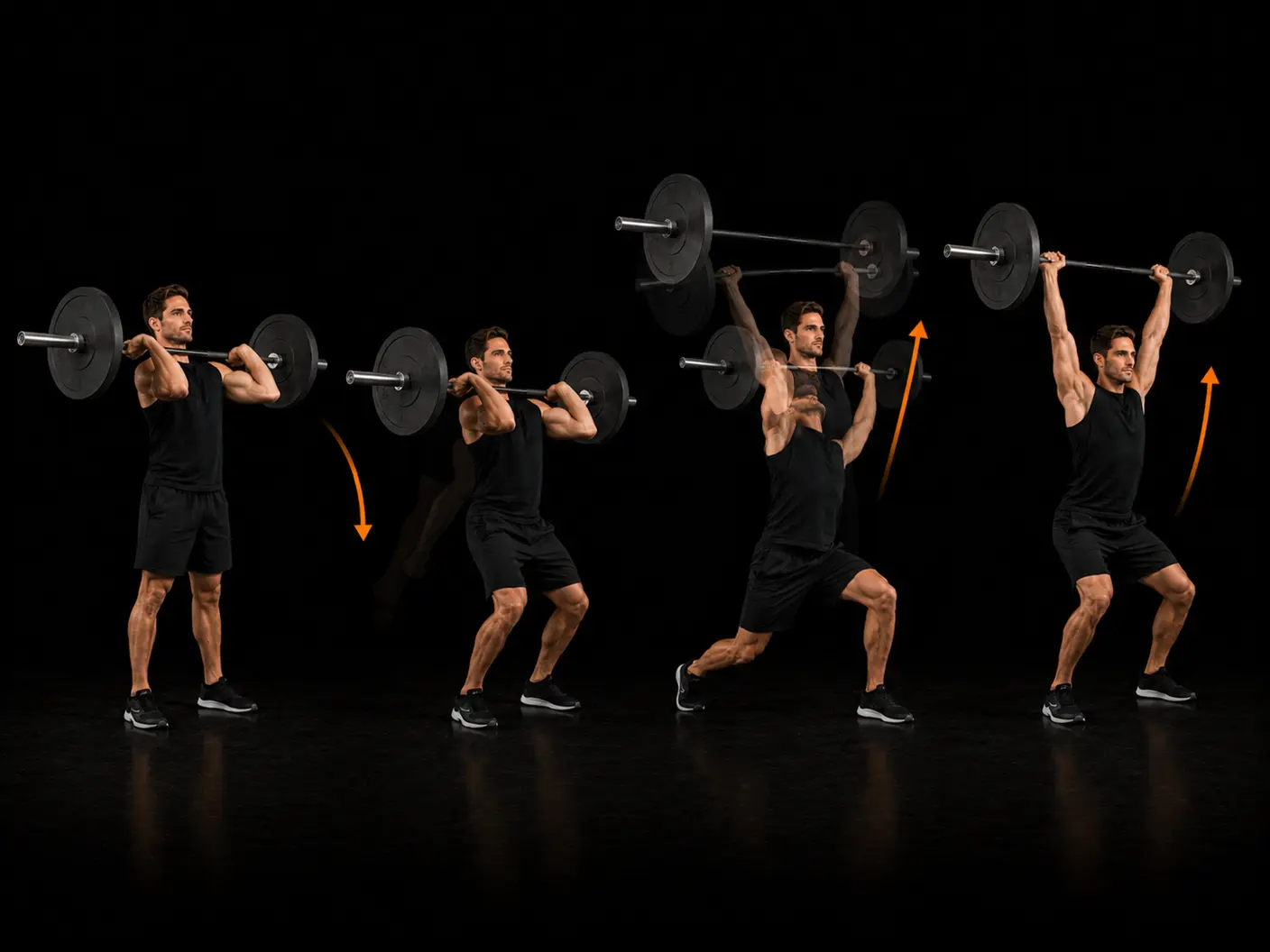
The push jerk is an Olympic-derived pressing movement that combines a leg drive, a second dip under the bar, and an overhead lockout — making it one of the most technically demanding ways to move a barbell overhead. It trains the power pattern by requiring the athlete to generate force rapidly through the lower body and then redirect under the bar to receive it at lockout. It suits intermediate-to-advanced lifters pursuing strength, athletic performance, or Olympic weightlifting development.
How to do it
Start with the bar in the front rack position — elbows up, bar on front delts. Dip by bending the knees (vertical torso, short dip). Drive the bar up violently using the legs. As the bar passes the head, dip under again into a quarter-squat and punch the arms to lockout overhead. Stand.
Coaching cues
- Vertical dip
- Drive the bar
- Punch under
- Lockout overhead
Why train it
- The requirement to produce maximal leg drive in a short dip develops explosive lower-body power that transfers directly to athletic movements such as sprinting, jumping, and change of direction.
- Loading the shoulders, quads, glutes, and triceps in a single coordinated effort makes the push jerk highly efficient for building total-body strength within a single movement.
- The overhead receiving position demands stability through the shoulders and core simultaneously, reinforcing structural control under load that carries over to other pressing and pulling exercises.
- As an advanced overhead variation, the push jerk can be loaded heavier than a strict press, making it a practical tool for progressive overload in athletic performance programmes.
Common mistakes
- Letting the torso lean forward during the dip — keep the chest tall and the dip strictly vertical so leg drive transfers directly into the bar rather than being lost to horizontal movement.
- Using too deep a dip — a short, sharp knee bend produces better bar speed; excessive depth slows the drive and disrupts timing between the push and the catch.
- Failing to punch under the bar aggressively — as the bar clears the head, actively drive the arms to lockout while dropping into the quarter-squat rather than pressing the bar up with the arms alone.
- Receiving the bar with soft elbows — the lockout must be fully extended and active overhead before you stand; catching with bent arms places excessive stress on the joints and loses structural integrity.
Primary: Anterior Deltoid, Quadriceps, Gluteus Maximus, Triceps Brachii.
Secondary: Trapezius, Pectoralis Major, Rectus Abdominis.
Equipment
Good for
Easier variation
Push press — remove the second dip under the bar.
Similar movements
Frequently asked
- What muscles does the push jerk work?
- The primary muscles are the shoulders (all three heads), quads, glutes, and triceps. The traps, upper pec, and core contribute as secondary stabilisers throughout the dip, drive, and overhead lockout.
- How many sets and reps should I do for the push jerk?
- For strength and power development, 3–5 sets of 2–5 reps with moderate-to-heavy load is a well-established approach. Because the movement is technically demanding, quality of bar speed and lockout should take priority over accumulating high repetitions.
- What is the difference between a push press and a push jerk?
- In a push press, the athlete uses one leg drive and presses the bar to lockout without re-dipping under it. In the push jerk, a second dip occurs as the bar passes the head, allowing the athlete to punch under the bar and receive it overhead in a quarter-squat — this makes it possible to handle greater loads than a push press.
- Is the push jerk suitable for beginners?
- The push jerk is classified as an advanced movement due to the coordination required between the initial drive, the re-dip, and the overhead catch. Beginners are better served building proficiency with the strict overhead press and push press before progressing to the push jerk.
- What equipment do I need for the push jerk?
- A barbell and a rack are required. The rack allows you to set the bar at front-rack height so you can unrack it safely before initiating the dip and drive, particularly important when working with heavier loads.
Want this movement in a plan built for you?
Adaptiv programmes the right exercises for your goal, equipment and experience — then adapts them as you train.
Build my programme