Split Jerk
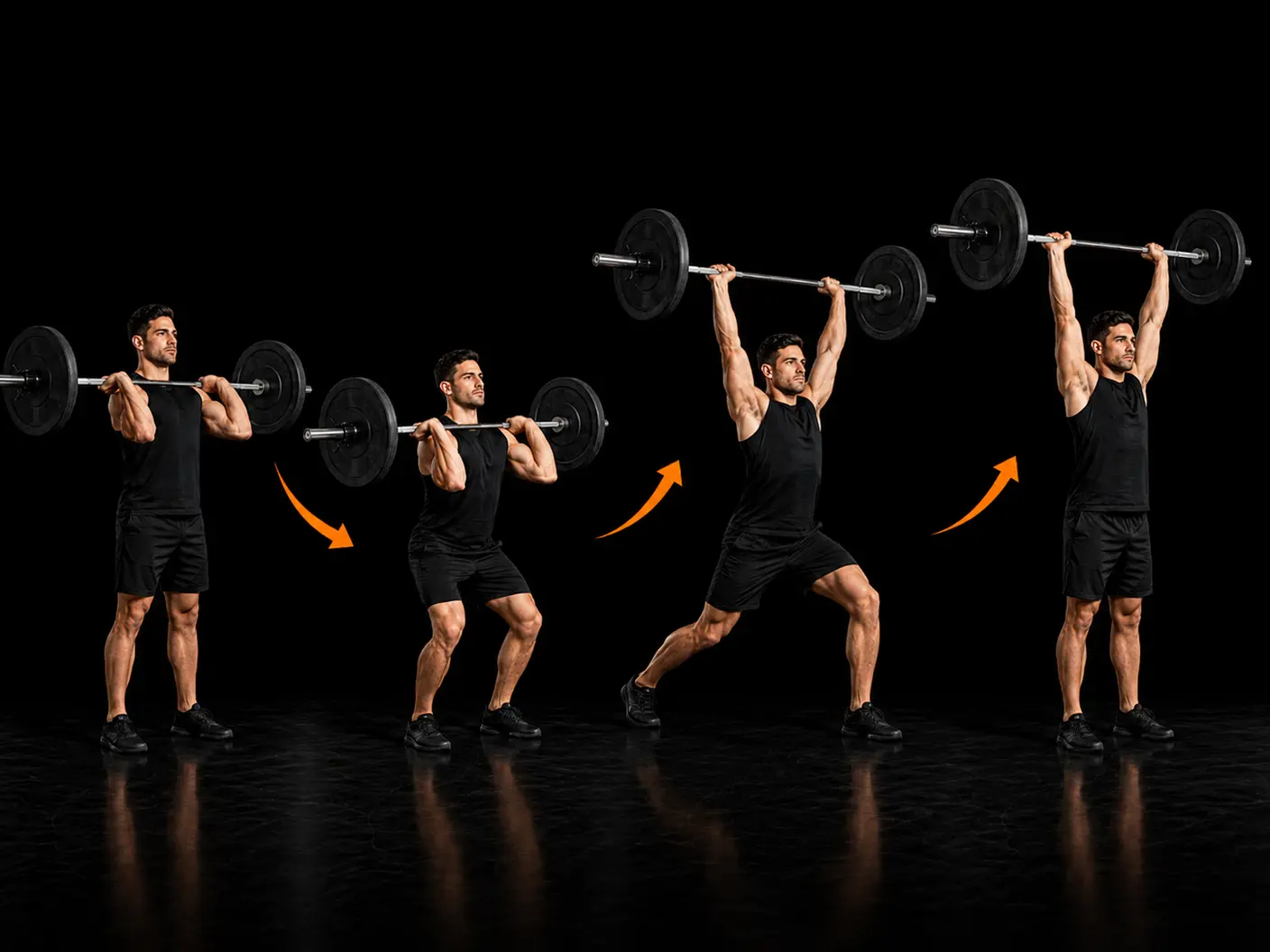
The split jerk is a barbell overhead lift in which the athlete uses a rapid leg drive and simultaneous foot split to receive a heavy load locked out above the head. It is the final phase of the clean and jerk and trains the power expression pattern — the ability to produce force quickly and absorb it under control. It suits experienced lifters and athletes who have already developed a solid overhead press foundation and reliable front rack position.
How to do it
Bar in front rack. Dip, drive, then split the feet — one forward, one back — and punch the arms to lockout overhead. Receive the bar in a split-stance lunge with arms fully extended. Recover by stepping the front foot back, then the back foot forward.
Coaching cues
- Vertical dip
- Drive through the legs
- Split the feet fast
- Solid overhead lockout
Why train it
- The combination of leg drive and overhead lockout develops full-body power expression, making it directly transferable to athletic performance demands.
- Receiving the bar in a split stance trains unilateral stability under load, exposing and correcting asymmetries between the left and right sides.
- The movement requires the shoulders, triceps, quads, and glutes to work simultaneously, delivering a high training stimulus across multiple major muscle groups in a single rep.
- Programming the split jerk develops coordination and bar control under maximal or near-maximal loads, qualities that carry over to broader strength sport preparation.
Common mistakes
- Cutting the dip too shallow — a controlled, vertical dip of consistent depth is required to generate sufficient leg drive to elevate the bar.
- Pressing the bar with the arms instead of punching to lockout — the arms should lock out simultaneously with the foot split, not after it, so that leg drive does the lifting work.
- Splitting the feet forward and back on the same line — the feet should remain hip-width apart laterally to create a stable, balanced receiving base.
- Recovering out of sequence — always step the front foot back first, then bring the rear foot forward; reversing this order destabilises the loaded overhead position.
Primary: Anterior Deltoid, Quadriceps, Gluteus Maximus, Triceps Brachii.
Secondary: Trapezius, Rectus Abdominis, Hip Flexors.
Equipment
Good for
Easier variation
Push jerk — simpler foot pattern.
Similar movements
Frequently asked
- What muscles does the split jerk work?
- The primary muscles trained are the shoulders, quads, glutes, and triceps, which drive and stabilise the bar from rack to overhead lockout. The traps, core, and hip flexors work as secondary stabilisers throughout the movement.
- How many sets and reps should I do for the split jerk?
- For strength and power development, 4–6 sets of 1–3 reps at 75–90% of your maximum is a standard approach, as the split jerk is a low-rep, high-intensity lift. Technical quality deteriorates quickly with fatigue, so rest periods of 2–3 minutes between sets are advisable.
- Is the split jerk suitable for beginners?
- The movement is classified as expert difficulty and is not recommended for those new to barbell training. A sound overhead press, push press, and front rack position should be established before progressing to the split jerk.
- What is the difference between a push jerk and a split jerk?
- In a push jerk the feet return to a parallel stance as the bar is received overhead, whereas in the split jerk one foot drives forward and one back into a lunge position. The split stance allows athletes to receive the bar lower and handle heavier loads, which is why it is the preferred technique in competitive weightlifting.
- What equipment do I need to perform the split jerk?
- A barbell and a rack are required. The rack allows the bar to be taken from a safe starting height in the front rack position, and a platform or appropriate flooring is advisable given the forces involved when recovering from the split.
Want this movement in a plan built for you?
Adaptiv programmes the right exercises for your goal, equipment and experience — then adapts them as you train.
Build my programme