Clean and Jerk
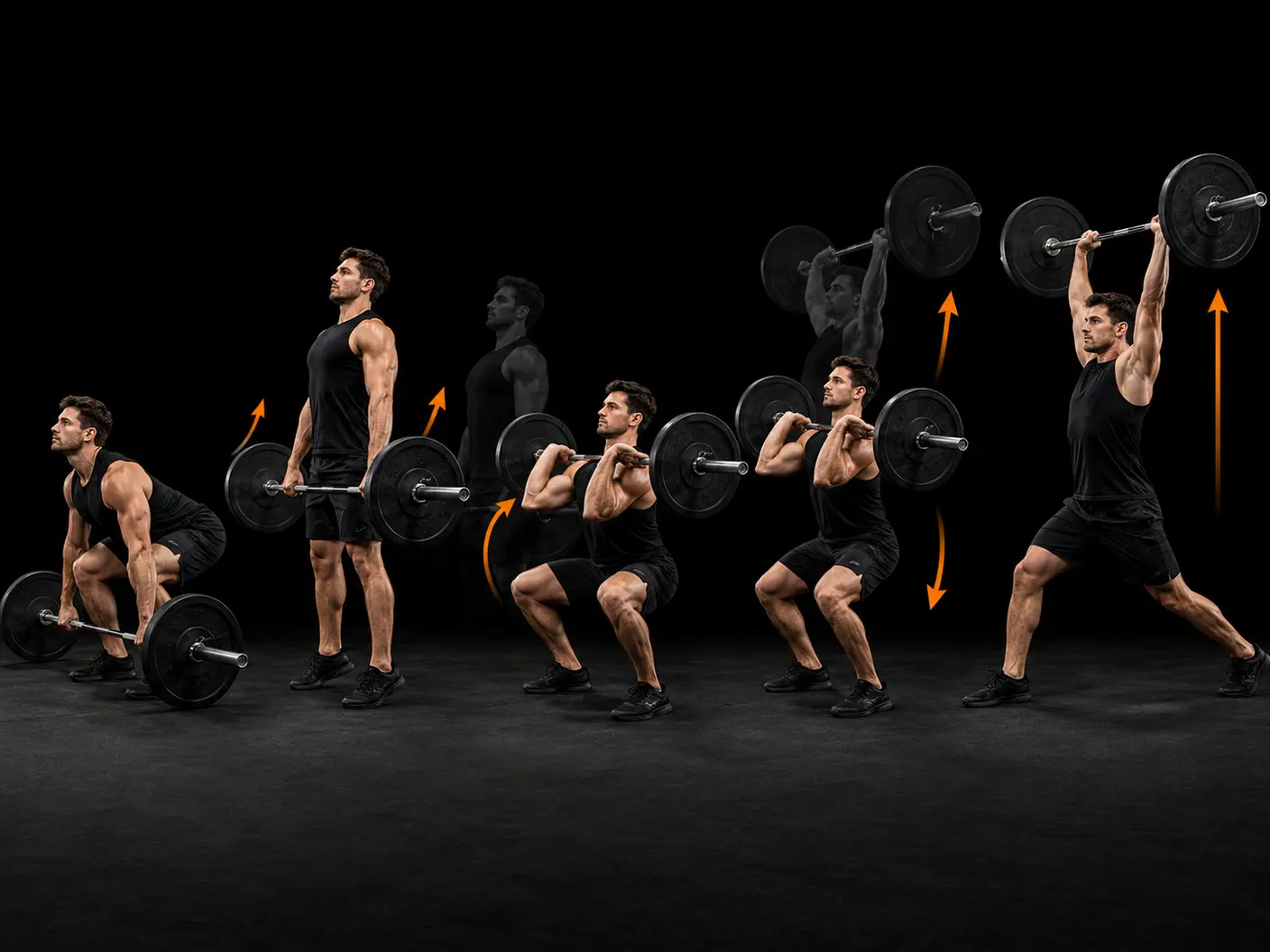
The clean and jerk is a two-phase barbell movement combining a clean to the front rack position with a subsequent jerk to full overhead lockout. It trains the entire force development chain — from a powerful pull through the hips, into an aggressive re-bend and drive that delivers the bar overhead. As one of the two competitive lifts in Olympic weightlifting, it suits intermediate-to-advanced trainees who have already established sound technique in both the clean and the overhead press pattern.
How to do it
Execute a clean (power or full) to the front rack position. Set up for the jerk — feet under the hips, elbows high. Execute a push or split jerk overhead. Complete lockout overhead with the bar over the mid-foot.
Coaching cues
- Clean with intent
- Reset for the jerk
- Drive vertical
- Finish overhead
Why train it
- It develops full-body power output by demanding rapid force expression through the pull, the catch, and the vertical drive of the jerk in a single connected effort.
- The front rack and overhead lockout positions require and reinforce shoulder, thoracic, and hip mobility under load, making it a useful diagnostic for athletic movement quality.
- Because it loads the entire kinetic chain — from the floor through to a locked-out bar overhead — it transfers directly to athletic performance demands that require coordinated, whole-body strength.
- Programming the clean and jerk builds technical proficiency across multiple movement patterns simultaneously, compressing training time without sacrificing specificity.
Common mistakes
- Pulling early with the arms — keep the arms straight and let the legs drive the bar before the elbows pull high and through.
- Failing to reset before the jerk — take a deliberate moment in the front rack to set the feet under the hips, raise the elbows, and stabilise before initiating the dip.
- A forward lean during the jerk dip — keep the torso vertical through the dip and drive phase to direct force straight up rather than out in front.
- Receiving the bar with the elbows dropped — maintain high elbows in the catch and lockout so the bar stays over the mid-foot and load is distributed through the skeleton rather than the joints.
Primary: Quadriceps, Gluteus Maximus, Hamstrings, Triceps Brachii, Anterior Deltoid.
Secondary: Trapezius, Erector Spinae, Rectus Abdominis, Forearm Flexors.
Equipment
Good for
Easier variation
Hang clean and push press — simpler full-body complex.
Similar movements
Frequently asked
- What muscles does the clean and jerk work?
- The movement is a full-body lift with no single dominant muscle group. The pull phase emphasises the posterior chain — glutes, hamstrings, and spinal erectors — while the catch loads the quadriceps and upper back. The jerk drive recruits the legs and trunk, and the lockout demands stability from the shoulders, triceps, and upper back throughout.
- How many sets and reps should I do for the clean and jerk?
- For strength and power development, most programmes use low rep ranges of one to three reps per set, typically across three to six sets. Higher rep schemes are rarely appropriate given the technical demands; fatigue degrades mechanics quickly, and quality of execution matters more than volume here.
- What is the difference between a power clean and jerk and a full clean and jerk?
- In the power version, the bar is caught in a partial squat above parallel before standing to the front rack; in a full clean, the lifter drops into a full squat to receive the bar. The jerk — push or split — follows in both cases. Full cleans allow heavier loads to be used, while power cleans are often used for speed work or when full squat depth is not yet established.
- Is the clean and jerk suitable for beginners?
- It is classified as an expert-level movement and is not recommended as an entry point into strength training. A lifter should first develop competency in the deadlift, front squat, overhead press, and the component pulls before combining them under the demands of a full clean and jerk.
- What are good alternatives to the clean and jerk?
- If the goal is power development, the power clean, hang clean, or push press each isolate one phase of the movement and are useful regression options. For those working towards the full lift, practising the clean and the jerk as separate exercises before combining them is the standard coaching approach.
Want this movement in a plan built for you?
Adaptiv programmes the right exercises for your goal, equipment and experience — then adapts them as you train.
Build my programme