Power Clean
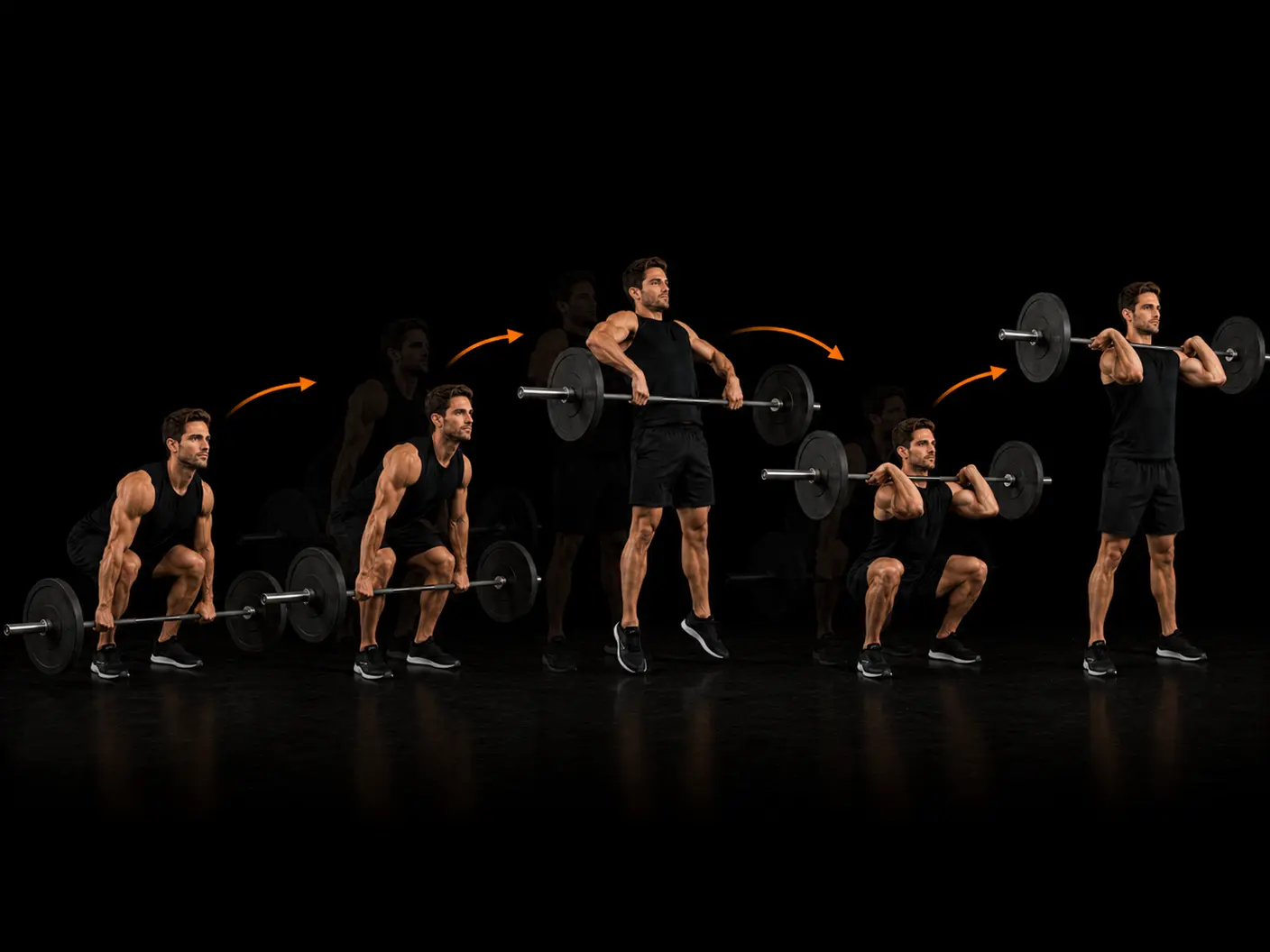
The power clean is an advanced barbell movement that trains the full-body power pattern — converting force generated from the lower body into rapid, coordinated bar acceleration and a controlled catch in a front rack position. It draws on the glutes, hamstrings, quads, and traps as primary movers, with the erectors, lats, core, forearms, and calves contributing throughout. It suits athletes and strength-focused lifters who have already established a solid deadlift and front rack foundation.
How to do it
Set up over the bar as a deadlift, feet hip-width, grip just outside the knees. Pack the lats, chest proud. Pull the bar off the floor with the legs; the bar stays close to the body. As the bar passes the knees, accelerate by extending the hips and knees violently — triple extension (ankles, knees, hips). Shrug aggressively and pull the body under the bar. Receive the bar in a quarter-squat front rack position — elbows high, bar on the front delts. Stand to full extension.
Coaching cues
- Patient off the floor
- Bar stays close
- Triple extension
- Fast elbows to the rack
Why train it
- Triple extension of the ankles, knees, and hips develops explosive lower-body power that transfers directly to sprinting, jumping, and change-of-direction tasks.
- The movement demands full-body coordination under load, reinforcing the ability to produce and absorb force rapidly — a quality that underpins athletic performance across most sports.
- Heavy loading of the traps, erectors, and posterior chain in a dynamic context builds the kind of structural strength that slower compound lifts cannot fully replicate.
- Because the catch requires active stabilisation in the front rack, the power clean also develops upper-back stiffness and core control under fatigue.
Common mistakes
- Jerking the bar off the floor — maintain controlled, leg-driven tension through the first pull so the bar stays close and the hips don't rise prematurely.
- Letting the bar drift away from the body — keep it dragging against the thighs as it passes the knees to preserve the mechanical advantage needed for the second pull.
- Pulling with the arms too early — the arms should remain straight until after triple extension is complete, acting as hooks rather than primary movers.
- Receiving the bar with low elbows — drive the elbows forward and high immediately on the catch so the bar sits on the front delts rather than the wrists.
Primary: Gluteus Maximus, Hamstrings, Quadriceps, Trapezius.
Secondary: Erector Spinae, Latissimus Dorsi, Forearm Flexors, Rectus Abdominis, Gastrocnemius.
Equipment
Good for
Easier variation
Clean pull — learn the power generation without the catch.
Similar movements
Frequently asked
- What muscles does the power clean work?
- The primary movers are the glutes, hamstrings, quads, and traps. The erectors, lats, core, forearms, and calves all contribute as secondary muscles across the pull, shrug, and catch phases.
- How many sets and reps should I do for the power clean?
- For athletic performance and power development, sets of 3–5 reps at moderate to heavy intensity work well — typically 4–6 sets. Because the movement requires high-quality mechanics, reps should be kept low enough that bar speed and technique do not degrade within a set.
- Is the power clean suitable for beginners?
- The power clean is classified as an advanced movement and is not well suited to beginners. A solid deadlift, adequate hip mobility, and a comfortable front rack position should be established before introducing it.
- What is the difference between a power clean and a full clean?
- In the power clean the bar is received in a quarter-squat position, meaning the lifter does not descend below parallel. A full squat clean requires the lifter to ride the bar down into a full-depth front squat, which demands greater mobility and technical proficiency but allows heavier loads to be handled.
- What exercises can I use as alternatives to the power clean?
- If you are working towards the power clean, Romanian deadlifts and barbell shrugs can develop the posterior chain and trap strength it requires. Hang power cleans reduce the complexity of the first pull and are a useful progression tool for those developing timing in the second pull.
Want this movement in a plan built for you?
Adaptiv programmes the right exercises for your goal, equipment and experience — then adapts them as you train.
Build my programme