Clean Pull
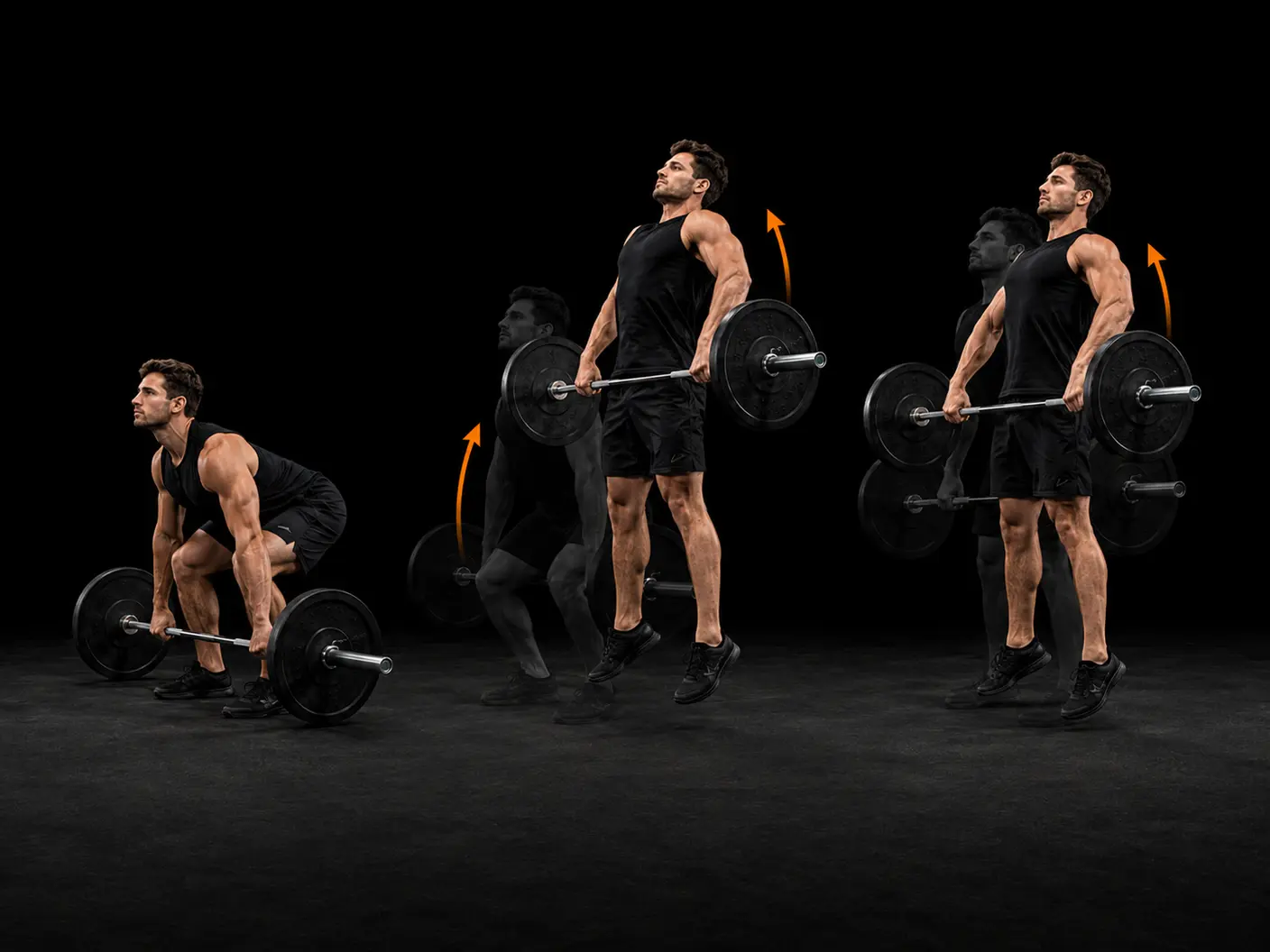
The clean pull is a barbell pulling derivative that trains the full triple extension pattern — ankle, knee, and hip — found at the heart of the clean and other power movements. Performed from the floor with a clean grip, the bar is driven to approximately lower-chest height through an aggressive shrug, with no turnover or catch required. It suits intermediate lifters developing pulling strength and rate of force development, or those reinforcing the mechanics of the full clean without the demands of the catch.
How to do it
Set up as a clean, clean-grip (just outside the knees). Pull through full triple extension. Shrug aggressively at the top. The bar rises to the lower chest; no turnover or catch. Lower under control.
Coaching cues
- Bar close to the body
- Explosive extension
- Full shrug at the top
- Controlled descent
Why train it
- Training triple extension under load develops the explosive hip, knee, and ankle drive that underpins athletic performance across a wide range of sports.
- Removing the catch phase allows heavier loads to be used than in the full clean, placing greater demand on the glutes, hamstrings, quads, and traps through the pulling portion.
- The movement reinforces bar path discipline — keeping the bar close to the body throughout — which carries directly over to cleaner technique in the full lift.
- Including a controlled descent builds eccentric familiarity with the pulling position, supporting consistency across repeated sets.
Common mistakes
- Letting the bar drift away from the body — keep it in contact with or close to the legs throughout the pull to maintain leverage and a vertical bar path.
- Initiating the pull by jerking with the back rather than pushing the floor away — begin by extending the legs first, keeping the torso angle consistent off the floor before the hips drive through.
- Cutting the extension short before the shrug — reach full triple extension at the ankle, knee, and hip before the traps fire, otherwise the shrug becomes the primary mover rather than the finish.
- Dropping the bar rather than lowering it under control — guide the barbell back to the floor in a deliberate manner to reinforce positional awareness and protect the lower back.
Primary: Gluteus Maximus, Hamstrings, Quadriceps, Trapezius.
Secondary: Erector Spinae, Latissimus Dorsi, Forearm Flexors.
Equipment
Good for
Easier variation
Deadlift — remove the shrug and extension; pure strength pull.
Similar movements
Frequently asked
- What muscles does the clean pull work?
- The primary muscles are the glutes, hamstrings, quads, and traps. The erectors, lats, and forearms contribute as secondary muscles, supporting posture, bar path, and grip throughout the movement.
- How is the clean pull different from a Romanian deadlift or a deadlift?
- The clean pull is a power-focused movement built around explosive triple extension and an aggressive shrug at the top, rather than a controlled strength lift through range. Unlike the deadlift, the intent is rate of force development rather than maximal load; unlike the Romanian deadlift, the knees rebend and the hips drive fully through rather than hinging with soft knees.
- What sets and reps are suitable for the clean pull?
- For strength and athletic performance, three to five sets of three to five repetitions at moderate to heavy load works well, keeping quality of extension high across every rep. Because the movement is explosive, higher rep ranges tend to compromise bar speed and mechanics rather than add meaningful stimulus.
- Can beginners perform the clean pull?
- The movement is classified as intermediate difficulty because it requires a sound hip hinge, a consistent bar path, and the ability to coordinate triple extension under load. Beginners would typically benefit from establishing these qualities through the deadlift and Romanian deadlift before introducing the clean pull.
- What are good alternatives if I cannot perform a clean pull?
- The barbell Romanian deadlift and conventional deadlift address the same primary muscle groups with less technical demand. If the goal is to develop explosive extension specifically, a kettlebell or dumbbell swing trains a similar hip-drive pattern and may serve as a useful stepping stone.
Want this movement in a plan built for you?
Adaptiv programmes the right exercises for your goal, equipment and experience — then adapts them as you train.
Build my programme