Hang Power Clean
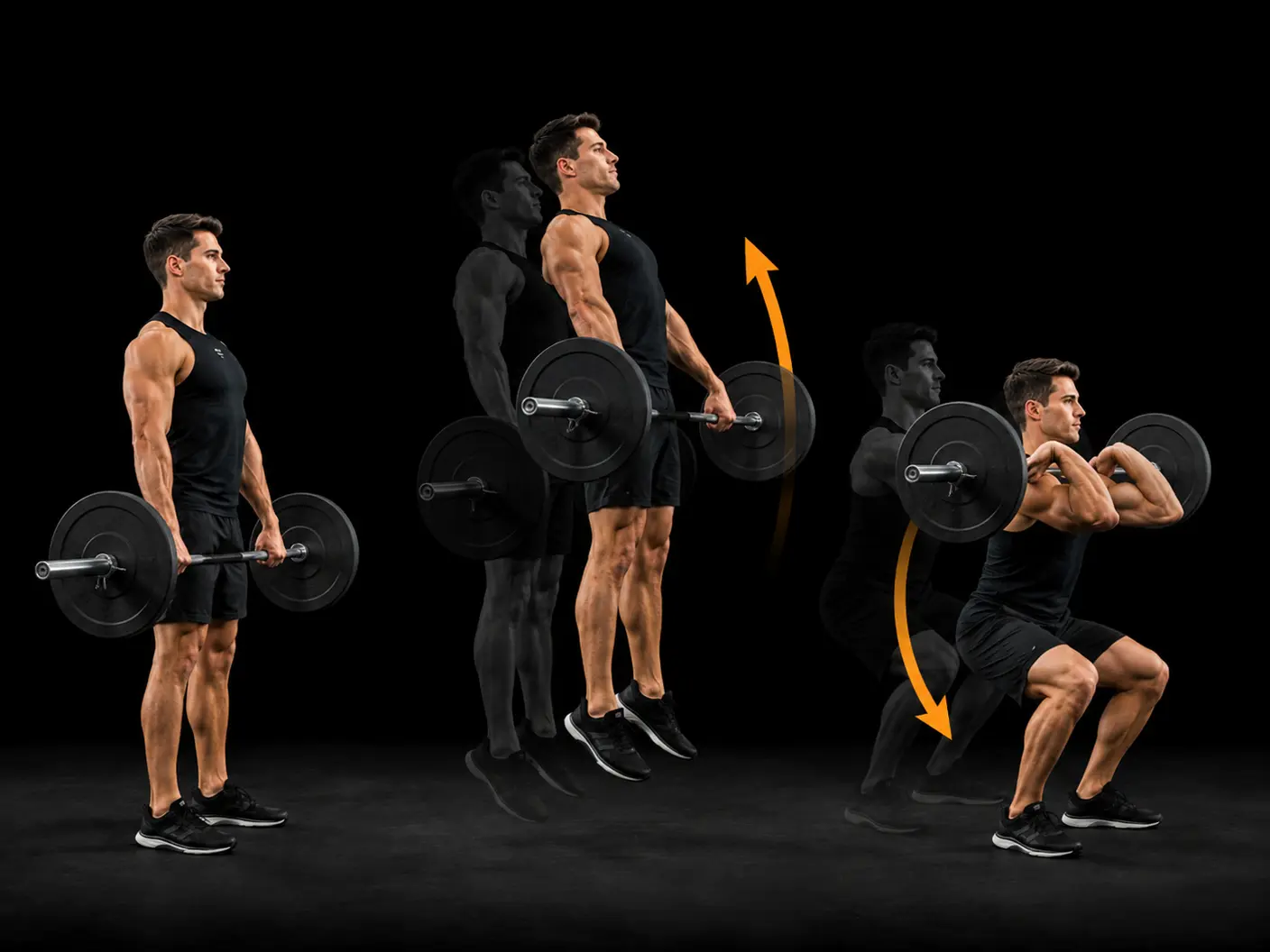
The hang power clean is a barbell compound movement built around an explosive hip extension from the hang position — bar starting at the hip crease, lowered to just above the knees before the lift initiates. It trains the full posterior chain through triple extension and demands rapid coordination to receive the bar in a solid front rack. It suits intermediate to advanced lifters pursuing athletic performance or strength development.
How to do it
Start standing, bar at hip crease. Hinge back to above the knees (hang position) — knees soft, bar sliding down the thighs. Pack the lats. Explosively extend hips and knees — triple extension. Shrug and pull under. Catch in a quarter-squat front rack.
Coaching cues
- Hinge to the hang
- Explode through the hips
- Fast under the bar
- Solid front rack
Why train it
- It develops powerful hip extension through the glutes, hamstrings, and quads simultaneously, making it directly transferable to sprinting, jumping, and change-of-direction demands.
- Starting from the hang shortens the pull compared to a full clean, allowing practitioners to accumulate high-quality repetitions and reinforce the most mechanically critical phase of the movement.
- The traps, erectors, lats, and core are all recruited as secondary contributors, meaning the exercise builds total-body structural strength alongside its primary power output.
- The front rack catch trains positional awareness and upper-body bracing under load, qualities that carry over to pressing, squatting, and contact sport scenarios.
Common mistakes
- Letting the bar drift away from the body on the hinge — keep it in contact with the thighs as you lower to the hang position to maintain a short, efficient pull path.
- Pulling early with the arms before the hips have fully extended — let the legs and hips drive triple extension first, then shrug, and the arms follow as a guide rather than the primary mover.
- Landing in an excessively deep squat on the catch — the hang power clean requires a quarter-squat receiving position, so if you are sinking significantly lower the load may be too heavy or the pull insufficient.
- Allowing the elbows to drop in the front rack — drive them up aggressively on the catch so the bar rests across the shoulders and the wrists are not bearing the full load.
Primary: Gluteus Maximus, Hamstrings, Quadriceps, Trapezius.
Secondary: Erector Spinae, Latissimus Dorsi, Forearm Flexors, Rectus Abdominis.
Equipment
Good for
Easier variation
Hang high pull — same triple extension, no catch phase.
Similar movements
Frequently asked
- What muscles does the hang power clean work?
- The primary muscles are the glutes, hamstrings, quads, and traps. The erectors, lats, forearms, and core contribute as secondary stabilisers and force transmitters throughout the pull and catch.
- How many sets and reps should I do for the hang power clean?
- For athletic power development, three to five sets of two to four repetitions at moderate to high intensity works well, as power output degrades quickly with fatigue. If you are using it for technique practice or general strength conditioning, slightly higher rep ranges of four to six per set with lighter loads are appropriate.
- What is the difference between a hang power clean and a full clean?
- The full clean starts from the floor and includes a deeper squat catch below parallel, whereas the hang power clean begins with the bar at the hip crease, lowered to just above the knees, and is caught in a quarter-squat position. The hang version reduces the range of pull and is often used to develop rate of force development and bar awareness in the extension phase.
- Is the hang power clean suitable for beginners?
- It is classified as an advanced movement due to the technical demands of coordinating triple extension, a fast pull-under, and a front rack catch simultaneously. Beginners are better served building familiarity with the Romanian deadlift, front squat, and barbell shrug before progressing to this exercise.
- What are good alternatives if I cannot perform the hang power clean?
- Kettlebell swings train explosive hip extension with lower technical demand on the upper body, while the barbell high pull removes the catch phase and allows focus on the extension and shrug. Both can serve as progressive stepping stones toward the full movement.
Want this movement in a plan built for you?
Adaptiv programmes the right exercises for your goal, equipment and experience — then adapts them as you train.
Build my programme