Hang Clean
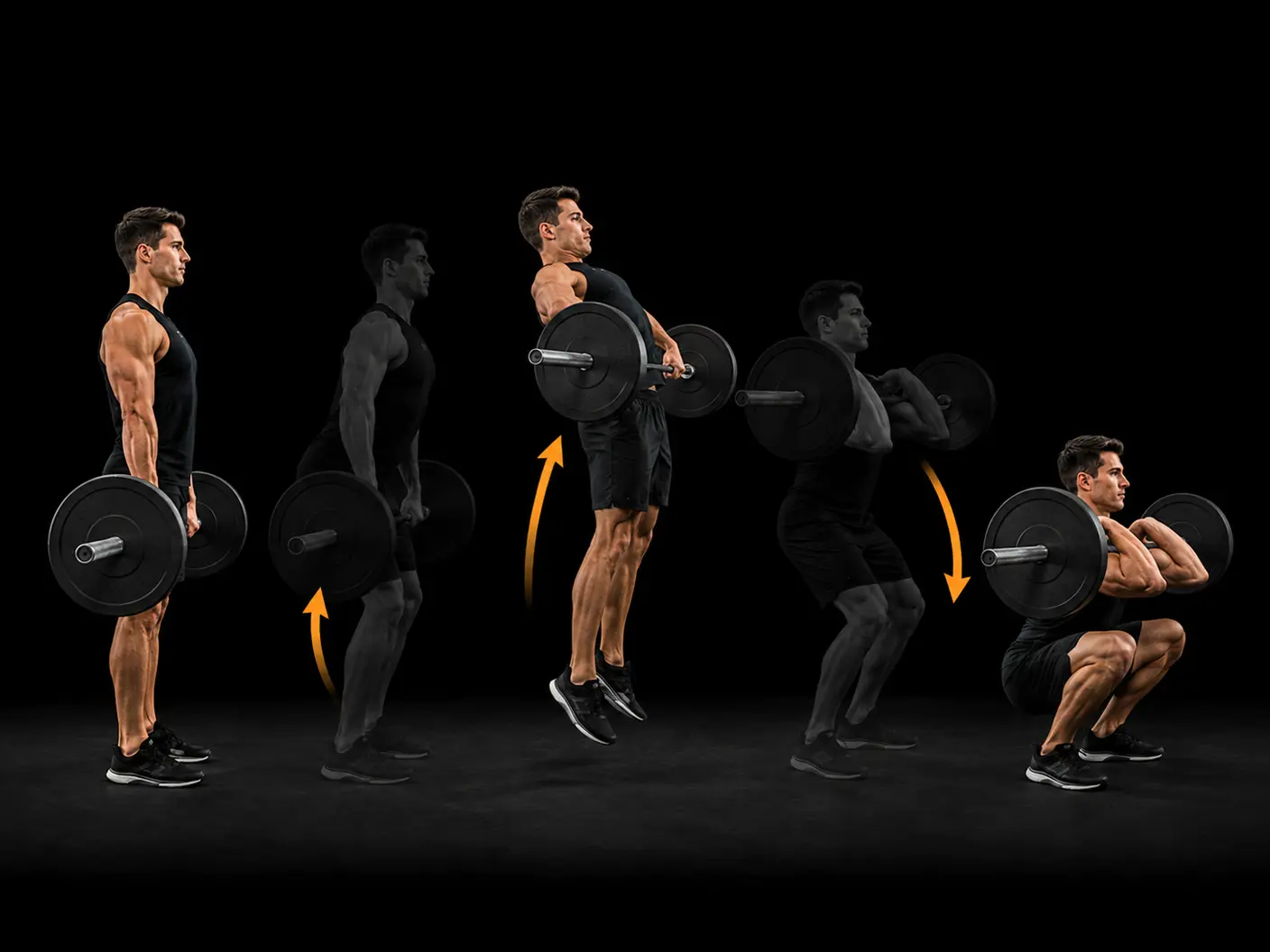
The hang clean is a barbell power movement that begins with the bar at the hip crease rather than the floor, removing the pull from the ground and placing full demand on the athlete's ability to generate explosive hip extension and rapidly transition under the bar. It trains the full power pattern — hinge, triple extension, and catch — making it a staple in athletic performance programming. It suits intermediate-to-advanced lifters who have sound hip hinge mechanics and are building towards full clean work or looking to develop rate of force development.
How to do it
Start standing with the bar at hip crease, clean grip. Hinge back to the hang position (just above the knees) — knees soft, bar sliding down the thighs, lats packed. Explosively extend hips and knees (triple extension). Shrug and pull the body aggressively under the bar; rotate the elbows fast to catch in a full front squat position. Stand from the squat.
Coaching cues
- Hinge to the hang
- Explode through the hips
- Pull under fast
- Stand from the catch
Why train it
- The explosive hip extension required at the catch develops power output across the glutes, hamstrings, and quadriceps simultaneously, transferring directly to sprint and jump performance.
- Starting from the hang position keeps time under tension focused on the most mechanically demanding phase of the lift, making each session highly specific to power development.
- The front rack catch position demands full-body coordination — the traps, lats, and core all contribute to stabilising the bar — reinforcing structural integrity under load.
- Removing the floor pull makes the hang clean easier to coach and to self-correct, giving athletes a reliable tool for maintaining movement quality across a training block.
Common mistakes
- Letting the bar drift away from the body during the hinge — keep the lats packed throughout so the bar stays in contact with the thighs on the way down.
- Relying on the arms to pull the bar upward rather than driving through the hips — the arms should act as hooks after full hip and knee extension, not as the primary mover.
- Catching the bar with a low elbow position — rotate the elbows aggressively and early so the bar settles into the front rack before the squat receives the load.
- Standing up too early in the catch — absorb the bar in a full front squat position and only stand once you are stable and in control, rather than collapsing the catch into a reverse-curl stance.
Primary: Gluteus Maximus, Hamstrings, Quadriceps, Trapezius.
Secondary: Erector Spinae, Latissimus Dorsi, Forearm Flexors, Rectus Abdominis.
Equipment
Good for
Easier variation
Hang power clean — receive in a quarter-squat instead of a full squat.
Similar movements
Frequently asked
- What muscles does the hang clean work?
- The primary movers are the glutes, hamstrings, and quadriceps, which drive the explosive hip extension. The traps are heavily recruited during the shrug and pull phase, while the erectors, lats, forearms, and core contribute as secondary stabilisers throughout the movement.
- How many sets and reps should I do for the hang clean?
- Because it is a power exercise, the hang clean is best programmed at low-to-moderate rep ranges — typically 3 to 5 sets of 2 to 4 repetitions — with full recovery between sets. Performing too many reps per set tends to degrade bar speed and movement quality, which defeats the purpose of the exercise.
- What is the difference between a hang clean and a power clean?
- The power clean starts with the bar on the floor, adding a pull from the ground that increases total work done and places greater demand on the posterior chain through a longer range of motion. The hang clean begins at the hip crease, removing that initial pull and concentrating the demand on the hip drive and catch phases specifically.
- Is the hang clean suitable for building general strength?
- It contributes to lower body and posterior chain strength, but its primary value is in developing explosive power and athletic performance rather than maximal strength. If absolute strength is the priority, movements such as the squat and deadlift offer more direct and measurable loading for that goal.
- What should I learn before attempting the hang clean?
- A sound hip hinge pattern, a competent front rack position, and the ability to perform a front squat to depth are all prerequisites. Practising the hang pull — the same movement without catching the bar in the front rack — is a useful intermediate step before committing to the full catch.
Want this movement in a plan built for you?
Adaptiv programmes the right exercises for your goal, equipment and experience — then adapts them as you train.
Build my programme