Full Clean (Squat Clean)
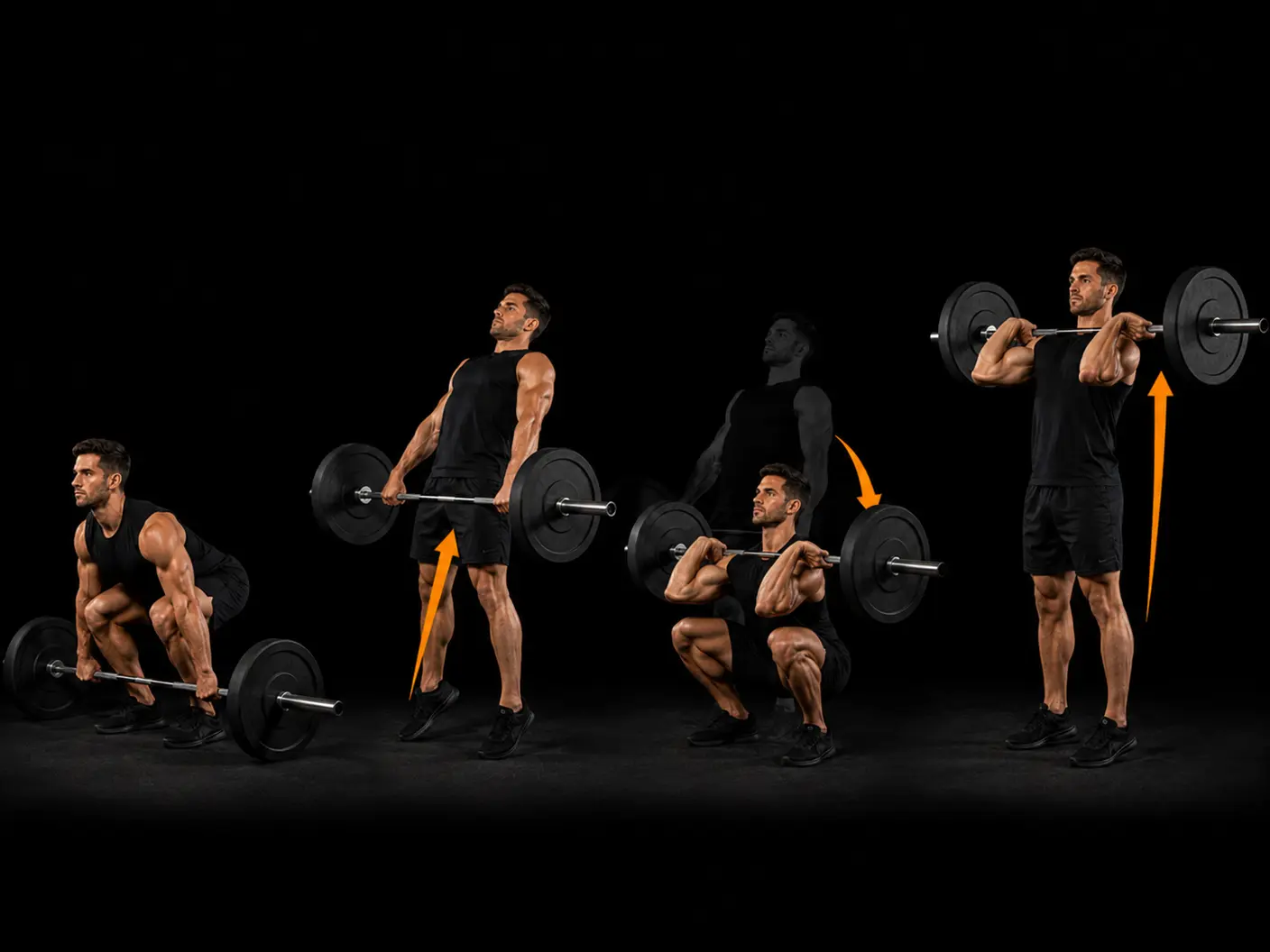
The full clean, or squat clean, is a barbell Olympic weightlifting movement in which the lifter pulls the bar from the floor, drives into triple extension, and catches it in the bottom of a front squat before standing to completion. It trains the entire posterior chain alongside explosive hip extension, coordinated upper-body turnover, and front-squat strength in a single integrated effort. It suits intermediate to advanced athletes who have already developed a reliable power clean, front squat, and the requisite mobility to receive the bar safely in a deep catch position.
How to do it
Set up as a power clean. Execute the pull and triple extension. Aggressively pull the body under the bar into a full front squat position. Catch the bar on the front delts in the bottom of a front squat. Stand up using front-squat mechanics.
Coaching cues
- Patient off the floor
- Aggressive turnover
- Catch in full squat
- Drive up vertically
Why train it
- The full clean develops explosive triple extension through the hips, knees, and ankles, making it a direct transfer to athletic performance demands such as sprinting and jumping.
- Catching in the bottom of a front squat requires and reinforces thoracic extension, wrist mobility, and hip flexibility, accumulating positional work that carries over to other compound lifts.
- The movement loads the glutes, hamstrings, quads, and traps under high-velocity conditions, building strength qualities that slower bilateral exercises cannot replicate at the same speed.
- Requiring the lifter to pull themselves under the bar and stabilise a loaded front squat demands significant core and lat engagement, developing total-body coordination as well as raw output.
Common mistakes
- Rushing the initial pull off the floor — maintain patience and lat tension through the first pull so the bar stays close and the hips remain in the correct position before the explosive second pull begins.
- Cutting the pull short before full extension — allow the hips, knees, and ankles to reach complete extension before initiating the turnover, otherwise the bar will not gain enough height to receive comfortably.
- Catching with the elbows low and the bar rolling off the front delts — aggressively rotate the elbows up and forward so the bar sits securely on the front deltoids in the rack position before absorbing the load.
- Rising out of the catch position before achieving stability — pause briefly in the bottom of the front squat to confirm balance and bar security, then drive vertically using the same mechanics you would apply to a loaded front squat.
Primary: Gluteus Maximus, Hamstrings, Quadriceps, Trapezius.
Secondary: Erector Spinae, Latissimus Dorsi, Forearm Flexors, Rectus Abdominis.
Equipment
Good for
Easier variation
Power clean — receive in quarter-squat instead of full squat.
Similar movements
Frequently asked
- What muscles does the full clean work?
- The primary muscles are the glutes, hamstrings, quads, and traps, which drive the pull and absorb the catch. The erectors, lats, forearms, and core work as secondary contributors to maintain position throughout the lift.
- How does the full clean differ from a power clean?
- In a power clean the bar is caught in a partial squat, typically above parallel, whereas the full clean requires the lifter to pull themselves into the bottom of a front squat to receive the bar. The full clean therefore demands greater mobility and a more aggressive pull-under, and it can accommodate heavier loads because the catch height is lower.
- What sets and reps are appropriate for the full clean?
- For strength and performance development, three to five sets of two to three repetitions at seventy to eighty-five per cent of one-rep max is a well-established approach. Technical quality degrades quickly with fatigue, so higher-rep sets are generally not advisable for this movement.
- What prerequisite movements should I be comfortable with before attempting the full clean?
- You should have a reliable power clean, a front squat with a secure rack position and adequate hip depth, and sufficient wrist and thoracic mobility to hold the bar on the front delts at the bottom of a squat. Practising the pull-under as a separate drill — the clean pull and hang clean from the hip — will also reduce technical risk.
- Is the full clean suitable for general strength training, or is it mainly for competitive lifters?
- The full clean is classified as an expert-level compound movement and is well-suited to any athlete or serious trainee whose primary goals include athletic performance and strength, not solely competitive weightlifters. That said, given its technical complexity, it is most productive when coached in person, at least initially, to establish safe receiving mechanics before load is added.
Want this movement in a plan built for you?
Adaptiv programmes the right exercises for your goal, equipment and experience — then adapts them as you train.
Build my programme