Power Snatch
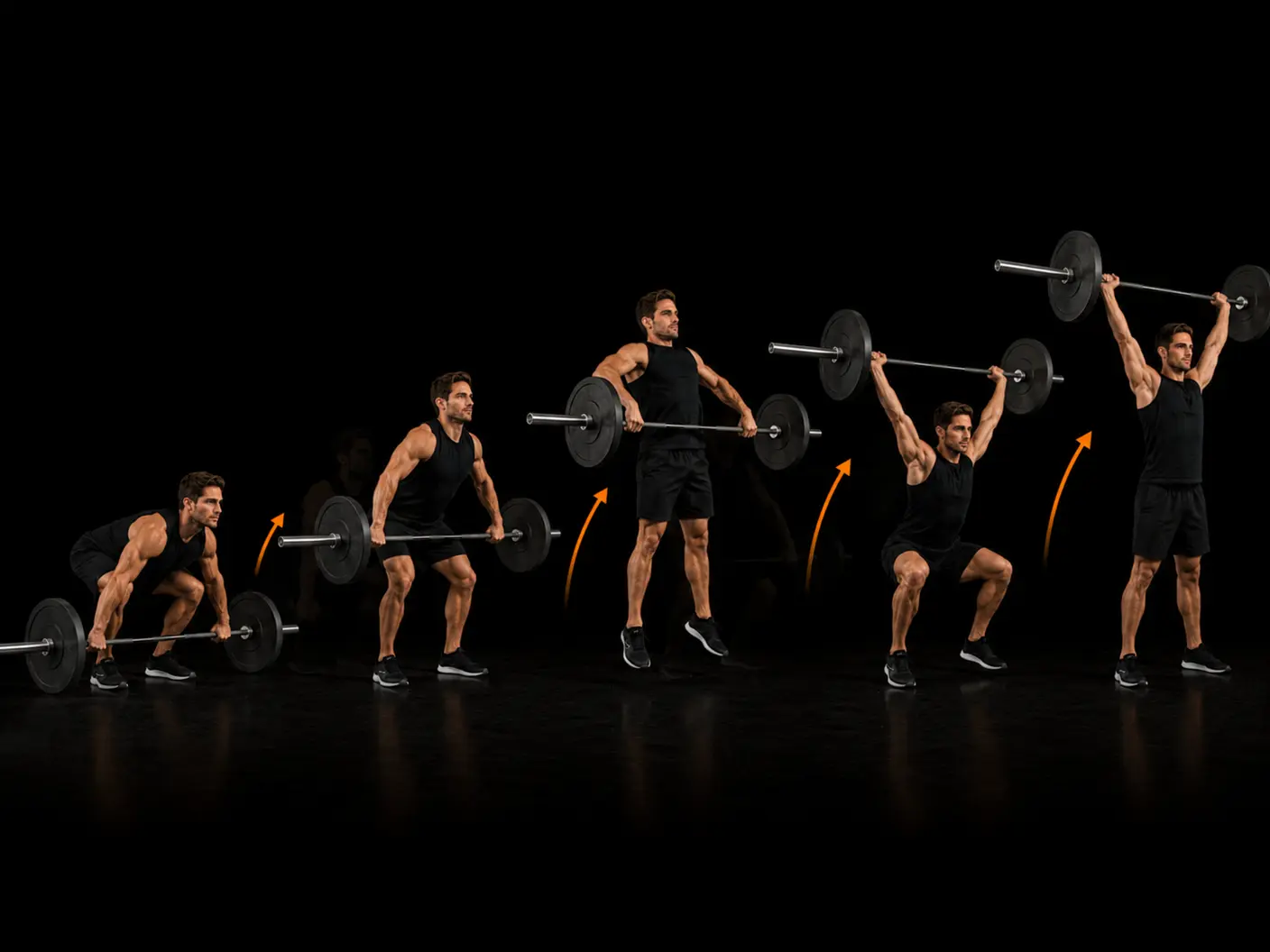
The power snatch is a barbell Olympic lifting variation in which the athlete pulls the bar from the floor and receives it overhead with arms locked out in a quarter squat rather than a full overhead squat. It trains the full-body power pattern — coordinated triple extension of the ankles, knees, and hips followed by a rapid transition under the bar — making it one of the most demanding movements in the weight room. It suits experienced lifters with a solid foundation in barbell mechanics, and athletes looking to develop explosive power transfer from the lower body through to the upper extremities.
How to do it
Set up over the bar with a wide snatch grip (hip crease at lockout). Pack the lats, chest proud. Pull through the legs, bar stays close. Triple extension. Shrug and pull the body under as the bar travels up. Catch in a quarter-overhead squat with arms fully locked out overhead. Stand.
Coaching cues
- Wide grip
- Bar close to the body
- Violent extension
- Punch to lockout overhead
Why train it
- The power snatch develops whole-body rate of force development by demanding maximal speed through the pull and an aggressive lockout overhead, qualities that transfer directly to sport performance.
- Catching the bar in a quarter squat rather than a full squat position requires the lifter to apply greater power during the pull, reinforcing high-velocity hip extension.
- The movement trains the glutes, hamstrings, quads, traps, and shoulders in a single coordinated effort, making it an efficient stimulus for athletes with limited training time.
- Programming the power snatch builds pulling mechanics and positional awareness overhead that carry over to more advanced Olympic lifting and general barbell competence.
Common mistakes
- Letting the bar drift away from the body during the pull — keep it in contact with the legs and maintain a close bar path throughout to preserve mechanical efficiency.
- Pulling early with the arms before triple extension is complete — concentrate on driving through the floor and reaching full hip, knee, and ankle extension before the shrug and arm pull begin.
- Failing to lock out the arms at the catch — the elbows must be fully extended and the bar stable overhead before you stand; a soft elbow at the catch is both a no-lift and a positional risk.
- Receiving the bar with excessive forward lean or a collapsed torso — pack the lats and keep the chest proud throughout so the catch position remains stacked and overhead, not out in front.
Primary: Gluteus Maximus, Hamstrings, Quadriceps, Trapezius.
Secondary: Erector Spinae, Latissimus Dorsi, Forearm Flexors, Rectus Abdominis, Anterior Deltoid.
Equipment
Good for
Easier variation
Snatch pull — same extension without the overhead catch.
Similar movements
Frequently asked
- What muscles does the power snatch work?
- The primary muscles are the glutes, hamstrings, quads, traps, and shoulders, which drive extension and receive the bar overhead. The erectors, lats, core, and forearms work as secondary contributors to maintain bar path, spinal position, and grip throughout the lift.
- How many sets and reps should I do for the power snatch?
- Because the power snatch is a power-dominant movement, lower rep ranges tend to be more productive — typically 3 to 5 sets of 2 to 4 repetitions at moderate to heavy intensity. Technical quality degrades quickly with fatigue, so it is usually programmed early in a session when the nervous system is fresh.
- Is the power snatch suitable for building general strength?
- The power snatch is primarily a power and athletic performance movement rather than a maximal strength exercise. If adding muscle mass or building limit strength is the main goal, compound pulling and pressing movements will generally be more appropriate, though the snatch can complement a strength programme when explosive output is also a priority.
- What are good alternatives to the power snatch?
- The hang power snatch reduces technical complexity by starting from above the knee, making it a useful progression step. The power clean follows a similar triple-extension pattern but receives the bar at the front rack rather than overhead, lowering the positional demand. Barbell jumps and kettlebell swings can also be used to train hip-extension power when Olympic lifting technique is not yet established.
- How do I know if I am ready to attempt the power snatch?
- A lifter should be confident with the overhead squat position, comfortable pulling from the floor under tension, and able to perform a reliable hang power snatch before attempting the full movement from the ground. If you are new to Olympic lifting, working with a qualified coach to establish pulling mechanics and receive position before loading the bar is strongly advisable.
Want this movement in a plan built for you?
Adaptiv programmes the right exercises for your goal, equipment and experience — then adapts them as you train.
Build my programme