Hang Power Snatch
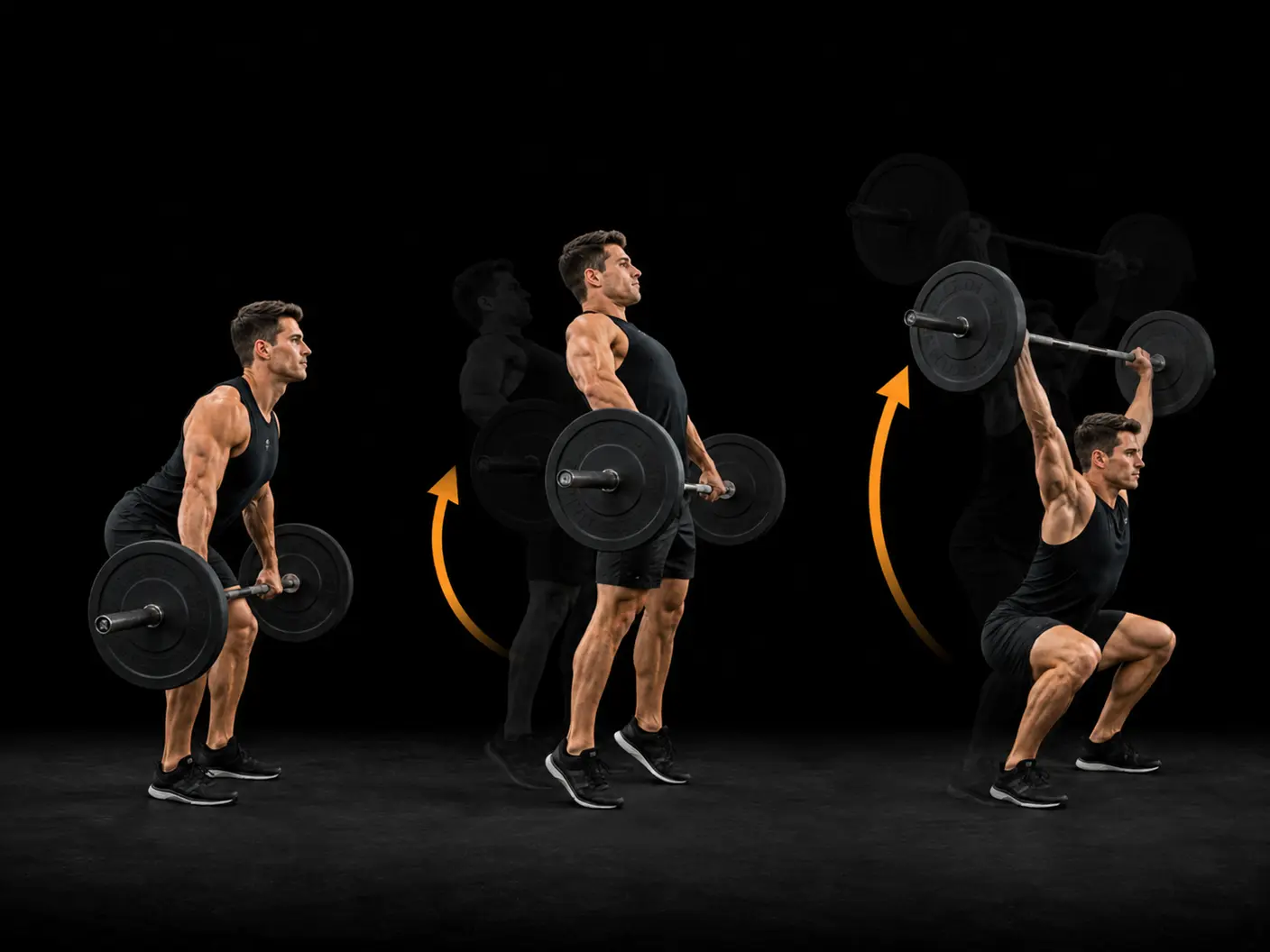
The hang power snatch is a barbell Olympic lifting variation that develops explosive triple extension — simultaneous extension of the ankle, knee, and hip — finishing with the bar caught overhead in a quarter-squat position. Starting from the hang rather than the floor reduces the range of motion and places greater emphasis on the hip drive phase, making the pattern more accessible to athletes learning the full snatch. It suits intermediate to advanced trainees pursuing athletic performance and full-body strength, and is a staple in speed and power development programmes.
How to do it
Start standing with the bar at hip crease, snatch grip. Hinge to the hang position (above the knees). Triple extension, shrug, pull under. Catch overhead in a quarter-squat with arms locked.
Coaching cues
- Tight lats
- Hip drive
- Pull under fast
- Overhead stability
Why train it
- Develops explosive hip extension through the glutes, hamstrings, and quads simultaneously, making it directly transferable to sprinting, jumping, and change-of-direction tasks.
- Challenges the traps and shoulders to decelerate and stabilise a loaded barbell overhead, building both power and upper-body structural resilience.
- The hang start removes the first pull from the floor, allowing athletes to accumulate more quality repetitions focused specifically on the critical hip drive and pull-under phases.
- Training the pull-under reinforces fast, efficient movement under load — a neuromuscular quality that carries over to other barbell lifts and athletic contexts.
Common mistakes
- Pulling early with the arms — keep the arms straight and let the hips extend fully before the shrug and pull begin, so the legs generate the force rather than the biceps.
- Losing lat tension at the hang position — brace the lats hard before initiating the drive to keep the bar close to the body throughout the movement.
- A slow or hesitant pull-under — commit to getting under the bar quickly after the shrug; any delay means the bar travels higher than necessary and the catch becomes unstable.
- Catching with soft elbows — lock the arms out firmly at the catch and stabilise the shoulder before standing, ensuring the overhead position is secure before any further movement.
Primary: Gluteus Maximus, Hamstrings, Quadriceps, Trapezius.
Secondary: Latissimus Dorsi, Forearm Flexors, Rectus Abdominis, Anterior Deltoid.
Equipment
Good for
Easier variation
Hang snatch high pull — no overhead catch.
Similar movements
Frequently asked
- What muscles does the hang power snatch work?
- The primary movers are the glutes, hamstrings, and quads, which drive the triple extension, along with the traps and shoulders, which control the shrug and overhead catch. The lats, forearms, and core contribute as secondary stabilisers throughout the lift.
- How many sets and reps should I do for the hang power snatch?
- For athletic power development, 3–5 sets of 2–4 repetitions at moderate to moderately heavy loads is a widely used structure, keeping each rep crisp and avoiding fatigue-driven technical breakdown. Because this is a ballistic movement, quality of execution matters more than volume accumulation.
- Is the hang power snatch suitable for beginners?
- This exercise is rated expert difficulty and requires a solid foundation in hip hinge mechanics, barbell cycling, and overhead stability before it is appropriate to programme. Beginners are better served building these qualities through Romanian deadlifts, overhead pressing, and medicine ball work before progressing to Olympic variations.
- What is the difference between the hang power snatch and the full snatch?
- The full snatch starts from the floor and includes a first pull phase, whereas the hang power snatch begins with the bar at hip crease height, removing that initial segment. Both finish with the bar overhead, but the hang version catches in a quarter-squat rather than a full overhead squat, making it less technically demanding while still training explosive hip extension.
- What are good alternatives if I cannot perform the hang power snatch?
- Kettlebell swings and Romanian deadlifts train the same hip extension pattern with lower technical demand, while dumbbell or barbell high pulls develop the shrug and upper-pull mechanics without requiring an overhead catch. These can serve as building blocks before returning to the hang power snatch.
Want this movement in a plan built for you?
Adaptiv programmes the right exercises for your goal, equipment and experience — then adapts them as you train.
Build my programme