Dumbbell Clean and Press
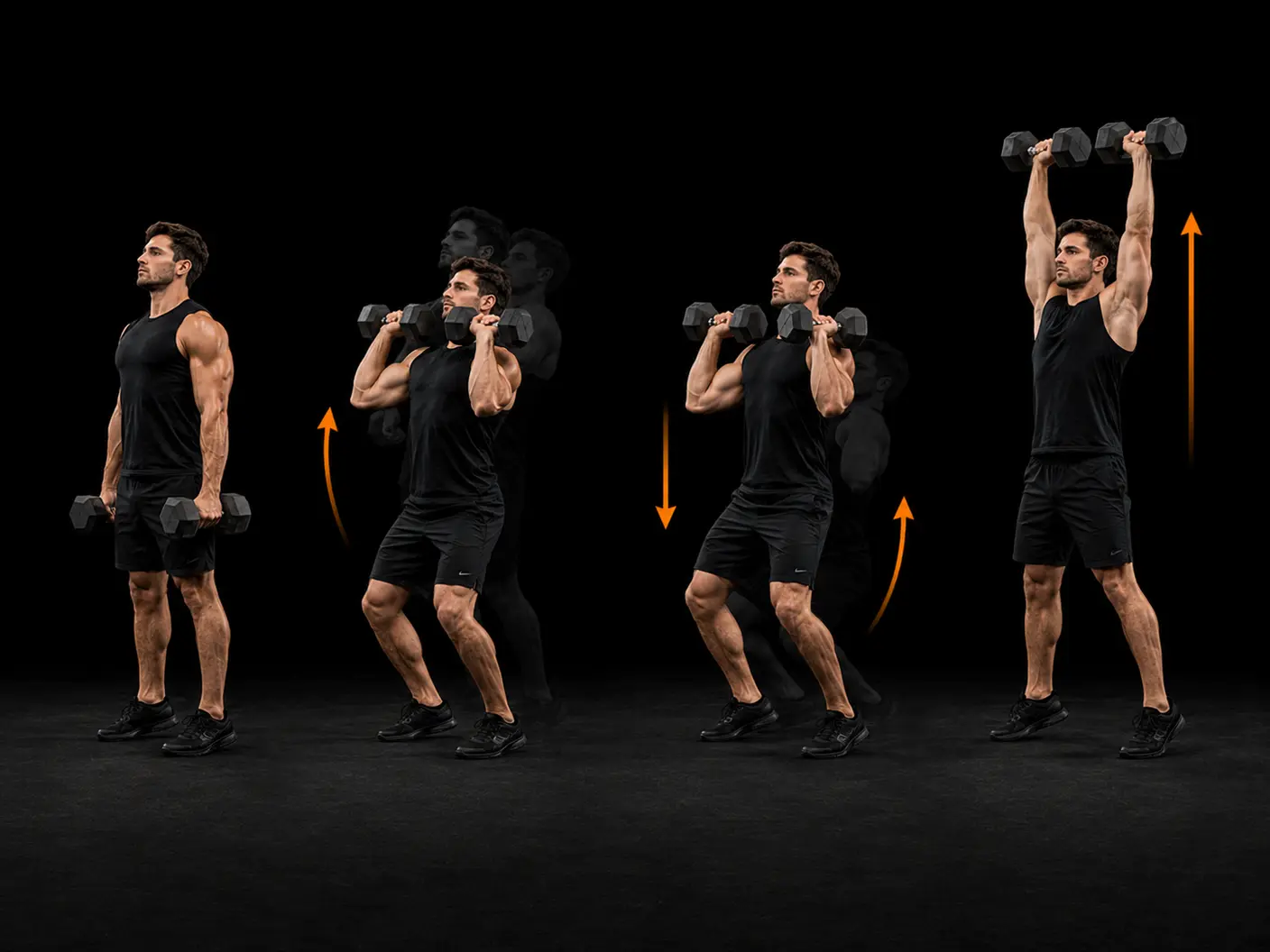
The dumbbell clean and press is a compound power movement that combines a hip-driven clean with an overhead press, training the full kinetic chain from floor to lockout in a single sequence. It develops coordinated strength across the lower body, upper back, and shoulders, making it well suited to athletes and general trainees who want to build power and work capacity simultaneously. Because each arm handles an independent dumbbell, the movement also demands greater stabilisation than its barbell equivalent, adding a useful coordination challenge for intermediate lifters.
How to do it
Stand over two dumbbells. Hinge and grip with a neutral grip. Deadlift or hang clean the dumbbells to the shoulders — drive the hips and use the momentum to flip the DBs to the catch position at the shoulders. From here, press overhead to full extension. Lower the dumbbells back to the shoulders, then to the floor. Reset and repeat.
Coaching cues
- Hips drive the clean
- Catch on the shoulders
- Press tall
- Control the descent
Why train it
- The hip-driven clean develops lower-body power through the glutes, hamstrings, and quadriceps in a way that translates directly to athletic performance.
- Combining a clean and a press into one movement elevates heart rate and energy expenditure, making it an efficient tool within fat-loss or conditioning programmes.
- Pressing from a bilateral dumbbell catch position builds overhead strength through the anterior deltoid and triceps while reinforcing scapular control under load.
- The independent nature of each dumbbell recruits the traps, erectors, core, and forearms to stabilise the load throughout, developing resilience across supporting musculature.
Common mistakes
- Pulling with the arms rather than driving with the hips — initiate every clean by extending the hips explosively first and let the arms guide the dumbbells to the shoulders as a consequence of that momentum.
- Catching the dumbbells too far forward rather than on the shoulders — actively flip the wrists and receive the load in a firm rack position at shoulder height so the skeleton, not the arms, supports the weight.
- Pressing before the catch is stable — pause briefly in the rack position to confirm your base and grip are set before initiating the overhead drive.
- Dropping the dumbbells uncontrolled on the descent — lower the weight deliberately back to the shoulders and then to the floor, maintaining tension through the erectors and core throughout.
Primary: Gluteus Maximus, Hamstrings, Quadriceps, Anterior Deltoid, Triceps Brachii.
Secondary: Trapezius, Erector Spinae, Rectus Abdominis, Forearm Flexors.
Equipment
Good for
Easier variation
Dumbbell deadlift + shoulder press performed as two separate movements.
Similar movements
Frequently asked
- What muscles does the dumbbell clean and press work?
- The primary muscles are the glutes, hamstrings, and quadriceps in the clean phase, and the anterior deltoid and triceps in the press phase. The traps, erectors, core, and forearms contribute as stabilisers throughout the movement.
- How many sets and reps should I do for the dumbbell clean and press?
- For athletic performance and power development, three to five sets of three to six reps with a weight that allows crisp technique is a sound starting point. For conditioning or fat-loss goals, moderate loads across four to five sets of six to ten reps work well, provided bar speed and form are maintained across all repetitions.
- Is the dumbbell clean and press suitable for beginners?
- The movement is classified as intermediate because it requires competent hip-hinge mechanics, a reliable catch position, and overhead pressing stability before load is added. Beginners are better served building these qualities separately — through Romanian deadlifts, dumbbell presses, and upright rows — before combining them into the full clean and press.
- What are good alternatives to the dumbbell clean and press?
- The barbell hang clean and press follows the same movement pattern with a single implement if bilateral loading is preferred. The dumbbell push press isolates the transition from rack to overhead if the clean is a limiting factor, and the kettlebell clean and press is a close equivalent that suits those already familiar with kettlebell sport mechanics.
- How do I progress the dumbbell clean and press over time?
- Begin by consolidating technique at a moderate load before increasing dumbbell weight in small increments. You can also progress by adding sets, reducing rest periods to build work capacity, or transitioning from a deadlift-start clean to a hang clean, which increases the demand on hip power and timing.
Want this movement in a plan built for you?
Adaptiv programmes the right exercises for your goal, equipment and experience — then adapts them as you train.
Build my programme