Barbell Thruster
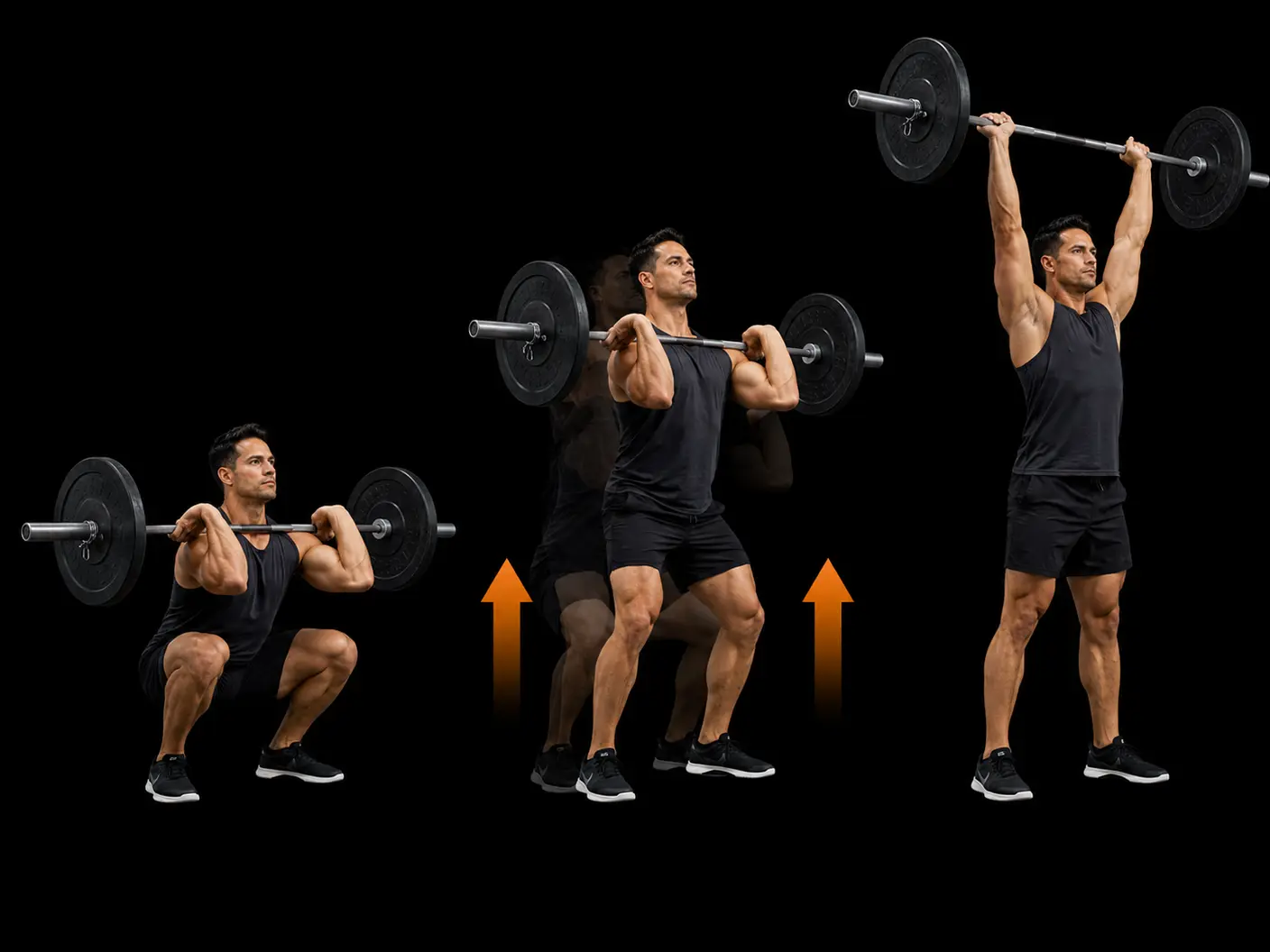
The barbell thruster combines a full front-squat with an immediate push press into a single continuous movement, using the momentum generated from the squat to drive the bar overhead. It trains the squat pattern under load whilst demanding coordinated upper-body pressing, making it a genuinely compound, full-body exercise. It suits intermediate to advanced lifters with a solid front squat and overhead press foundation, and is a staple in athletic performance and conditioning programmes.
How to do it
Bar in the front rack, feet shoulder-width. Perform a full front squat. Drive up out of the squat and immediately transition into a push press — bar overhead at the top. Return the bar to the front rack and repeat.
Coaching cues
- Front squat full depth
- Drive hard out of the hole
- Press at the top
- Fluid transition
Why train it
- It develops lower-body strength through the quadriceps and glutes whilst simultaneously building anterior deltoid and triceps pressing capacity in one efficient movement.
- The fluid transition between squat and press demands significant core and upper-back engagement to stabilise the front rack position throughout the full range of motion.
- Because it recruits a large amount of muscle mass across a long range of motion, it places a high metabolic demand on the body, making it a practical choice within fat-loss or conditioning blocks.
- The coordination required between the lower and upper body trains the kind of whole-body force transfer that underpins athletic performance in sport.
Common mistakes
- Cutting the squat short — reach full depth on every repetition to ensure the quadriceps and glutes contribute maximally and to generate the drive needed for the press.
- Pausing between the squat and the press — the transition should be immediate and fluid, using the upward momentum from the hole to assist the overhead drive rather than treating them as two separate lifts.
- Allowing the elbows to drop out of the front rack — keep them high throughout the squat so the bar stays balanced on the shoulders and the wrists remain in a neutral, supported position.
- Pressing from a half-extended position — make sure the bar reaches full lockout overhead at the top of every rep to train the triceps and deltoids through their complete range.
Primary: Quadriceps, Gluteus Maximus, Anterior Deltoid, Triceps Brachii.
Secondary: Rectus Abdominis, Rhomboids, Gastrocnemius.
Equipment
Good for
Easier variation
DB thruster — easier front rack.
Similar movements
Frequently asked
- What muscles does the barbell thruster work?
- The primary muscles are the quadriceps, glutes, anterior deltoid, and triceps. The core, upper back, and calves contribute as secondary stabilisers throughout the movement.
- How many sets and reps should I do for the barbell thruster?
- For strength and athletic performance, three to five sets of three to six reps at a challenging load works well. For conditioning or fat-loss goals, lower loads across four to six sets of eight to twelve reps with controlled rest periods are more appropriate.
- What are good alternatives to the barbell thruster?
- The dumbbell thruster follows the same pattern and is a useful option when a rack is unavailable or when load needs to be reduced. The kettlebell thruster is another accessible alternative that also challenges grip and shoulder stability.
- Is the barbell thruster suitable for beginners?
- It is rated as an advanced movement, so beginners should first develop competence in the front squat and overhead press separately before combining them. The front-rack position requires shoulder and wrist mobility that takes time to develop safely.
- Can the barbell thruster be used for fat loss?
- Yes — because the movement recruits muscle mass across the lower body, core, and upper body simultaneously, it generates a high metabolic demand per repetition. Programmed with moderate load and shorter rest intervals, it fits effectively within a fat-loss conditioning block.
Want this movement in a plan built for you?
Adaptiv programmes the right exercises for your goal, equipment and experience — then adapts them as you train.
Build my programme