Barbell Back Squat
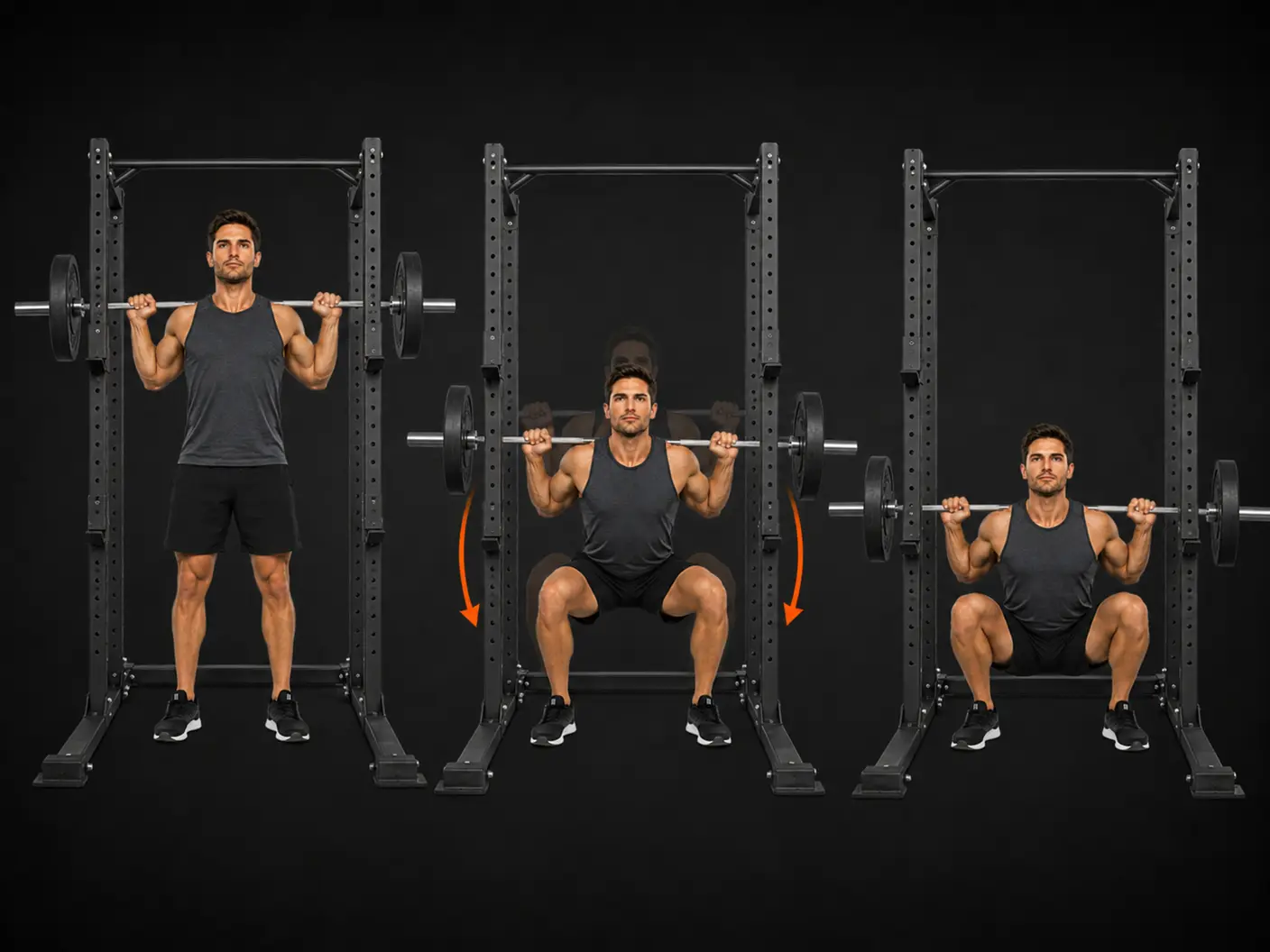
The barbell back squat is a compound, free-weight movement in which a loaded barbell is supported across the upper traps while the lifter performs a deep squat to below parallel. It trains the squat pattern under significant axial load, demanding coordinated strength from the lower body, posterior chain, and core simultaneously. It suits intermediate to advanced trainees who have established sound squat mechanics and sufficient thoracic and ankle mobility to maintain position under a bar.
How to do it
Set the bar at mid-sternum; grip slightly wider than shoulders with elbows pulled down to lock the bar on the upper traps. Unrack with 2–3 steps back, feet shoulder-width, toes 15–30° out. Brace the core with a Valsalva breath. Break hips and knees simultaneously; knees track over toes. Descend until the hip crease is below the knee crease. Drive through the whole foot; chest rises with hips. Exhale through the sticking point and fully extend.
Coaching cues
- Spread the floor
- Knees out
- Push the floor away
- Big chest
Why train it
- It loads the quadriceps and glutes through a large range of motion, making it one of the most effective exercises for developing lower-body strength and muscle mass.
- The axial loading demands continuous bracing from the erectors and core, reinforcing full-body tension and spinal stability under real load.
- As a multi-joint movement driven by force applied through the whole foot, it transfers well to athletic qualities such as acceleration, jumping, and change of direction.
- Programming the squat around a barbell allows precise, incremental load increases over time, making long-term progressive overload straightforward to track and manage.
Common mistakes
- Letting the chest fall forward in the descent — maintain a big chest and keep the elbows pulled down throughout to hold the bar firmly on the upper traps and preserve an upright torso.
- Allowing the knees to cave inward at the bottom or on the drive up — actively spread the floor with your feet and cue the knees out to keep them tracking over the toes.
- Rising hips-first out of the hole, turning the movement into a good morning — focus on driving the chest and hips upward together so the torso angle stays consistent from the bottom to the sticking point.
- Failing to reach depth — the hip crease must descend below the knee crease on every repetition, so address any mobility restrictions before adding load rather than compensating with a reduced range.
Primary: Quadriceps, Gluteus Maximus.
Secondary: Hamstrings, Adductors, Erector Spinae, Gastrocnemius, Rectus Abdominis.
Equipment
Good for
Easier variation
Goblet squat with dumbbell or kettlebell at chest — teaches upright torso and self-limits load.
Similar movements
Frequently asked
- What muscles does the barbell back squat work?
- The primary movers are the quadriceps and glutes. The hamstrings, adductors, calves, erectors, and core all contribute as secondary muscles, making it one of the most broadly demanding lower-body exercises available.
- How many sets and reps should I do for the barbell back squat?
- For strength, three to five sets of three to six reps at 80–90% of your one-rep max is a well-established range. For hypertrophy, three to four sets of six to twelve reps with controlled tempo and a challenging but manageable load is more appropriate. General fitness trainees typically respond well to three sets of eight to ten reps at moderate intensity.
- Is the barbell back squat suitable for beginners?
- It is classified as an advanced movement due to the technical demands of bar position, bracing, and achieving depth under load. Beginners are generally better served by building the squat pattern with a goblet squat or front-loaded variation before progressing to a barbell back squat.
- What is a good alternative to the barbell back squat?
- The barbell front squat trains a very similar pattern with greater emphasis on an upright torso and is a common progression or variation. For those without access to a squat rack, the goblet squat or dumbbell squat preserve the movement pattern while reducing axial load.
- How do I stop my lower back rounding at the bottom of the squat?
- Lower-back rounding at depth is usually related to limited hip or ankle mobility, insufficient core bracing, or excessive forward lean — take a Valsalva breath before the descent, brace firmly, and address mobility restrictions progressively rather than simply adding load and hoping the position improves.
Want this movement in a plan built for you?
Adaptiv programmes the right exercises for your goal, equipment and experience — then adapts them as you train.
Build my programme