Goblet Squat
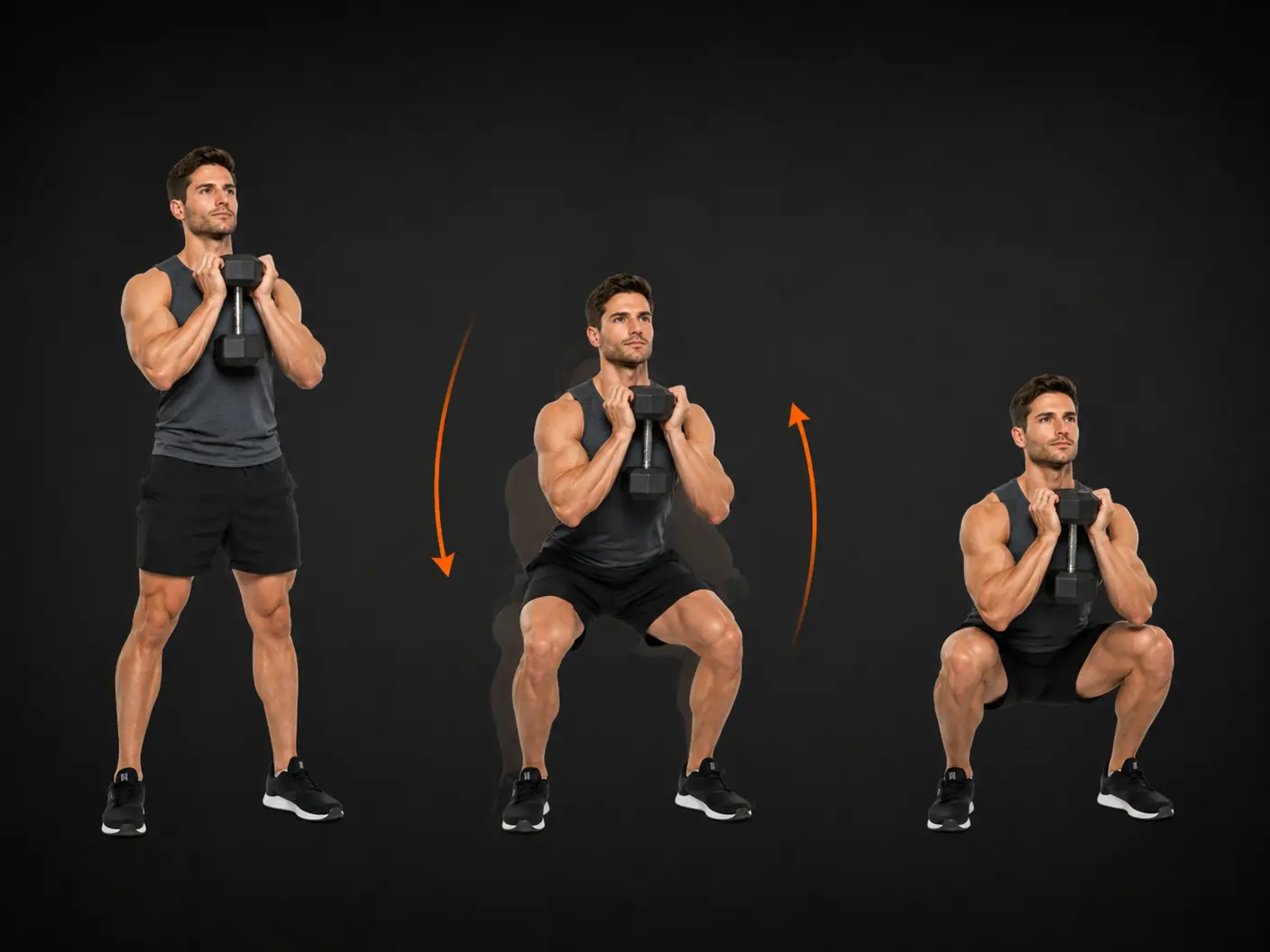
The goblet squat is a foundational compound movement in which a single load — a dumbbell or kettlebell held at chest height — acts as a counterbalance, naturally encouraging an upright torso throughout the squat pattern. It trains the lower body through a full range of motion while simultaneously demanding bracing from the core and engagement from the upper back. The movement suits beginners learning squat mechanics and experienced trainees seeking a technically honest loading option for hypertrophy or general fitness work.
How to do it
Hold a dumbbell vertically or kettlebell by the horns at chest height, elbows tucked. Feet shoulder-width, toes slightly out. Inhale, brace, and sit down between the hips — elbows travel inside the knees at the bottom. Chest stays tall; the load self-corrects posture. Drive through the whole foot to stand.
Coaching cues
- Elbows inside knees
- Tall chest
- Sit between the hips
- Drive up
Why train it
- The front-loaded position self-corrects posture by pulling the lifter into an upright chest, making it an effective teaching tool for squatting mechanics before progressing to barbell variations.
- It develops the quadriceps and glutes through a deep, controlled range of motion, supporting hypertrophy and lower-body strength across a broad range of training goals.
- Holding the load at chest height requires sustained core and upper back engagement throughout every rep, adding structural work without a separate exercise.
- The movement is accessible with minimal equipment — a single dumbbell or kettlebell is sufficient — making it practical for home environments, commercial gyms, and travel settings alike.
Common mistakes
- Letting the chest fall forward — keep the elbows tucked and the load pressed lightly towards the sternum to maintain a tall spine from top to bottom.
- Heels rising off the floor — if the heels lift as you descend, reduce the depth until ankle mobility improves, or elevate the heels slightly to keep the whole foot in contact with the ground.
- Knees collapsing inward — actively drive the knees out in line with the toes throughout the descent and the drive phase, using the elbows pressing inside the knees at the bottom as a positional cue.
- Rising onto the toes during the drive phase — press through the entire foot as you stand, distributing force evenly rather than shifting weight forward onto the ball of the foot.
Primary: Quadriceps, Gluteus Maximus.
Secondary: Rectus Abdominis, Rhomboids, Adductors.
Equipment
Good for
Easier variation
Counterbalance squat holding a light plate at arm's length in front — teaches sitting back without tipping.
Similar movements
Frequently asked
- What muscles does the goblet squat work?
- The primary muscles trained are the quadriceps and glutes. The core, upper back, and adductors work as secondary stabilisers throughout the movement.
- How many sets and reps should I do for the goblet squat?
- For general fitness and learning the pattern, three to four sets of eight to twelve reps at a controlled tempo works well. If hypertrophy is the priority, staying in the eight to fifteen rep range with progressive load over time is appropriate; for strength development, lower rep ranges of five to eight with heavier loading can be used once technique is consistent.
- Is the goblet squat suitable for beginners?
- Yes — its difficulty is classified as foundational, and the front-loaded position actively assists posture, which makes it one of the more forgiving squat variations to learn. It is a practical starting point before progressing to bilateral barbell squats.
- What is a good alternative to the goblet squat?
- If no equipment is available, a bodyweight squat trains the same pattern. For those ready to progress, a front squat with a barbell or a dumbbell held in each hand at the shoulders replicates the upright-torso demand with greater loading potential.
- Can the goblet squat help with squat depth?
- The counterbalance effect of the load at chest height often allows a lifter to sit lower than they can unloaded, making it a useful drill for developing comfort and range in the bottom position. However, if limited ankle mobility is restricting depth, addressing that directly will have a more lasting effect.
Want this movement in a plan built for you?
Adaptiv programmes the right exercises for your goal, equipment and experience — then adapts them as you train.
Build my programme