Barbell Front Squat
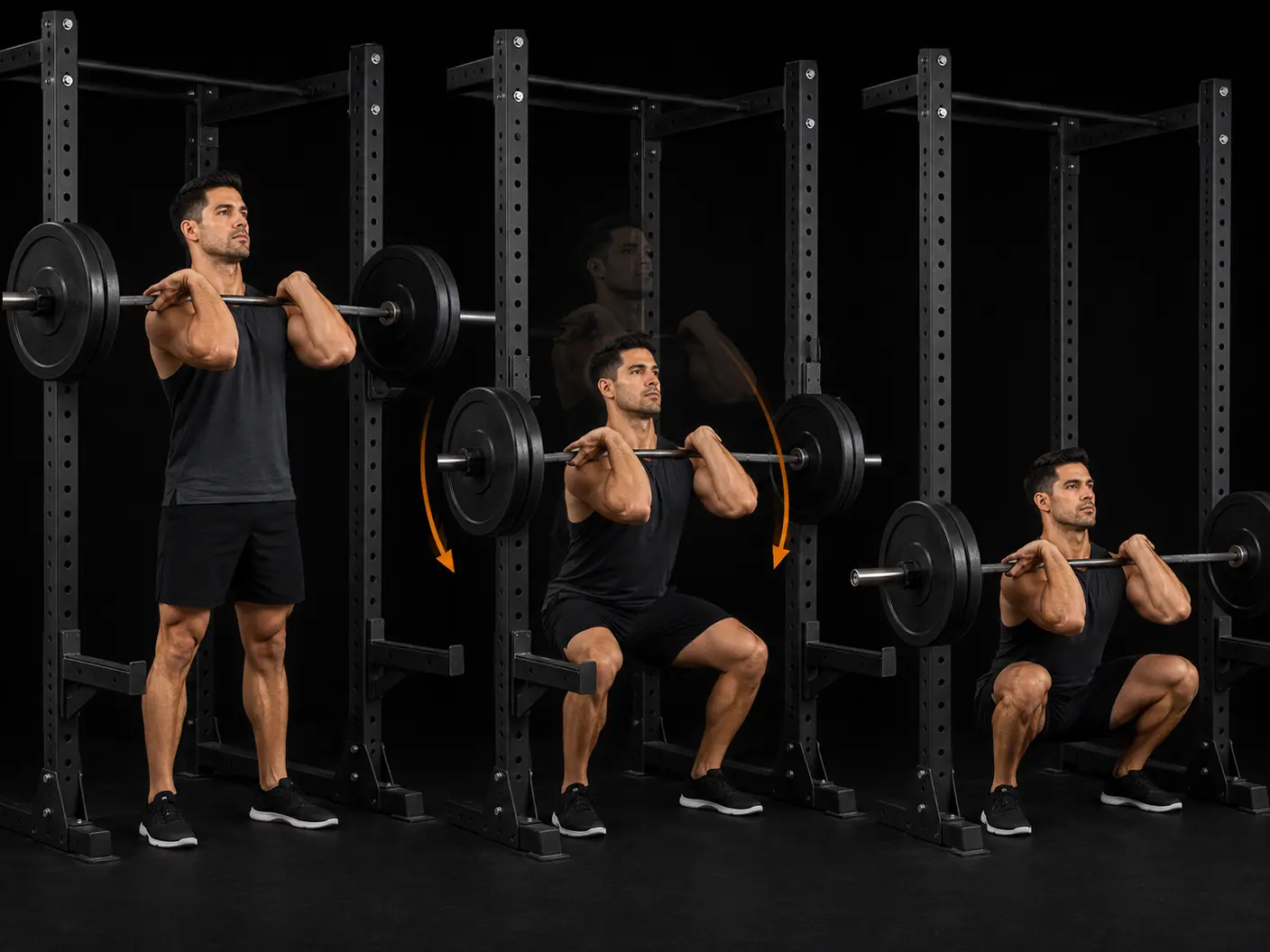
The barbell front squat is a compound lower-body movement in which the barbell is held in a front-rack position across the anterior deltoids, demanding a markedly more upright torso than its back-squat counterpart. It trains the squat pattern with a strong emphasis on quadriceps development and thoracic extension, while placing significant demand on the upper back and core to maintain position under load. It suits intermediate to advanced lifters who have already established sound squat mechanics and adequate shoulder and wrist mobility.
How to do it
Set the bar across the front delts with elbows high and fingertips under the bar. Clear the rack and step back; feet shoulder-width, toes slightly out. Brace hard — the front rack punishes any spinal flexion. Descend with the torso as vertical as possible; knees travel forward over the toes. Hit full depth, then drive the elbows up and chest through to stand.
Coaching cues
- Elbows high
- Tall chest
- Knees track toes
- Drive elbows up
Why train it
- The upright torso position shifts the loading emphasis firmly onto the quadriceps, making it one of the more effective barbell movements for quad hypertrophy and strength.
- Front-rack positioning requires continuous upper-back and core bracing, reinforcing the kind of trunk rigidity that carries over to Olympic lifting, sport, and general compound performance.
- The forward knee travel and vertical torso mechanics closely replicate athletic positions seen in jumping, receiving, and change-of-direction tasks, supporting athletic performance development.
- Because the bar position self-limits the load if posture breaks down, the front squat acts as an honest diagnostic of mobility and bracing quality across the whole kinetic chain.
Common mistakes
- Dropping the elbows during the descent — actively drive them up and forward throughout the entire rep, as any elbow drop collapses the front rack and shifts the bar dangerously forward.
- Excessive forward lean of the torso — prioritise keeping the chest tall by improving thoracic mobility and ankle dorsiflexion before adding load, since forward lean under a front-rack bar places disproportionate stress on the lower spine.
- Allowing the knees to cave medially — consciously push the knees out in line with the toes from the first inch of descent to the top of the drive, which keeps the adductors and glutes properly engaged.
- Rising onto the toes at the bottom — if heel elevation occurs, address ankle mobility or use a small heel raise temporarily, as losing heel contact destabilises the entire lift and limits depth.
Primary: Quadriceps.
Secondary: Gluteus Maximus, Rhomboids, Rectus Abdominis, Adductors.
Equipment
Good for
Easier variation
Goblet squat or Zercher squat with lighter load — reduces rack position mobility demand.
Similar movements
Frequently asked
- What muscles does the barbell front squat work?
- The primary muscles are the quadriceps — specifically the rectus femoris and all three vastus heads — which are heavily loaded due to the upright torso and forward knee travel. Secondary contributors include the glutes, adductors, upper back, and core, which work to maintain the front-rack position and stabilise the spine throughout the movement.
- How many sets and reps should I do for the barbell front squat?
- For strength, three to five sets of three to five reps at high relative intensity works well. For hypertrophy, four sets of six to ten reps with controlled tempo is a practical starting point. Given the technical demands of the movement, it is generally better to keep total volume moderate and prioritise position quality over accumulating fatigue.
- What is the difference between a front squat and a back squat?
- The primary distinction is bar placement: the front squat positions the bar across the anterior deltoids, requiring a more vertical torso and placing greater demand on the quadriceps and upper back, whereas the back squat allows a more inclined torso and distributes load more evenly across the posterior chain. Neither is categorically superior — they serve different emphases and can complement each other within a well-structured programme.
- What are good alternatives if I lack the mobility for a front squat?
- A goblet squat trains a similar upright-torso squat pattern with far lower demands on wrist and shoulder mobility, making it a useful preparatory movement. A safety-bar squat can also approximate the torso position without the front-rack requirement. Working on thoracic extension, ankle dorsiflexion, and wrist flexibility in parallel will make the front squat accessible over time.
- Is the barbell front squat suitable for building muscle as well as strength?
- Yes — the movement is listed under both hypertrophy and strength goals precisely because the quad loading is substantial and the range of motion at full depth is considerable. Programming it in the six-to-ten rep range with deliberate tempo on the descent will accumulate sufficient mechanical tension for muscle development, provided technique remains sound throughout each set.
Want this movement in a plan built for you?
Adaptiv programmes the right exercises for your goal, equipment and experience — then adapts them as you train.
Build my programme