Safety Squat Bar Squat
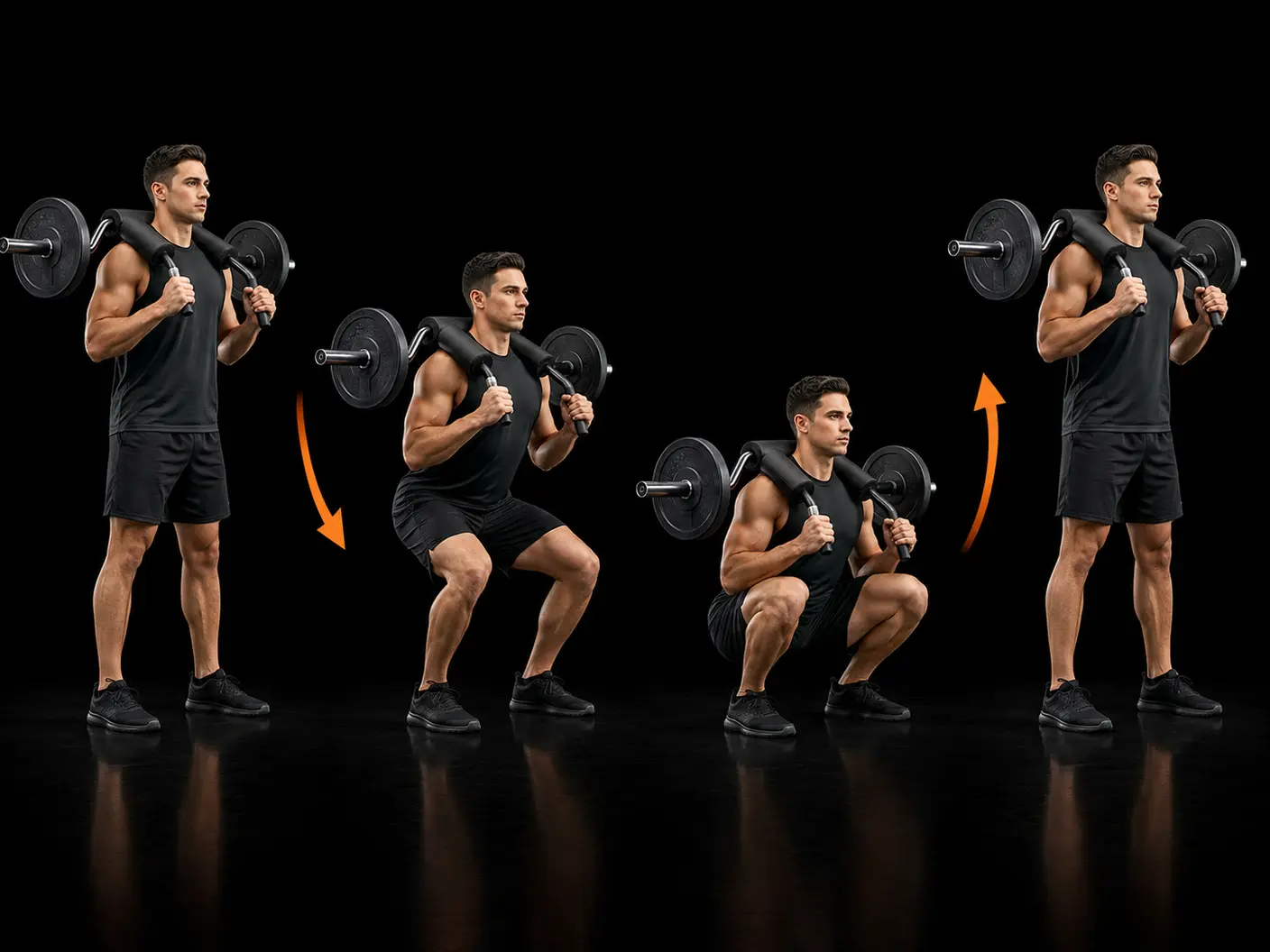
The safety squat bar (SSB) squat is a barbell squatting variation performed with a cambered specialty bar that positions the load in front of the lifter's centreline, creating a forward-tipping moment the torso must actively resist throughout the lift. This makes it a uniquely demanding compound movement that trains the quadriceps and glutes as the primary movers while placing considerable demand on the upper back and core to maintain an upright position. It suits intermediate lifters looking to build squat strength and lower-body mass, and is particularly useful for those who find a straight-bar squat uncomfortable on the shoulders or wrists.
How to do it
Set the SSB on the upper traps; grip the handles in front of the shoulders. The cambered bar pulls you forward — fight it with an upright chest and braced torso. Unrack, step back, feet shoulder-width. Break hips and knees together; descend to at least parallel. Drive up through mid-foot, keeping the chest tall; the bar will try to tip you forward, so stay stacked.
Coaching cues
- Fight the bar forward
- Tall chest
- Brace hard
- Stand stacked
Why train it
- The forward camber of the bar increases the demand on the upper back and core, developing postural strength that carries over to other loaded movements.
- Training the quadriceps and glutes under a compound, full-range pattern makes it an effective stimulus for lower-body hypertrophy when programmed with appropriate volume.
- Because the handles are gripped in front of the shoulders rather than behind the back, the SSB squat places far less stress on the shoulder and elbow joints than a conventional back squat.
- The bar's design encourages a naturally more upright torso, reinforcing good squatting mechanics that transfer across the full spectrum of strength training.
Common mistakes
- Letting the chest drop forward — actively fight the bar by driving the chest tall throughout the descent and ascent, as though pushing your head into the ceiling.
- Losing core tension at the bottom — brace hard before you unrack and maintain that intra-abdominal pressure for the entire set, not just the descent.
- Rising onto the toes rather than pressing through the mid-foot — keep the foot fully in contact with the floor and drive evenly through the whole base to stay stacked over the bar.
- Breaking at the knees before the hips, or vice versa — initiate the squat by moving the hips and knees simultaneously to maintain balance and keep the bar path vertical.
Primary: Quadriceps, Gluteus Maximus.
Secondary: Rhomboids, Rectus Abdominis, Hamstrings.
Equipment
Good for
Easier variation
Front-loaded goblet squat — teaches resisting forward torso lean without the axial loading.
Similar movements
Frequently asked
- What muscles does the safety squat bar squat work?
- The primary movers are the quadriceps and glutes. The upper back and core are heavily involved as secondary muscles in resisting the forward pull of the cambered bar, and the hamstrings contribute as stabilisers through the movement.
- How many sets and reps should I do for the SSB squat?
- For strength, three to five sets of three to six reps at a challenging load works well. For hypertrophy or general fitness, three to four sets of six to twelve reps with a controlled tempo is a reliable starting point. Rest two to three minutes between sets when lifting heavy.
- Is the SSB squat harder than a regular back squat?
- Most lifters find it harder to maintain an upright torso with the SSB because the cambered bar continuously pulls the shoulders forward, demanding more from the upper back and core. As a result, the load used is often lower than on a straight-bar squat for the same perceived effort.
- Can I use the SSB squat as an alternative to the conventional back squat?
- Yes — it trains the same fundamental squat pattern and primary muscle groups, making it a practical direct substitute. It is particularly useful if a shoulder, wrist, or elbow issue makes the standard bar position uncomfortable, though you should consult a qualified professional if you are working around a specific complaint.
- What equipment do I need to perform the SSB squat?
- You need a safety squat bar and a squat rack or power rack. The bar is a specialty item not found in all commercial gyms, so confirm your facility has one before programming this lift.
Want this movement in a plan built for you?
Adaptiv programmes the right exercises for your goal, equipment and experience — then adapts them as you train.
Build my programme