Dumbbell Squat
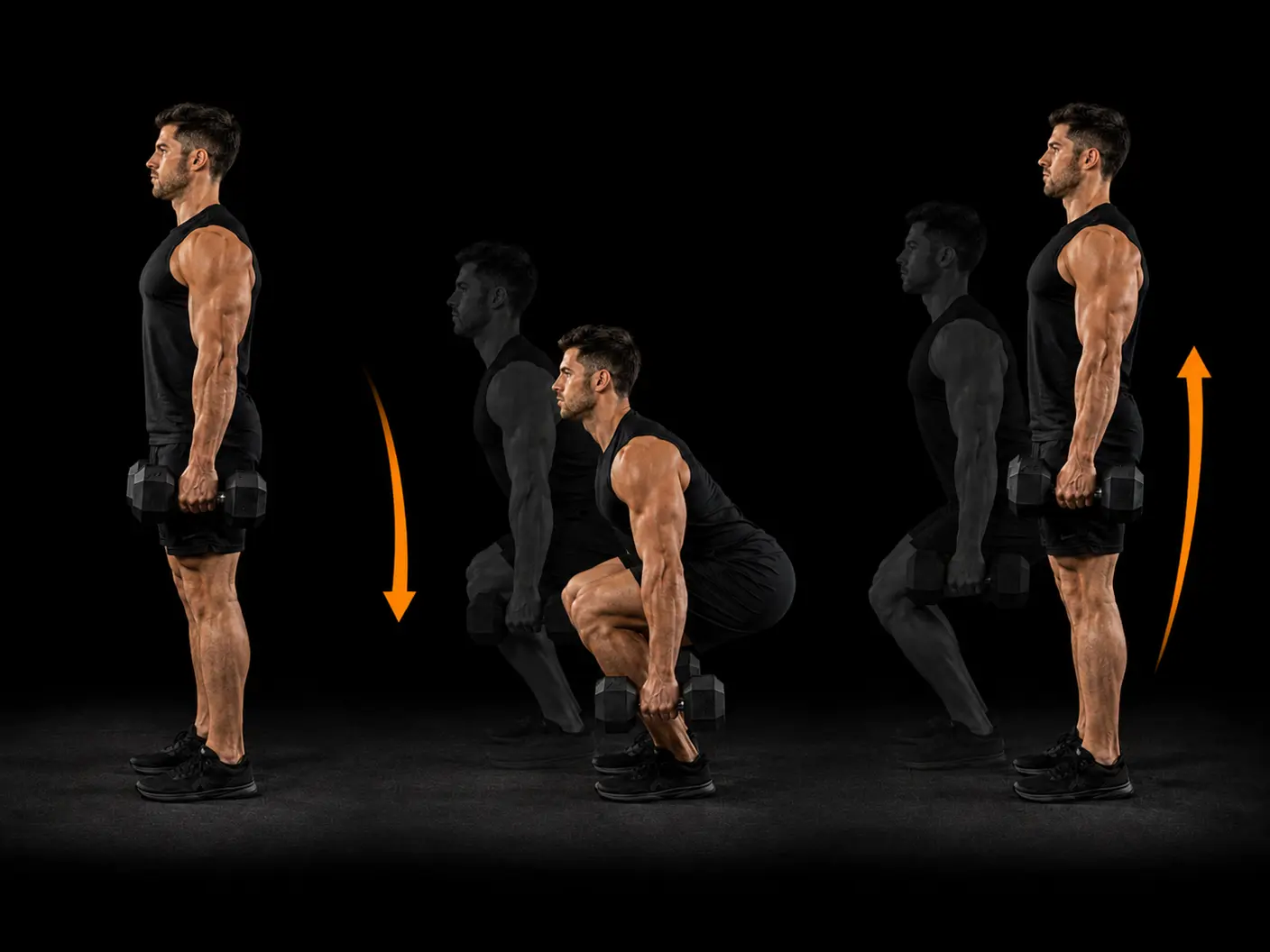
The dumbbell squat is a foundational compound movement that trains the lower-body pushing pattern using a pair of dumbbells held at the sides rather than a barbell across the back or front rack. It develops strength and muscle mass through the quadriceps and glutes while demanding core stability and grip endurance throughout each rep. The accessible equipment requirement and relatively low technical threshold make it well suited to beginners building movement competency, as well as intermediate trainees training away from a barbell or adding volume within a hypertrophy block.
How to do it
Hold a dumbbell in each hand at your sides, feet shoulder-width, toes slightly out. Brace the core. Break hips and knees, descending until the hip crease drops below the knee. Keep the chest tall and dumbbells at the sides — do not let them drift forward. Drive through mid-foot to stand.
Coaching cues
- Chest tall
- DBs stay at sides
- Full depth
- Drive through mid-foot
Why train it
- Develops quadriceps and glute strength simultaneously, making it an efficient choice for lower-body hypertrophy programmes with limited equipment.
- The bilateral, symmetrical load challenges grip endurance and core bracing, reinforcing full-body tension that carries over to more advanced compound lifts.
- Holding the dumbbells at the sides rather than overhead or in a front rack position imposes minimal shoulder and wrist demands, reducing technical barriers for newer trainees.
- As a foundational squat variation, it establishes the movement mechanics — depth, mid-foot drive, and upright torso — that underpin more complex squat patterns introduced later in a programme.
Common mistakes
- Allowing the chest to fall forward as you descend — brace the core harder and keep your gaze level to maintain a tall torso throughout the full range of motion.
- Letting the dumbbells drift forward away from the sides — keep them close to your body so they do not shift your centre of mass and pull the shoulders down.
- Stopping short of full depth — continue the descent until the hip crease passes below the knee, as partial reps reduce the stimulus to the glutes and limit the training benefit.
- Allowing the heels to rise off the floor — if this occurs, widen your stance slightly or turn the toes out a fraction more until ankle mobility improves enough to sustain a flat-footed position.
Primary: Quadriceps, Gluteus Maximus.
Secondary: Hamstrings, Rectus Abdominis, Forearm Flexors.
Equipment
Good for
Easier variation
Bodyweight squat — remove load entirely to groove the pattern.
Similar movements
Frequently asked
- What muscles does the dumbbell squat work?
- The primary muscles are the quadriceps and glutes. The hamstrings, core, and grip musculature work as secondary contributors — the core to maintain a braced, upright torso and the grip to control the dumbbells throughout the set.
- How many sets and reps should I do for the dumbbell squat?
- For general fitness and movement quality, three sets of eight to twelve reps at a controlled tempo is a sound starting point. If hypertrophy is the goal, working in the eight to fifteen rep range across three to four sets with two minutes of rest between sets aligns with established volume guidelines.
- Is the dumbbell squat a good alternative to the barbell back squat?
- It trains the same fundamental squat pattern and the same primary muscles, making it a practical substitute when a barbell is unavailable or when a lifter is not yet ready for the technical demands of barbell loading. The load ceiling is lower, so advanced trainees seeking maximal strength expression will eventually benefit from progressing to a barbell variation.
- What is the difference between the dumbbell squat and a goblet squat?
- In the dumbbell squat, a dumbbell is held in each hand at the sides; in a goblet squat, a single dumbbell or kettlebell is held at the chest. The goblet position naturally encourages a more upright torso and is often used as an earlier teaching tool, whereas the dumbbell squat demands more active bracing to prevent forward lean.
- Can I use the dumbbell squat to build bigger legs?
- Yes, provided the load, volume, and progressive overload are managed appropriately. Reaching adequate depth — hip crease below the knee — maximises the stimulus to the quadriceps and glutes, which are the muscles with the greatest hypertrophy potential in this movement.
Want this movement in a plan built for you?
Adaptiv programmes the right exercises for your goal, equipment and experience — then adapts them as you train.
Build my programme