45° Leg Press
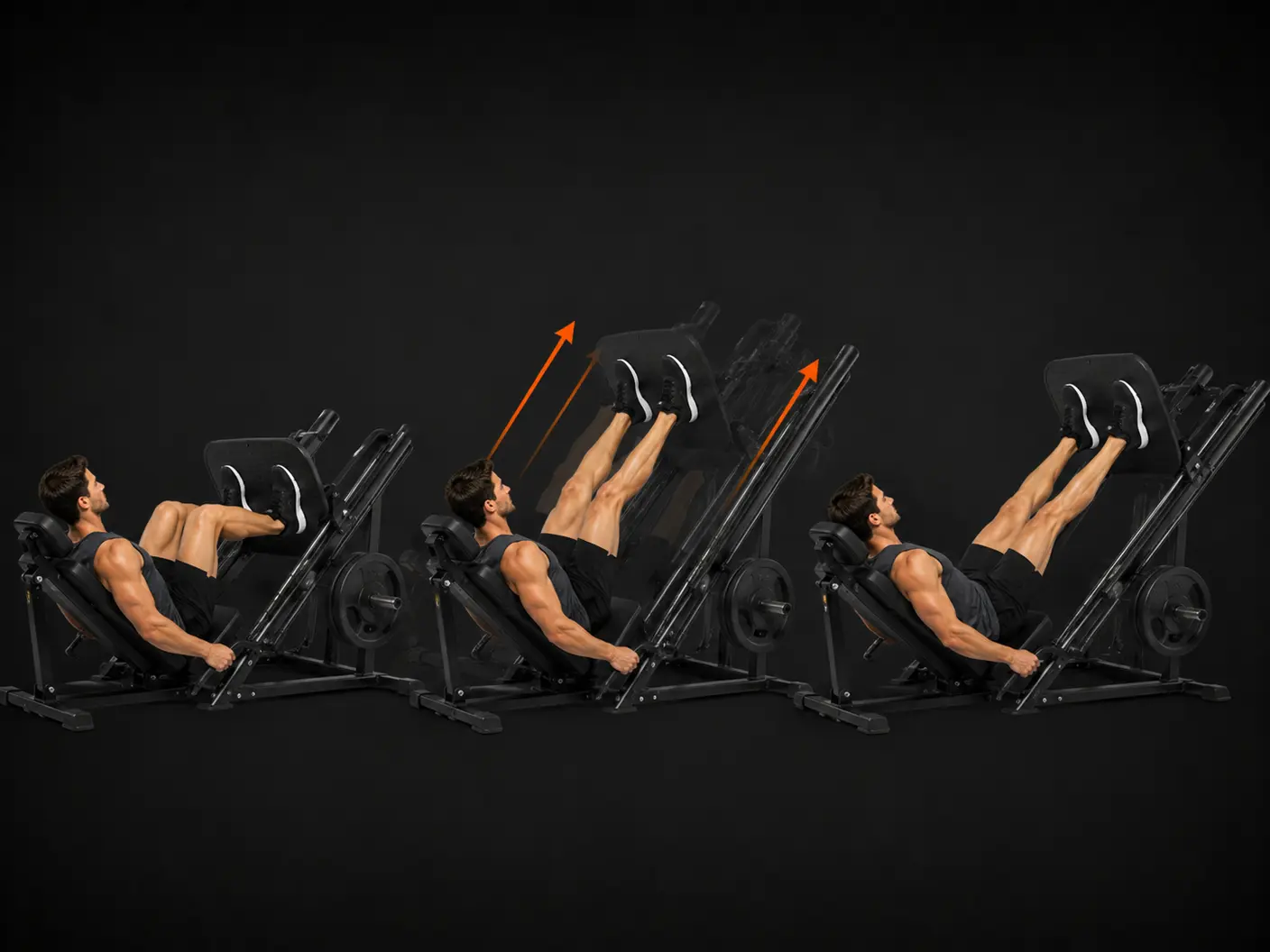
The 45° leg press is a machine-based compound movement that trains the squat pattern through a fixed, guided range of motion. Seated at an incline, the lifter pushes a weighted sled away from the body, loading the quadriceps and glutes with minimal demand on spinal stability compared to a barred squat. It suits intermediate trainees looking to accumulate lower-body volume, develop quad and glute strength, or supplement free-weight squatting with additional machine work.
How to do it
Sit back into the pad with hips fully seated. Place feet shoulder-width on the platform, mid-foot centred. Unrack the sled and lower under control until knees approach the chest — stop before the lower back rounds off the pad. Drive the platform up through mid-foot without locking out hard. Keep the head and hips pressed into the pad throughout.
Coaching cues
- Knees track toes
- Mid-foot drive
- Lower back stays pinned
- No lockout slam
Why train it
- The guided sled path allows heavier loading across the quadriceps and glutes without the balance and coordination demands of a barbell squat, making higher-volume sets more manageable.
- Foot position on the platform can be adjusted to shift emphasis between the quadriceps and glutes, offering meaningful variety within a single piece of equipment.
- Because the torso is supported throughout, the lower back is largely removed from the equation, allowing lifters to train the legs hard on sessions when spinal fatigue is a limiting factor.
- The movement translates well to general strength goals, providing a reliable progressive overload stimulus that complements squatting patterns in a well-rounded programme.
Common mistakes
- Allowing the lower back to round off the pad at the bottom — stop the descent before the lumbar spine loses contact with the seat, as the pad provides the reference point for safe range.
- Driving the knees inward during the press — actively track the knees over the toes throughout the movement to maintain alignment and distribute force evenly across the joint.
- Slamming the sled into lockout at the top — stop just short of full knee extension to keep tension on the working muscles and avoid unnecessary joint stress.
- Placing the feet too low on the platform — a low foot position shifts load away from the glutes and increases shear at the knee, so keep the feet at mid-platform with a shoulder-width stance.
Primary: Quadriceps, Gluteus Maximus.
Secondary: Hamstrings, Adductors.
Equipment
Good for
Easier variation
Horizontal leg press with a shorter range of motion — easier to control depth for beginners.
Similar movements
Frequently asked
- What muscles does the 45° leg press work?
- The primary muscles are the quadriceps and glutes, with the hamstrings and adductors working as secondary contributors. The degree of glute involvement can be increased by placing the feet slightly higher on the platform.
- How many sets and reps should I do on the leg press?
- For hypertrophy, three to four sets of eight to fifteen reps with a controlled tempo works well. For strength, four to five sets of four to eight reps with heavier loading is more appropriate. Rest periods of ninety seconds to three minutes between sets allow adequate recovery.
- What is the difference between the 45° leg press and a hack squat machine?
- The 45° leg press seats the lifter at a reclined angle and pushes the platform away, keeping the torso largely stationary. The hack squat machine has the lifter in a more upright position descending with the body, which places greater demand on the quadriceps and requires more core and upper-body bracing.
- Can the leg press replace barbell squats in a programme?
- The leg press can substitute for squatting in terms of lower-body volume and hypertrophy stimulus, but it does not replicate the demands on core stability, balance, and the posterior chain that free-weight squatting develops. For most trainees, using both movements in a programme yields better overall results than relying on one alone.
- Is the 45° leg press suitable for beginners?
- It is rated as an intermediate movement, partly because managing the sled weight and controlling range of motion safely requires a baseline of body awareness. Beginners can use it, but should start with a conservative load and focus on keeping the lower back pinned to the pad before adding weight.
Want this movement in a plan built for you?
Adaptiv programmes the right exercises for your goal, equipment and experience — then adapts them as you train.
Build my programme