Hack Squat Machine
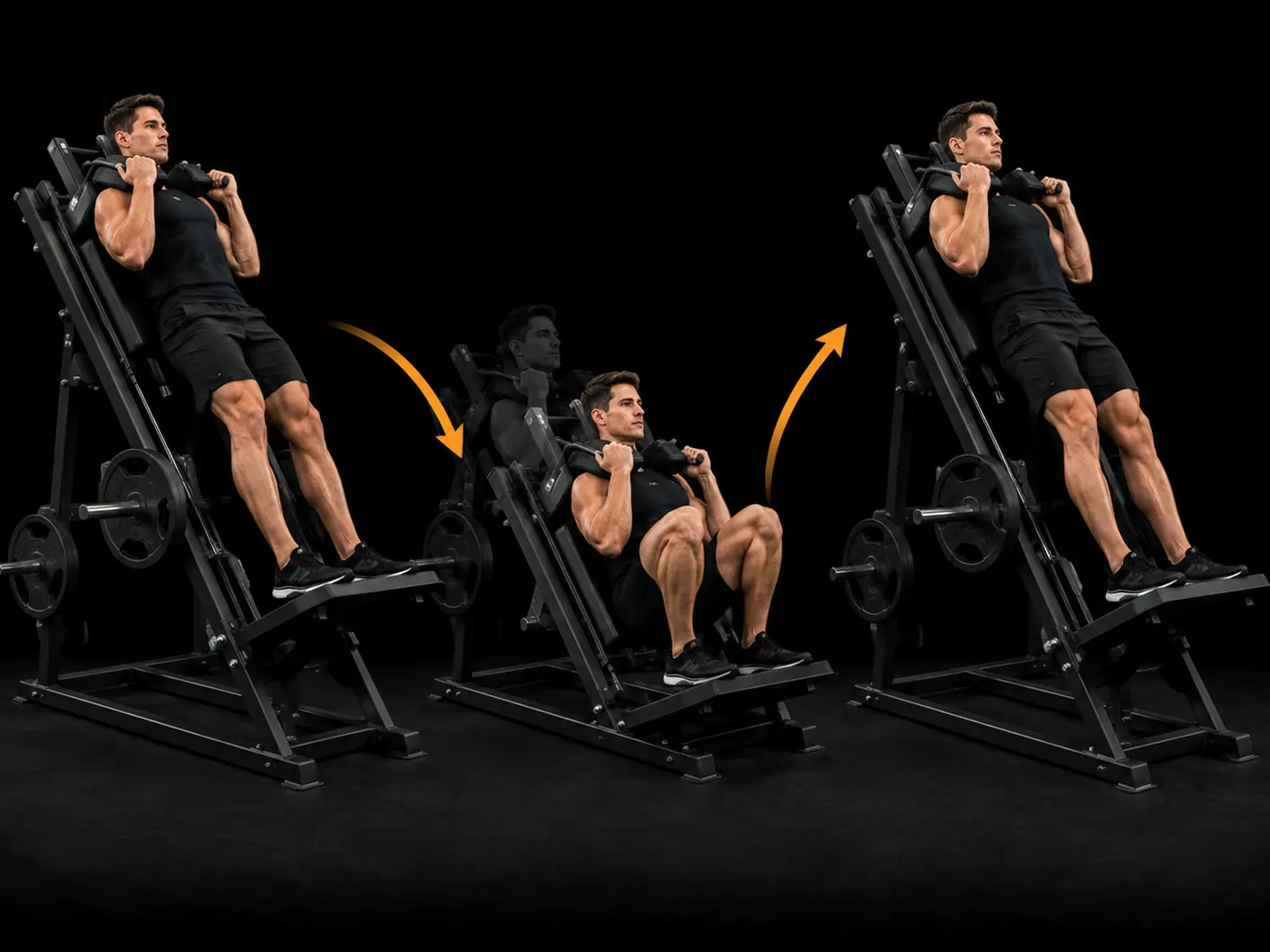
The hack squat machine is a plate-loaded or selectorised compound movement that places the body in a fixed inclined plane, allowing a deep, controlled squat pattern with reduced spinal loading compared to a free-bar squat. The guided track isolates the quadriceps — particularly the vastus lateralis, medialis, and intermedius — while the glutes and hamstrings contribute as secondary movers. It suits intermediate lifters looking to build leg mass or strengthen the squat pattern with mechanical consistency.
How to do it
Set shoulders under the pads with the back flat against the platform. Feet shoulder-width, slightly lower on the platform for quad emphasis. Release the handles and descend until the knees track over the toes and thighs pass parallel. Drive the platform up through mid-foot, keeping the lower back pressed into the pad. Stop just short of lockout to maintain tension.
Coaching cues
- Back flat to pad
- Knees track toes
- Stop short of lockout
- Full depth
Why train it
- The fixed track removes the balance demand of a barbell, allowing full attention to depth and quad recruitment without compensatory movement.
- Foot position can be adjusted lower on the platform to shift emphasis further onto the quadriceps, making this a precise hypertrophy tool for the front of the thigh.
- The padded back platform keeps the lumbar spine supported throughout the range of motion, reducing axial load while still demanding significant lower-body strength.
- Stopping just short of lockout at the top maintains constant tension on the quadriceps, maximising time under load across each set.
Common mistakes
- Allowing the lower back to peel away from the pad at the bottom — keep the lumbar spine pressed firmly into the platform throughout the entire descent.
- Letting the knees collapse inward during the drive phase — actively track the knees in line with the toes from the moment you initiate the push.
- Locking out fully at the top of each rep — stop just short of full extension to preserve tension on the quadriceps and protect the knee joint from shear force.
- Using a foot position that is too high on the platform — placing the feet lower shifts load onto the quads, which is the primary intention of this exercise for most programmes.
Primary: Quadriceps.
Secondary: Gluteus Maximus, Hamstrings.
Equipment
Good for
Easier variation
Leg press — removes the stabilisation demand and reduces knee flexion depth.
Similar movements
Frequently asked
- What muscles does the hack squat machine work?
- The primary muscles are the quadriceps — specifically the vastus lateralis, vastus medialis, and vastus intermedius. The glutes and hamstrings act as secondary contributors, particularly during the drive phase out of the bottom position.
- How many sets and reps should I do on the hack squat machine?
- For hypertrophy, three to four sets of eight to twelve reps with a load that makes the final two reps genuinely challenging is a reliable starting point. For strength development, four to five sets of four to six reps at a higher relative load is more appropriate.
- Is the hack squat machine suitable for beginners?
- It is classed as an intermediate movement, largely because correct setup — foot placement, back contact, and depth — requires a degree of body awareness that benefits from prior squatting experience. Beginners would typically develop that foundation through goblet squats or leg press before progressing to this machine.
- What is a good alternative to the hack squat machine?
- The leg press offers a similar guided, low-spinal-load quad stimulus and is the most direct substitute. The Bulgarian split squat or barbell front squat are free-weight alternatives that train a comparable pattern, though they introduce greater balance and stability demands.
- Should I squat to full depth on the hack squat machine?
- Yes — the form guidance calls for the thighs to pass parallel at the bottom, which constitutes full depth on this movement. Stopping short of that reduces the range of motion through which the quadriceps are loaded and limits the stimulus for both strength and hypertrophy.
Want this movement in a plan built for you?
Adaptiv programmes the right exercises for your goal, equipment and experience — then adapts them as you train.
Build my programme