Dumbbell Thruster
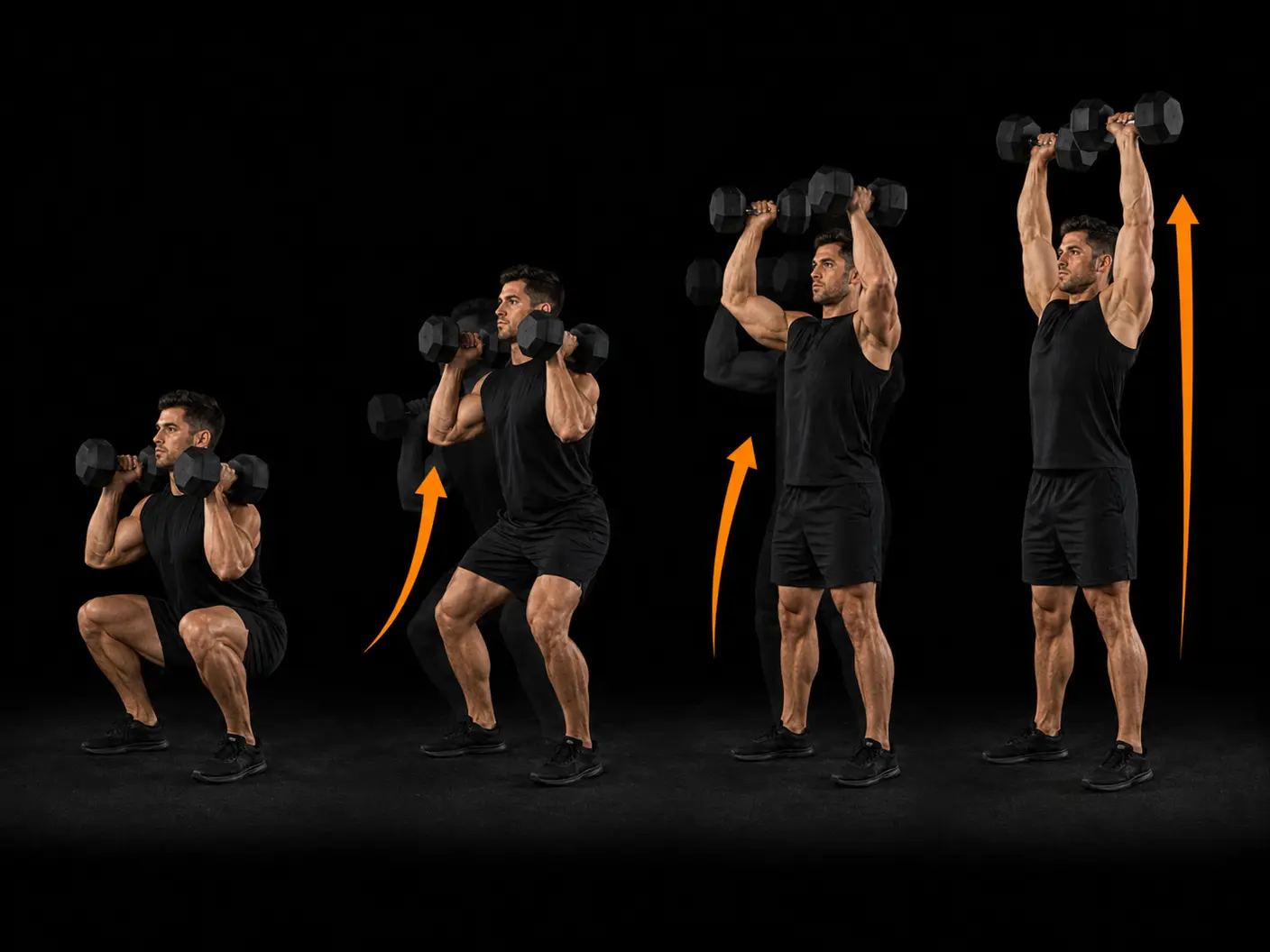
The dumbbell thruster combines a full front squat with an overhead press into a single, continuous movement, making it a compound exercise that trains the squat pattern and upper-body pushing in one fluid chain. By linking the leg drive from the squat directly into the press, the movement demands coordination between the lower and upper body rather than treating them as separate efforts. It suits intermediate trainees who have a solid squat foundation and comfortable overhead pressing mechanics, and is commonly programmed for fat loss, athletic conditioning, and general fitness.
How to do it
Hold dumbbells at the shoulders. Perform a full front squat. As you drive up from the squat, transfer the momentum into a push press — drive the dumbbells overhead at the top. Lower the dumbbells to the shoulders and immediately descend into the next squat.
Coaching cues
- Squat full depth
- Drive from the legs
- Press overhead
- Smooth chain
Why train it
- The thruster taxes the quadriceps, glutes, anterior deltoid, and triceps simultaneously, making it an efficient choice when session time is limited.
- Because the movement demands continuous effort from multiple large muscle groups, it places a significant metabolic demand on the body, supporting energy expenditure goals.
- The requirement to stabilise dumbbells at the shoulders and overhead reinforces core and upper-back engagement across the full range of motion.
- Linking the squat drive directly into the press develops the kind of whole-body power transfer that carries over to athletic movements requiring force from the ground up.
Common mistakes
- Pressing too early — wait until you are fully driving out of the squat before initiating the press, so the leg momentum feeds into the movement rather than the arms working in isolation.
- Cutting the squat short — commit to full depth on every repetition, as a partial squat undermines the lower-body contribution and reduces the exercise to little more than a loaded press.
- Letting the torso fold forward at the bottom — keep the chest tall and elbows high throughout the squat phase to maintain control of the dumbbells at the shoulders.
- Losing control on the descent — lower the dumbbells with intent back to the shoulders and move smoothly into the next squat rather than dropping the weights and disrupting the chain.
Primary: Quadriceps, Gluteus Maximus, Anterior Deltoid, Triceps Brachii.
Secondary: Rectus Abdominis, Rhomboids, Gastrocnemius.
Equipment
Good for
Easier variation
Squat press at slower tempo — separate the movements.
Similar movements
Frequently asked
- What muscles does the dumbbell thruster work?
- The primary muscles are the quadriceps, glutes, anterior deltoid, and triceps. The core, upper back, and calves contribute as secondary stabilisers throughout the movement.
- How many sets and reps should I do for the dumbbell thruster?
- For conditioning and fat loss, sets of 8–15 repetitions work well, often within a circuit or interval format. For general fitness and strength-endurance, 3–4 sets of 10–12 reps with a moderate load and controlled rest periods is a practical starting point.
- What is the difference between a dumbbell thruster and a barbell thruster?
- The mechanics are the same, but dumbbells require each side to work independently, which places greater demand on shoulder stability and can expose asymmetries between sides. Dumbbells are also easier to set up and are a practical alternative when a barbell rack is unavailable.
- Is the dumbbell thruster suitable for beginners?
- The movement is classed as intermediate because it requires competence in both the front squat and the overhead press before combining them under fatigue. Beginners are better served building those two patterns separately before progressing to the thruster.
- Can I use the dumbbell thruster for fat loss?
- It is well-suited to fat loss programming because it engages multiple large muscle groups continuously, creating a high metabolic demand relative to the time spent. Pairing it with short rest periods or including it in circuit-style sessions tends to amplify that effect.
Want this movement in a plan built for you?
Adaptiv programmes the right exercises for your goal, equipment and experience — then adapts them as you train.
Build my programme