Dumbbell Standing Overhead Press
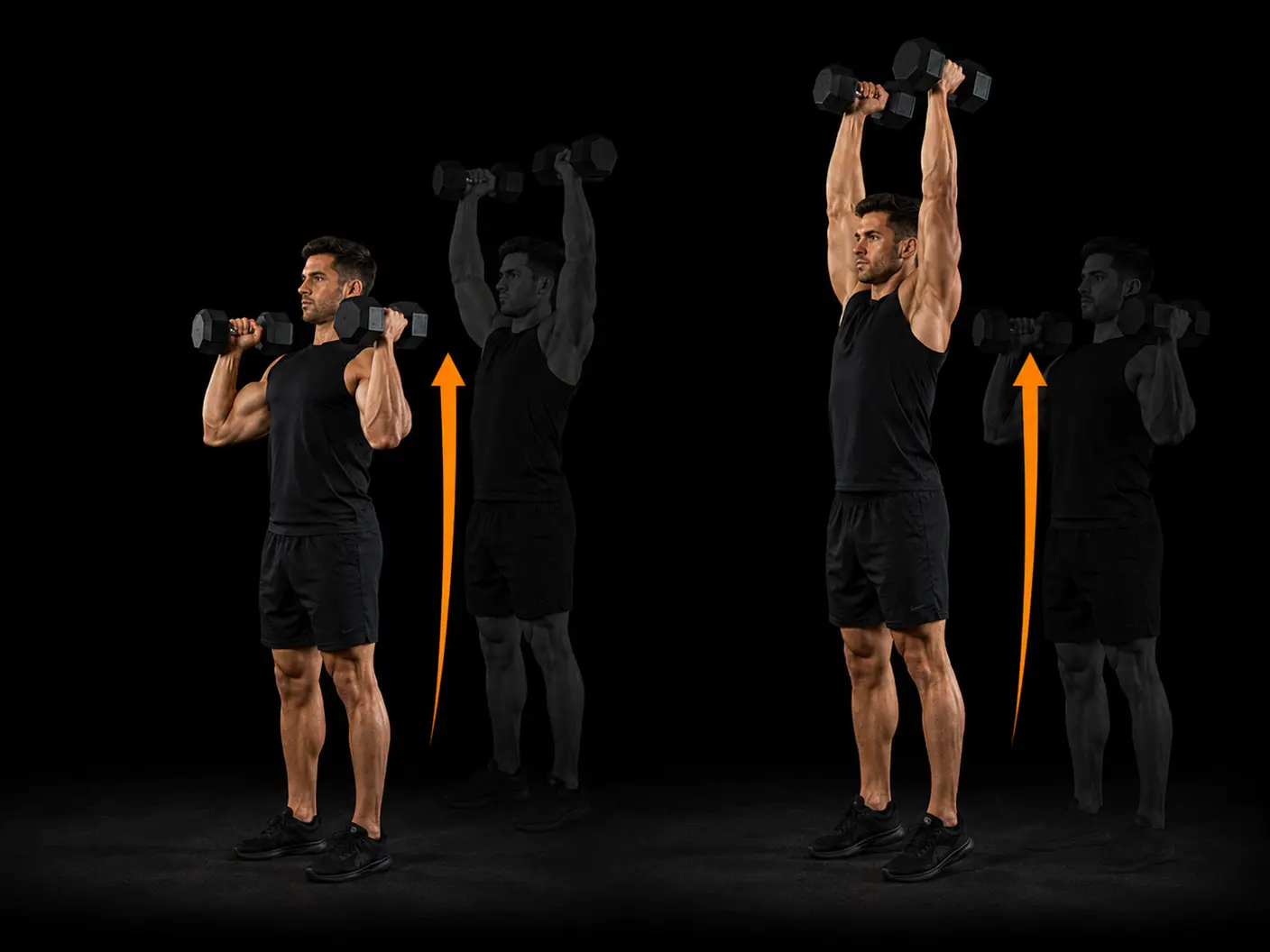
The dumbbell standing overhead press is a compound vertical pushing movement that develops shoulder and triceps strength through a full, loaded range of motion above the head. Because each arm works independently, the exercise also challenges the core and stabilising musculature to a greater degree than its barbell equivalent. It suits intermediate lifters looking to build pressing strength, upper-body mass, or a well-rounded fitness base.
How to do it
Stand with feet shoulder-width, core braced. Hold dumbbells at shoulder height, palms facing forward (or slightly inward). Press the dumbbells overhead until the arms are fully extended — do not allow the elbows to fully lock aggressively. Lower the dumbbells under control to the starting position. Maintain a neutral lower back — do not lean back to compensate.
Coaching cues
- Core tight
- Press in a straight line
- Full lockout
- Control the descent
Why train it
- Training each arm independently exposes and corrects left-to-right strength imbalances that a barbell can mask.
- The standing position demands continuous core and trunk stabilisation, making it a more demanding total-body exercise than a seated variation.
- The anterior and lateral deltoids are loaded through a mechanically challenging overhead range, which supports shoulder hypertrophy and pressing strength simultaneously.
- It transfers well to general fitness goals by reinforcing the ability to move and control load overhead — a pattern relevant to both sport and everyday function.
Common mistakes
- Leaning back through the lower spine to get the weight up — brace the core hard before the press begins and keep the ribcage down throughout the movement.
- Pressing the dumbbells in an arc outward rather than a straight vertical path — focus on driving the weight directly overhead so the dumbbells finish above the shoulders, not behind them.
- Losing tension at the top by passively hanging in the lockout — achieve full elbow extension with control rather than dumping the load into the joints.
- Rushing the descent — lower the dumbbells under deliberate control back to shoulder height to maintain tension on the working muscles and protect the shoulder joint.
Primary: Anterior Deltoid, Lateral Deltoid, Triceps Brachii.
Secondary: Trapezius, Serratus Anterior, Rectus Abdominis.
Equipment
Good for
Easier variation
Seated dumbbell shoulder press — removes the core stability demand and reduces load requirements.
Similar movements
Frequently asked
- What muscles does the dumbbell standing overhead press work?
- The primary muscles are the anterior and lateral deltoids along with the triceps. The upper trapezius, serratus anterior, and core musculature work as secondary stabilisers throughout the movement.
- How many sets and reps should I do for the dumbbell standing overhead press?
- For hypertrophy, three to four sets of eight to twelve repetitions with a moderate load works well. For strength development, three to five sets of four to six repetitions at a heavier load is more appropriate, provided technique remains sound.
- Is the dumbbell standing overhead press suitable for beginners?
- It is classified as an intermediate movement, primarily because the standing position requires meaningful core stability and shoulder control under load. Beginners may benefit from starting with the seated dumbbell overhead press to establish the pressing pattern before progressing to the standing version.
- What is a good alternative to the dumbbell standing overhead press?
- The barbell overhead press trains the same vertical pushing pattern and allows heavier loading, though it removes the independent arm requirement. The seated dumbbell overhead press is a useful regression if core stability or balance is limiting the standing variation.
- Should I use a neutral grip or a pronated grip for this exercise?
- Either is appropriate. A pronated grip with palms facing forward is the conventional position, while a neutral or slightly inward-facing grip can feel more comfortable on the shoulders for some lifters. Choose the grip that allows you to maintain the described pressing path and neutral lower back throughout.
Want this movement in a plan built for you?
Adaptiv programmes the right exercises for your goal, equipment and experience — then adapts them as you train.
Build my programme