Sandbag Bear Hug Carry
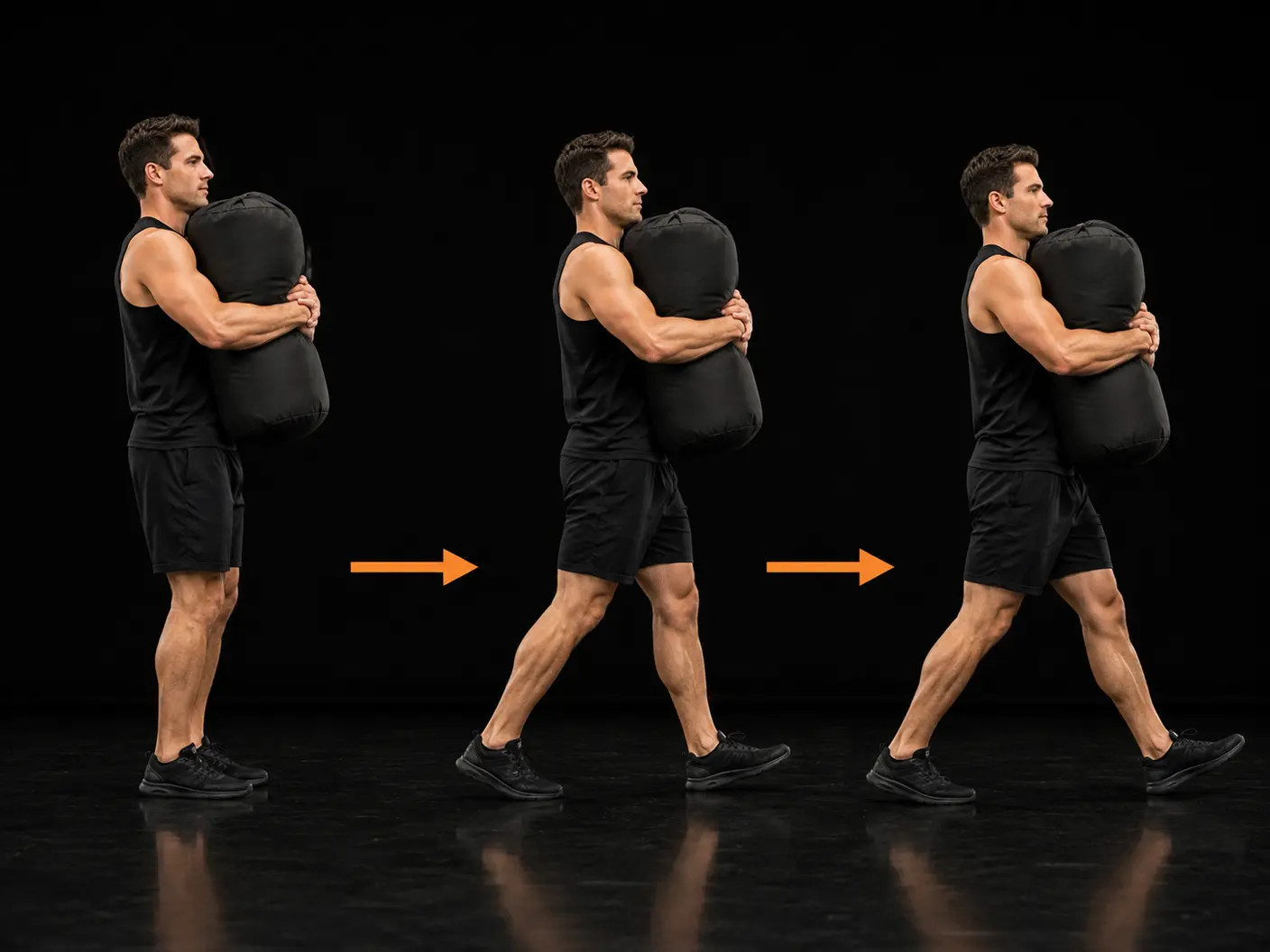
The sandbag bear hug carry is a loaded locomotion exercise in which you cradle a sandbag against your chest and walk for a set distance or time. It trains the carry movement pattern, demanding simultaneous bracing from the core, upper back, glutes, and quads to keep the body upright under an unstable, shifting load. It suits intermediate trainees looking to build functional strength and athletic durability that transfers beyond the gym.
How to do it
Bear hug a sandbag at the chest. Stand tall with a braced core. Walk for distance or time. Keep the sandbag from drifting down — aggressive upper-back squeeze.
Coaching cues
- Hug tight
- Tall torso
- Controlled steps
- Breathe steady
Why train it
- The shifting load of a sandbag forces the core and upper back to work continuously throughout the carry, developing anti-extension and postural endurance that a barbell cannot replicate.
- Carrying under a compressive chest load trains the glutes and quads to produce powerful, controlled steps, making it a practical tool for athletic performance and general movement quality.
- Because the implement is held in a bear hug rather than gripped, the forearms and shoulders accumulate meaningful volume as stabilisers without the grip fatigue that limits other loaded carries.
- The exercise is easily scaled by adjusting sandbag weight, distance, or rest intervals, making it a versatile addition to strength, conditioning, or general fitness programmes.
Common mistakes
- Letting the sandbag drift down the torso — maintain an aggressive upper-back squeeze throughout the walk to keep the bag pinned high against the chest.
- Leaning back to counterbalance the load — stand tall with a braced core rather than extending the lower back, which reduces stability and places unnecessary strain on the lumbar spine.
- Taking short, shuffling steps out of tension — use deliberate, controlled strides that keep the hips under the torso and reinforce proper gait mechanics.
- Holding the breath for the duration — breathe steadily throughout the carry to sustain intra-abdominal pressure without creating excessive cardiovascular stress or tension loss.
Primary: Rectus Abdominis, Gluteus Maximus, Quadriceps, Rhomboids.
Secondary: Forearm Flexors, Anterior Deltoid.
Equipment
Good for
Easier variation
Lighter sandbag or shorter distance.
Similar movements
Frequently asked
- What muscles does the sandbag bear hug carry work?
- The primary muscles are the core, glutes, quads, and upper back, which work together to keep the torso upright and drive each step. The forearms and shoulders contribute as secondary stabilisers, working to maintain the bear hug position against the shifting load.
- How many sets and reps should I do for the sandbag bear hug carry?
- This exercise is typically programmed by distance or time rather than reps. A practical starting point is three to four sets of 20–40 metres or 30–45 seconds, with rest periods of 60–90 seconds between sets, adjusted according to your training goal and current capacity.
- What weight sandbag should I use?
- Choose a weight that allows you to maintain a tall torso and steady breathing for the full set without the bag drifting down or your posture collapsing. For most intermediate trainees, a bag between 20 and 40 kg is a reasonable starting range, but the correct load is the one that challenges you without compromising form.
- Is the sandbag bear hug carry a good exercise for athletic performance?
- Yes — the combination of an unstable load, full-body bracing, and locomotion makes it a practical tool for developing the kind of integrated strength and postural control that carries over to sport and physical work. It sits well alongside other compound and carry-based movements in an athletic performance programme.
- What are good alternatives to the sandbag bear hug carry?
- If a sandbag is unavailable, a heavy dumbbell or kettlebell held at the chest in a goblet position offers a similar anterior carry stimulus, though with a more stable load. The farmer's carry is a related carry variation that shifts emphasis toward grip and lateral stability rather than anterior bracing.
Want this movement in a plan built for you?
Adaptiv programmes the right exercises for your goal, equipment and experience — then adapts them as you train.
Build my programme