Dumbbell Waiter Walk
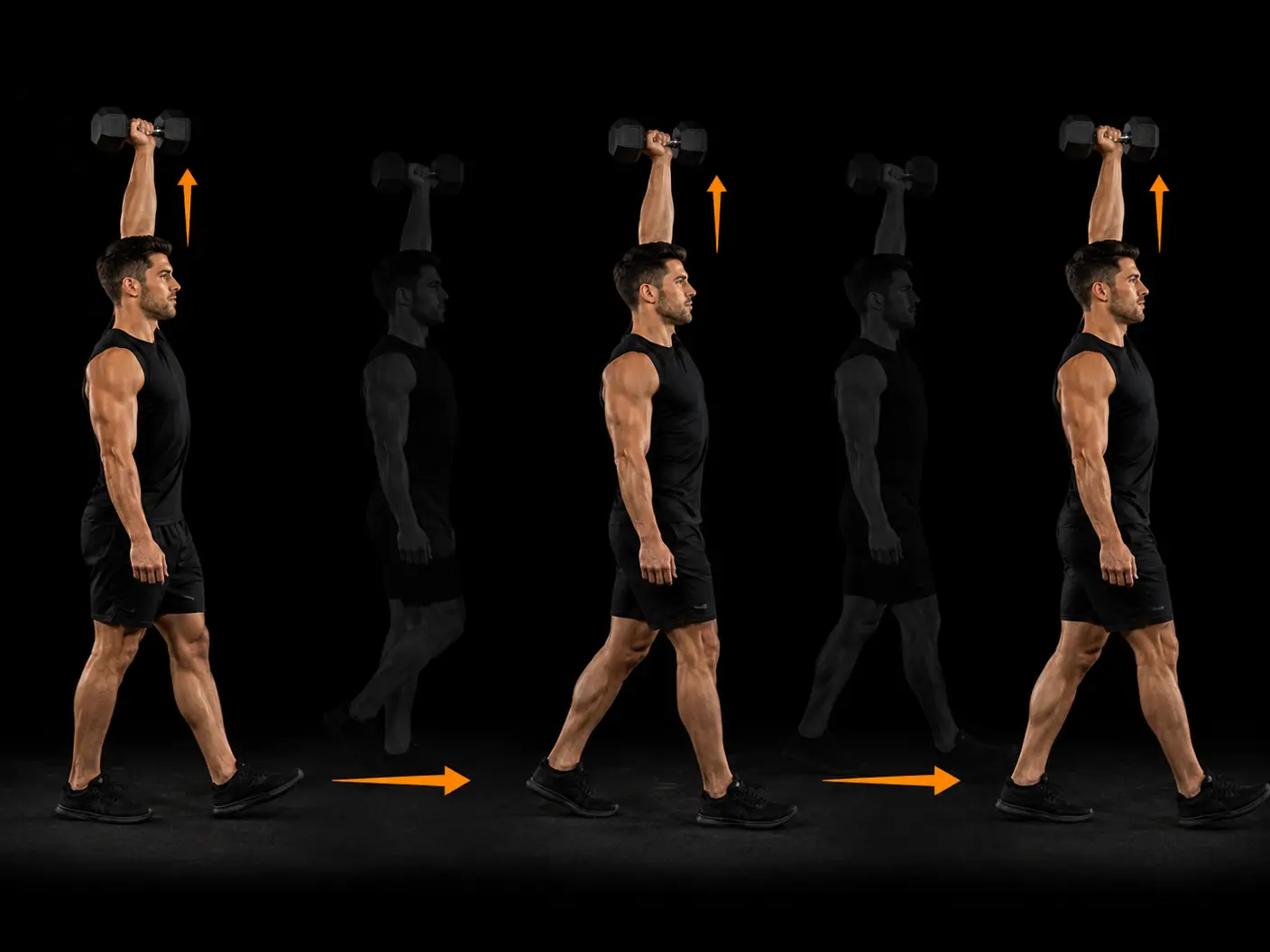
The dumbbell waiter walk is a unilateral overhead carry in which a single dumbbell is pressed to full lockout and held stationary while you walk for a prescribed distance or time. It trains the rotator cuff and deltoids under sustained load, demanding continuous shoulder stability and anti-lateral-flexion control from the core. It suits intermediate trainees looking to build overhead resilience and is equally relevant in general fitness and athletic performance contexts.
How to do it
Press one dumbbell overhead to full lockout with the arm fully extended. Walk for the prescribed distance or time, maintaining a packed, stable shoulder (not shrugged) and a straight, vertical arm. The free hand can hang at the side or rest lightly on the hip. Resist lateral trunk flexion and keep the torso upright throughout.
Coaching cues
- Full lockout
- Pack the shoulder
- Stay upright
- Look forward
Why train it
- Develops rotator cuff endurance and deltoid stability under real positional demand, reinforcing the overhead position that many pressing movements require.
- Challenges the core's ability to resist lateral trunk flexion, building the kind of structural integrity that transfers directly to sport and daily movement.
- The unilateral loading exposes and addresses side-to-side strength imbalances in both the shoulder complex and the torso.
- Because it combines movement with a held overhead position, it trains shoulder packing and scapular control in a dynamic setting rather than a static one.
Common mistakes
- Shrugging the shoulder towards the ear — actively pack the shoulder by drawing the scapula down and back to create a stable base for the arm overhead.
- Allowing the trunk to lean away from the loaded side — brace the core and keep the torso strictly vertical throughout the walk.
- Losing elbow lockout as fatigue sets in — if the arm begins to bend, reduce the load or the distance until the position can be maintained fully extended.
- Looking down at the floor — keep the gaze forward and the chin level, which supports an upright posture and keeps the whole carry pattern honest.
Primary: Anterior Deltoid, Trapezius, Rectus Abdominis.
Secondary: Forearm Flexors, Triceps Brachii, Rotator Cuff.
Equipment
Good for
Easier variation
Overhead dumbbell hold (standing) — practise the locked-out position before adding locomotion.
Similar movements
Frequently asked
- What muscles does the dumbbell waiter walk work?
- The primary muscles are the rotator cuff and deltoids, which work continuously to stabilise the loaded arm overhead. The core, upper trapezius, and triceps contribute as secondary stabilisers throughout the movement.
- How many sets and reps should I do for the dumbbell waiter walk?
- Because this is a carry, programme it by distance or time rather than reps — 20 to 40 metres per side, or 20 to 30 seconds per side, for two to four sets is a practical starting point. Rest fully between sets so shoulder position does not degrade.
- What weight should I use for the dumbbell waiter walk?
- Start lighter than you expect to need, as the overhead position magnifies the perceived load quickly. A weight you can press cleanly and hold at full lockout without shrugging or leaning is the correct starting point; increase it only when position is consistently solid.
- Is the dumbbell waiter walk suitable for building shoulder strength?
- It builds shoulder endurance and stability rather than maximal strength in the conventional sense. If raw overhead strength is your primary goal, overhead pressing movements should lead the programme, with the waiter walk used to reinforce positional integrity.
- What are good alternatives to the dumbbell waiter walk?
- The kettlebell waiter walk is a direct alternative that slightly increases the demand on wrist and forearm position due to the implement's shape. The single-arm farmers carry trains similar unilateral and anti-lateral-flexion qualities at the side rather than overhead, and the overhead barbell carry replicates the pattern with bilateral loading.
Want this movement in a plan built for you?
Adaptiv programmes the right exercises for your goal, equipment and experience — then adapts them as you train.
Build my programme