Side Bend
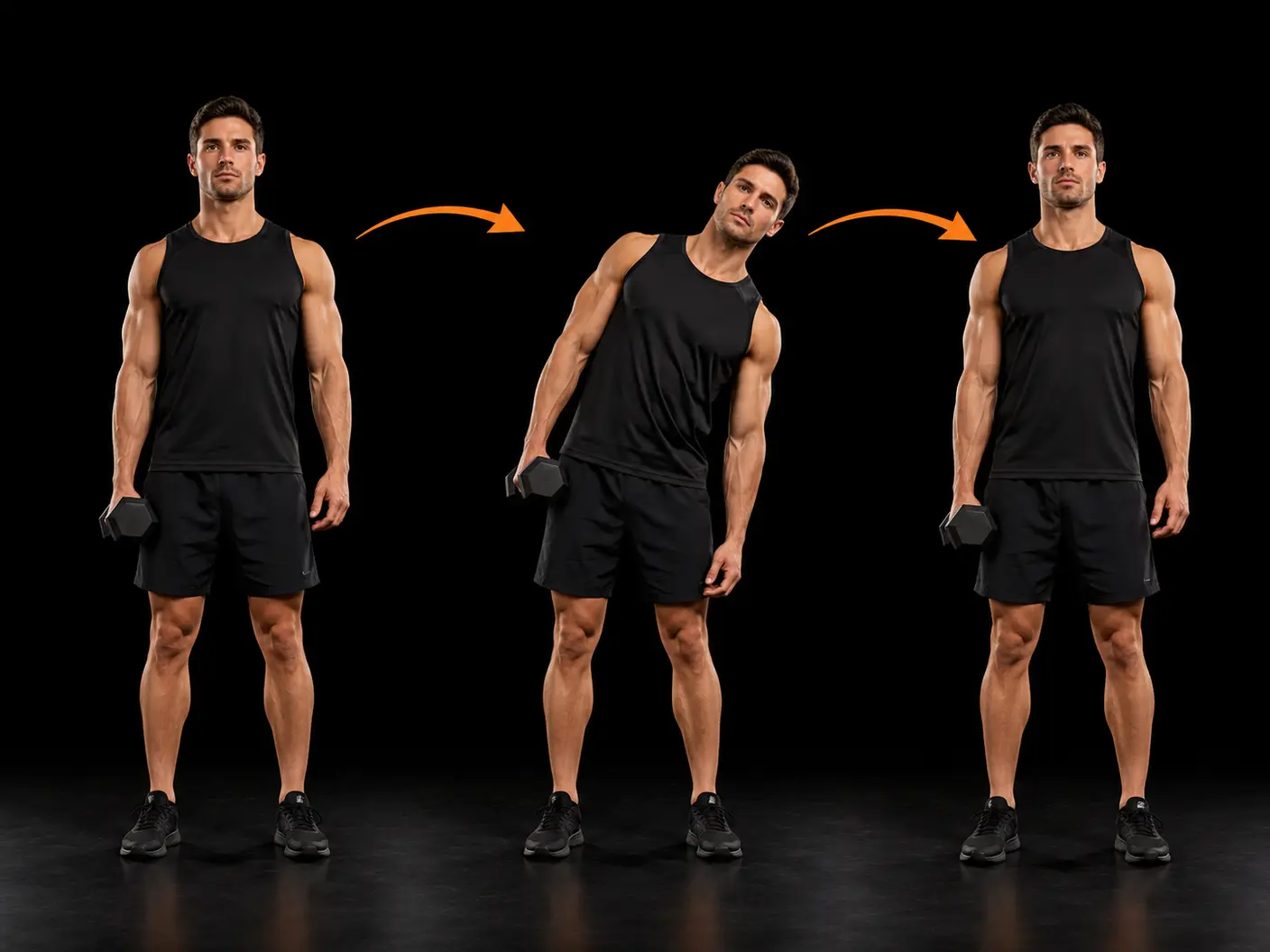
The side bend is a foundational core exercise that trains lateral flexion of the trunk — the ability to bend sideways and resist unwanted side-to-side movement under load. Performed with a dumbbell or cable, it directly targets the obliques and quadratus lumborum, two structures that are often undertrained in programmes dominated by sagittal-plane movements. It suits beginners building core awareness as well as intermediate trainees looking to add direct lateral-chain work to their routine.
How to do it
Stand tall with a dumbbell in one hand at the side. Keep the opposite hand behind the head or on the hip. Laterally flex the trunk, allowing the dumbbell to slide down the thigh. Stop before the spine is compromised. Reverse by contracting the oblique on the opposite side to return to upright. Complete all reps on one side before switching.
Coaching cues
- Slide down the leg
- Keep the torso in one plane
- Return under control
- No rotation
Why train it
- Direct loading of the obliques and quadratus lumborum promotes hypertrophy in muscles that standard pressing and hinging patterns leave largely unstimulated.
- Training controlled lateral flexion builds the lateral stiffness needed to stabilise the spine during carries, overhead work, and unilateral lower-body movements.
- The dumbbell or cable setup requires minimal equipment and is simple to load progressively, making it a practical addition to most training environments.
- Completing all reps on one side before switching encourages equal attention to each side, which can help identify and address asymmetries in lateral trunk strength.
Common mistakes
- Rotating the torso as you bend — keep the chest facing directly forward throughout so the movement stays in the frontal plane and the target muscles do the work.
- Bending too far and compromising the lumbar spine — stop the descent when the oblique on the working side has reached a comfortable end range, not when the lower back begins to buckle.
- Using momentum to swing the weight down — allow the dumbbell to slide down the thigh under control, and return to upright at the same deliberate tempo.
- Letting the non-working arm pull the head or shift the shoulder — keep the free hand lightly on the hip or behind the head without applying force, so it plays no role in generating movement.
Primary: Obliques, Quadratus Lumborum.
Secondary: Erector Spinae, Transverse Abdominis.
Equipment
Good for
Easier variation
Bodyweight side bend — same pattern without load.
Similar movements
Frequently asked
- What muscles does the side bend work?
- The primary muscles are the obliques and the quadratus lumborum, which sit deep in the lateral lower back. The erector spinae and transverse abdominis contribute as secondary stabilisers throughout the movement.
- How many sets and reps should I do for side bends?
- For hypertrophy, 3–4 sets of 10–15 reps per side with a load that makes the final two or three reps genuinely challenging is a sound starting point. For general fitness and core endurance, slightly lighter loads across 12–20 reps per side work well.
- Is a cable better than a dumbbell for side bends?
- A cable provides a more consistent line of resistance throughout the range of motion, which can increase time under tension for the obliques. A dumbbell is more accessible and still highly effective; the choice comes down to what equipment is available and personal preference.
- Can I do side bends every session?
- The lateral trunk muscles recover reasonably quickly, but 2–3 sessions per week with adequate rest between them is sufficient to drive adaptation without accumulating unnecessary fatigue. If you are training the obliques through other means — such as carries or rotational work — factor that volume in before adding more direct work.
- What are good alternatives to the side bend?
- Exercises that train the same anti-lateral flexion pattern include the suitcase carry, where you resist lateral lean while walking with a load in one hand, and the cable Pallof press in a kneeling lateral position. These challenge the lateral trunk in a more dynamic, anti-flexion context rather than through direct loaded flexion.
Want this movement in a plan built for you?
Adaptiv programmes the right exercises for your goal, equipment and experience — then adapts them as you train.
Build my programme