Open Book Stretch
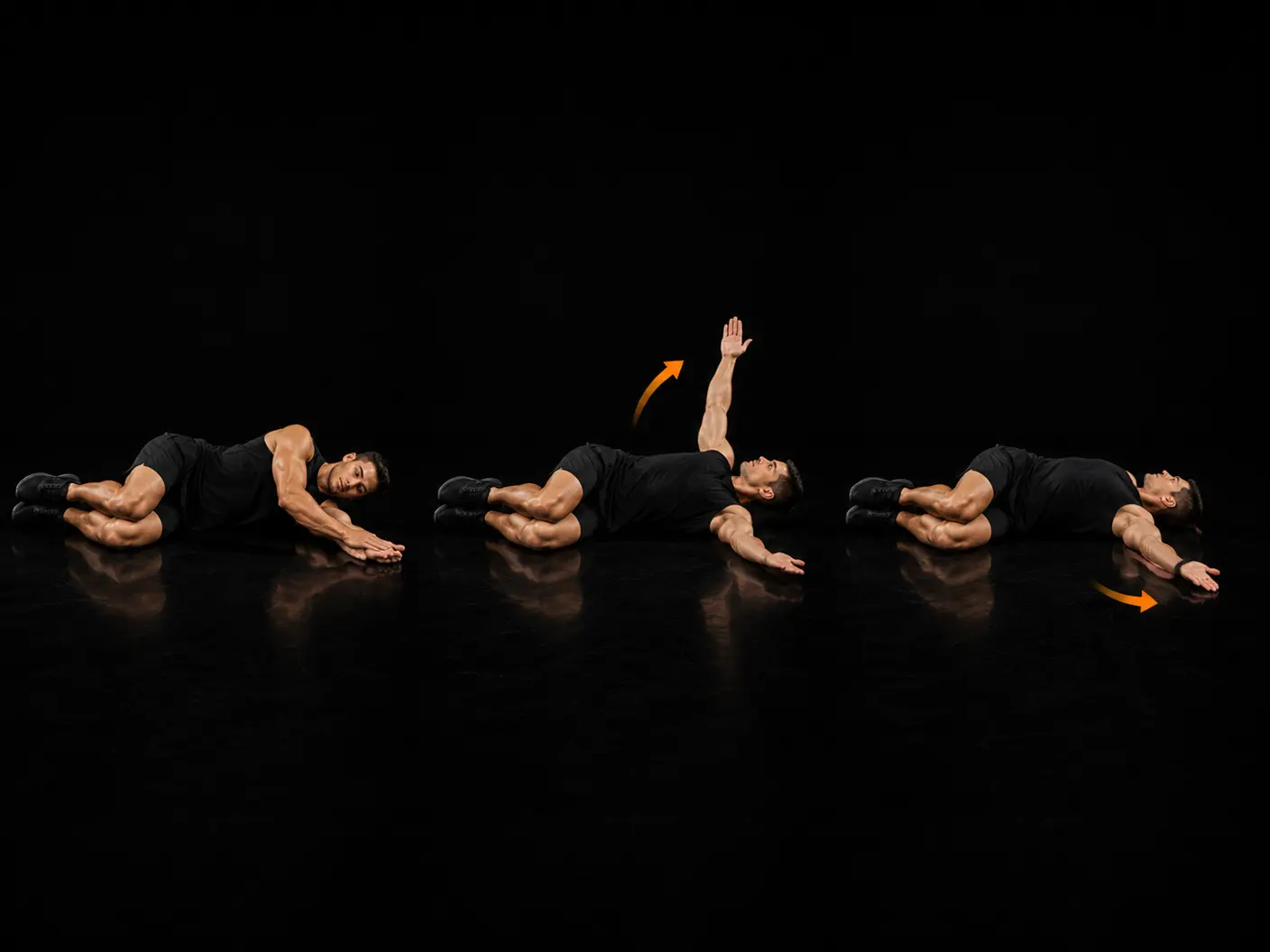
The open book stretch is a side-lying mobility drill that targets rotation through the thoracic spine, with the obliques working to control the movement and the shoulders following passively through range. Performed with bodyweight alone, it trains the upper back's capacity to rotate while the hips remain relatively fixed — a pairing that is often restricted in people who spend long periods seated. It suits all training ages and fits naturally into warm-up, cool-down, or standalone mobility work.
How to do it
Lie on your side, knees bent at 90° stacked, arms extended in front at shoulder height (palms together). Lift the top arm and rotate the torso open, reaching the arm toward the floor on the opposite side. Keep the knees stacked. Pause; return. Alternate sides after the set.
Coaching cues
- Knees stacked
- Rotate through the thoracic
- Reach across
- Breathe
Why train it
- Improving thoracic rotation directly supports performance in movements that require trunk rotation, such as pressing, rowing, and rotational sport patterns.
- Keeping the knees stacked throughout isolates the thoracic segment, reducing the tendency to compensate with lumbar movement and building cleaner segmental control.
- The breathing cue — exhaling as you open — encourages the ribcage to release, which can meaningfully increase the range achieved over successive reps.
- As an equipment-free drill, it is straightforward to programme as daily maintenance work without requiring gym access or a warm-up period of its own.
Common mistakes
- Letting the hips rotate with the torso — keep the knees firmly stacked throughout to isolate the thoracic spine rather than allowing the lumbar region to compensate.
- Rushing through the rotation — pause at end range and use a full exhale to allow the chest to open further before returning.
- Reaching with the arm before the thoracic spine has moved — initiate the rotation from the upper back first, with the arm following as a result of that movement.
- Craning the neck to follow the hand — keep the head relaxed and allow the gaze to follow the rotation naturally rather than straining the cervical spine.
Primary: Obliques.
Secondary: Anterior Deltoid.
Equipment
Good for
Easier variation
Smaller rotation range.
Similar movements
Frequently asked
- What muscles does the open book stretch work?
- The primary targets are the thoracic spine and obliques, with the shoulders acting as a secondary area as the top arm sweeps across and reaches toward the floor.
- How many sets and reps should I do for the open book stretch?
- Two to three sets of eight to ten controlled repetitions per side is a practical starting point for most people. Prioritise range and a deliberate pause at end range over volume.
- When should I include the open book stretch in my session?
- It works well at the start of a session as part of a thoracic warm-up, particularly before pressing or pulling work, and is equally useful in a cool-down or as standalone daily mobility work.
- Is the open book stretch suitable for beginners?
- Yes — it is rated as a foundational movement, requires no equipment, and the side-lying position makes it accessible regardless of current mobility levels. Beginners should focus on breathing and control rather than maximising range immediately.
- What are good alternatives to the open book stretch?
- Other side-lying or quadruped thoracic rotation drills address a similar pattern. If you are unsure which variation best suits your current limitations or goals, a qualified coach can help you select an appropriate progression.
Want this movement in a plan built for you?
Adaptiv programmes the right exercises for your goal, equipment and experience — then adapts them as you train.
Build my programme