Thread the Needle
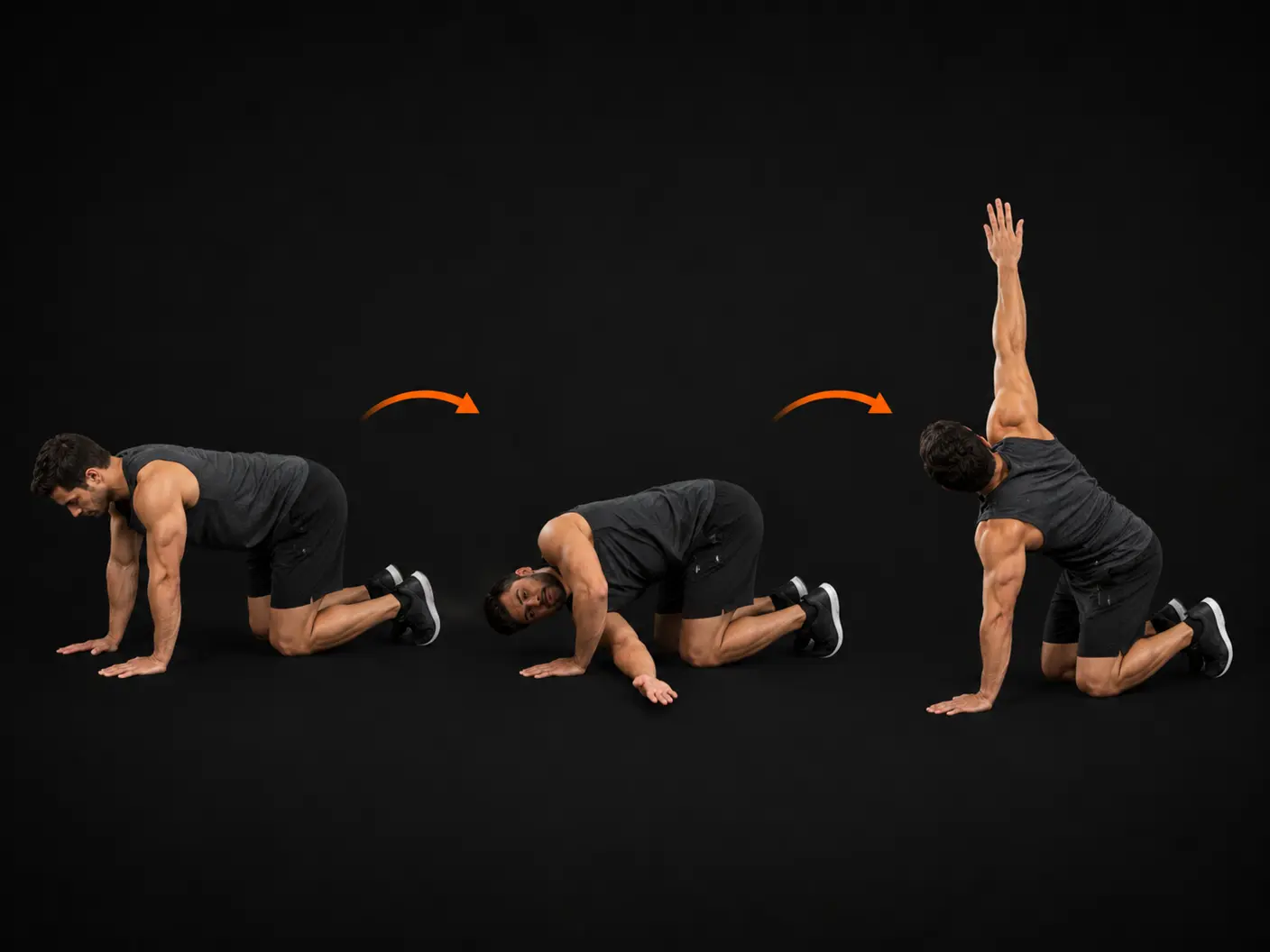
Thread the needle is a bodyweight mobility drill performed on all fours, targeting rotation through the thoracic spine. By reaching one arm beneath the body and lowering the same-side shoulder toward the floor, it systematically opens the mid and upper back through a controlled rotational pattern. It suits a broad range of trainees — from beginners establishing baseline spinal mobility to more experienced lifters using it as a warm-up or recovery tool.
How to do it
Start on all fours. Reach one arm under the opposite shoulder, palm up. Lower the same-side shoulder toward the floor, letting the head rest. Pause at end range; breathe. Return; alternate.
Coaching cues
- Reach under and through
- Drop the shoulder
- Breathe into the stretch
- Controlled
Why train it
- Develops rotational mobility through the thoracic spine, a region that commonly becomes stiff from prolonged sitting or repetitive forward-loaded training.
- The supported, quadruped position allows the shoulder and rhomboids to release passively, making it accessible even when active mobility is limited.
- Breathing into the end-range stretch encourages genuine tissue lengthening rather than superficial movement, improving the quality of the rotation over time.
- Its low load and foundational difficulty make it a reliable choice for warm-up sequences, cool-downs, or active recovery sessions.
Common mistakes
- Rushing through the movement — pause at end range and use each exhale to settle deeper into the rotation rather than simply cycling through repetitions.
- Rotating from the lower back rather than the thoracic spine — keep the hips level and squared so the movement is generated above the lumbar region.
- Keeping the palm face-down as the arm threads under — turn the palm upward to allow the shoulder to drop closer to the floor and achieve fuller rotation.
- Holding the breath through the stretch — breathe deliberately into the chest and upper back to help the tissues relax and increase available range.
Secondary: Anterior Deltoid, Rhomboids.
Equipment
Good for
Easier variation
Easier quadruped rotation — less depth.
Similar movements
Frequently asked
- What muscles does thread the needle work?
- The primary target is the thoracic spine, with the movement demanding controlled rotation through the mid and upper back. The shoulders and rhomboids act as secondary muscles, releasing and lengthening as the arm threads beneath the body.
- How many sets and reps should I do for thread the needle?
- Two to three sets of five to eight slow repetitions per side is a practical starting point for most trainees. Prioritise time spent at end range over total repetitions — a two-to-three second pause at the bottom of each rep is more productive than cycling through quickly.
- When should I include thread the needle in a session?
- It works well at the start of a session to prepare the thoracic spine and shoulders before pressing, pulling, or overhead work. It can also be used during cool-downs or on active recovery days to maintain mobility without adding meaningful load to the body.
- Is thread the needle suitable for beginners?
- Yes — it is classified as a foundational movement and requires no equipment beyond a comfortable surface. The quadruped position provides stability, making it approachable for trainees who are new to deliberate mobility work.
- What are good alternatives to thread the needle?
- Other bodyweight drills that address thoracic rotation and shoulder mobility can serve a similar purpose, such as open books or seated thoracic rotations. If you have any existing shoulder or spinal concerns, consult a qualified professional before substituting or progressing movements.
Want this movement in a plan built for you?
Adaptiv programmes the right exercises for your goal, equipment and experience — then adapts them as you train.
Build my programme