Cat-Cow
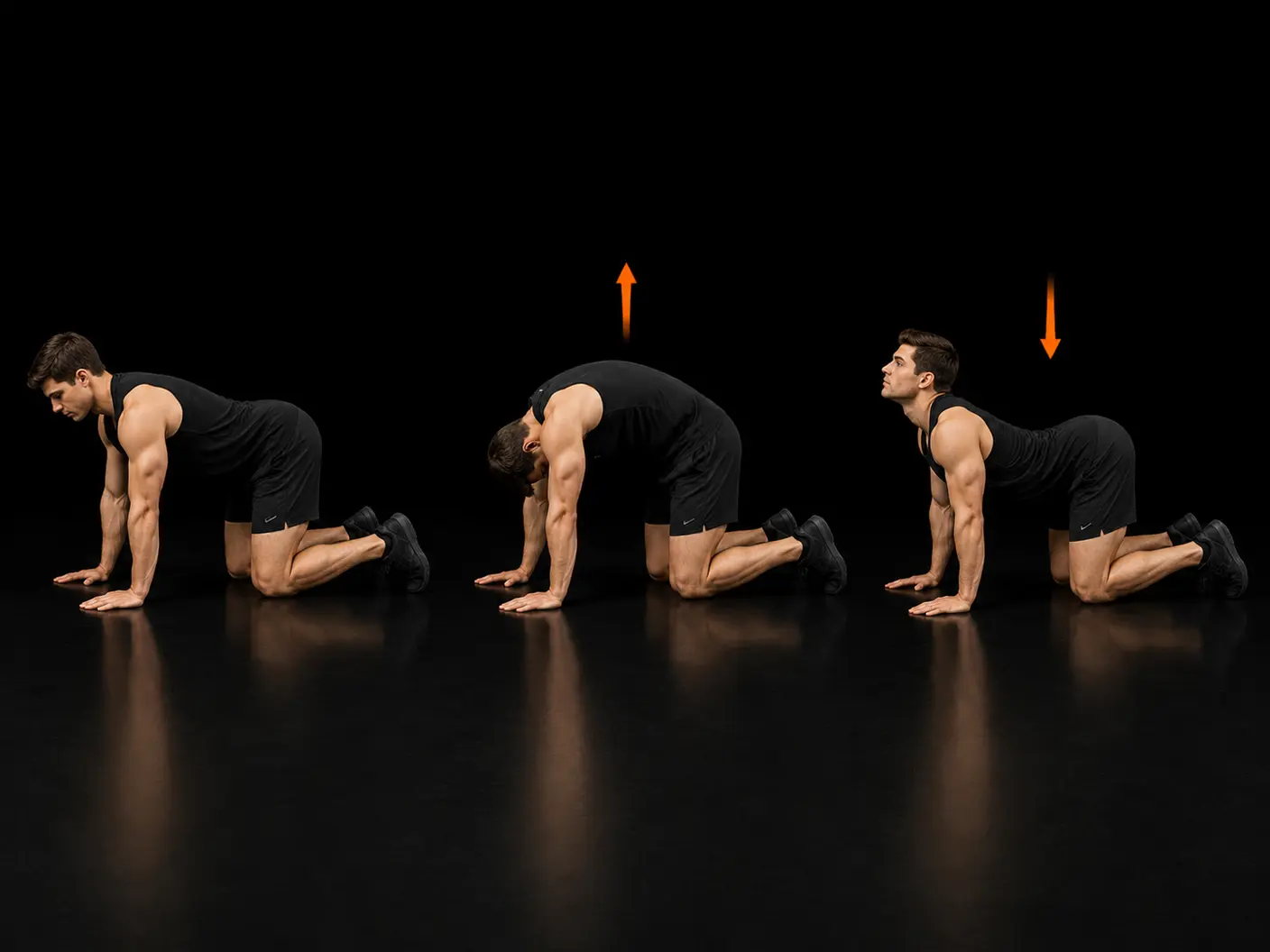
Cat-Cow is a foundational spinal mobility drill performed on all fours, cycling the spine through full flexion and extension with each breath cycle. It trains segmental movement through the vertebral column, coordinating the spinal erectors and rectus abdominis in a controlled, alternating pattern. It suits beginners, those returning to exercise, and anyone using it as a warm-up or cool-down tool.
How to do it
Start on all fours, hands under shoulders, knees under hips. Cat: round the spine upward, tucking the tailbone and pulling the chin to the chest. Cow: drop the belly, lift the chest and tailbone. Alternate smoothly with the breath.
Coaching cues
- Move with the breath
- Full spinal flexion and extension
- Smooth transitions
- No force
Why train it
- Develops active range of motion through the full length of the spine, reinforcing both flexion and extension in a single continuous drill.
- Encourages breath-movement coordination, helping the lifter learn to use respiration as a timing mechanism for controlled mobility work.
- Requires no equipment and minimal space, making it practical as a daily warm-up, cool-down, or standalone mobility session.
- Engages the spinal erectors and rectus abdominis through their functional ranges, building body awareness of how the trunk moves under no external load.
Common mistakes
- Moving only at the neck and lower back — focus on creating motion through every section of the spine, including the mid-back, for a genuinely segmental wave.
- Rushing the transitions — slow each phase to match the length of your inhale and exhale, allowing the movement to be led by the breath rather than momentum.
- Holding tension through the shoulders — keep the arms straight but relaxed, ensuring the upper body serves as a stable base rather than a point of unnecessary strain.
- Forcing the range beyond what feels comfortable — the cue is smooth and controlled; the movement should be explored rather than pushed to end range aggressively.
Primary: Erector Spinae, Rectus Abdominis.
Secondary: Hip Flexors.
Equipment
Good for
Easier variation
Partial range — just focus on one half.
Similar movements
Frequently asked
- What muscles does Cat-Cow work?
- Cat-Cow primarily works the spinal erectors and rectus abdominis, which control extension and flexion of the spine respectively. The core and hip flexors provide secondary support throughout the movement.
- How many reps and sets should I do for Cat-Cow?
- For general warm-up use, 8 to 12 slow breath-led repetitions is a practical starting point. If using it as a standalone mobility drill, two to three sets works well, with the emphasis on quality of movement rather than volume.
- When is the best time to do Cat-Cow?
- It is commonly used at the start of a session to mobilise the spine before loading, or at the end as a cool-down. It can also be performed independently on rest days as part of a general mobility routine.
- Is Cat-Cow suitable for complete beginners?
- Yes — it is classified as a foundational movement, requires only bodyweight, and places no compressive load on the spine. It is an appropriate starting point for individuals new to structured exercise.
- What are good alternatives or progressions from Cat-Cow?
- Thread-the-needle adds thoracic rotation to complement the flexion and extension pattern established in Cat-Cow. For those looking to load spinal extension further, a bodyweight prone cobra or sphinx position can serve as a natural next step.
Want this movement in a plan built for you?
Adaptiv programmes the right exercises for your goal, equipment and experience — then adapts them as you train.
Build my programme