Child's Pose to Cobra
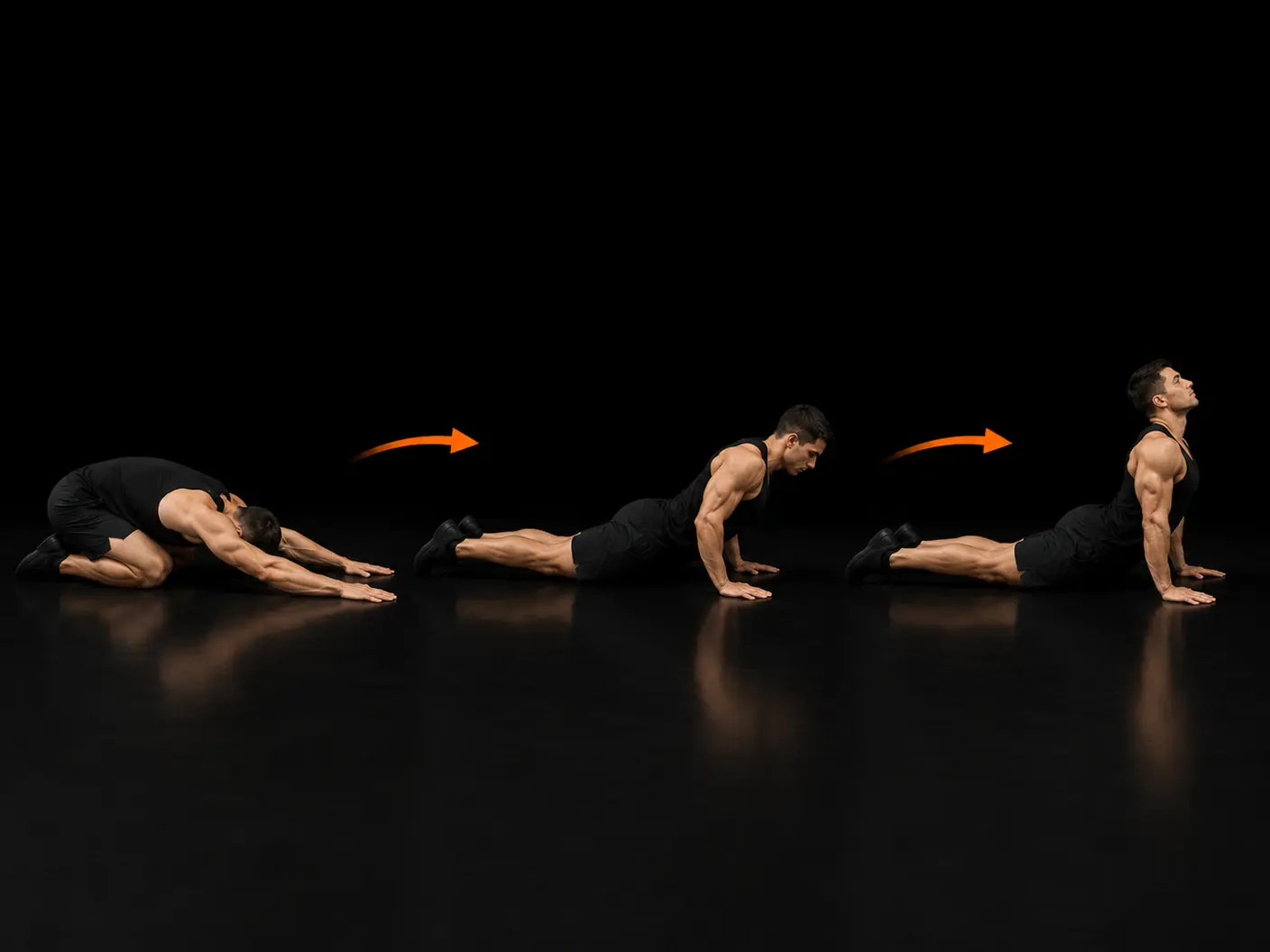
Child's Pose to Cobra is a flowing bodyweight mobility drill that cycles between spinal flexion and extension, making it one of the more accessible ways to address range of motion along the full length of the spine. The movement trains the thoracic and lumbar extensors concentrically as you press into cobra, while the abdominals and hip flexors work eccentrically on the return. It suits beginners, those returning to training, and anyone looking to bookend a session with deliberate spinal movement.
How to do it
Start in child's pose: kneel and sit back onto the heels, arms extended overhead, forehead on the floor. Slide the hands under the shoulders. Press up into cobra by extending the elbows while the hips remain on the floor, lifting the chest and creating a thoracic and lumbar extension. Hold briefly. Return to child's pose and repeat.
Coaching cues
- Reach long in child's pose
- Press through the hands in cobra
- Feel the front-body stretch
- Breathe through
Why train it
- The alternating flexion-extension pattern takes the spine through complementary ranges of motion in a single, low-load drill, making it an efficient addition to a warm-up or cool-down.
- Holding the extended cobra position actively loads the thoracic and lumbar extensors, helping to build baseline capacity in muscles that support posture during loaded movements.
- The child's pose phase provides a sustained stretch through the latissimus dorsi and creates gentle traction along the spine, which can help restore a sense of length before or after training.
- Because no equipment beyond a mat is required and the difficulty is foundational, the exercise is accessible regardless of training age or setting.
Common mistakes
- Shrugging the shoulders towards the ears in cobra — consciously draw the shoulder blades down and back as you press up to keep the neck long and the movement centred in the thoracic spine.
- Pushing the hips off the floor in cobra — the pelvis should remain in contact with the mat throughout the press; if the hips lift, reduce the height of the extension until mobility allows a fuller range.
- Rushing the transition between positions — move deliberately and use the breath to pace each phase, inhaling as you press into cobra and exhaling as you return to child's pose.
- Allowing the hands to drift wide during the press — position the hands directly under the shoulders before moving into cobra so the load is distributed evenly through the wrists and arms.
Primary: Erector Spinae.
Secondary: Hip Flexors, Rectus Abdominis, Latissimus Dorsi.
Equipment
Good for
Easier variation
Cat-cow — smaller thoracic range performed on all fours.
Similar movements
Frequently asked
- What muscles does Child's Pose to Cobra work?
- The primary muscles are the thoracic and lumbar extensors, which contract to lift the chest in cobra. The hip flexors and abdominals work eccentrically as you lower back into child's pose, and the latissimus dorsi is stretched during the child's pose phase.
- How many sets and reps should I do?
- For a warm-up or cool-down context, two to three sets of six to ten slow, controlled repetitions is a practical starting point. Prioritise breath and range of motion over quantity.
- Is this exercise suitable for beginners?
- Yes — it is classified as a foundational movement and requires only a mat and bodyweight. If you have any existing spinal concerns, check with a qualified professional before adding spinal extension drills to your programme.
- When in a session should I use this exercise?
- It works well as part of a pre-training warm-up to prepare the spine for loaded movement, or as a cool-down drill to restore range of motion after a session involving prolonged sitting or heavy posterior-chain work.
- What are good alternatives to Child's Pose to Cobra?
- Cat-Cow is a closely related drill that similarly cycles the spine through flexion and extension and can be used interchangeably depending on preference. A static Sphinx or Cobra hold targets the same lumbar and thoracic extensors if you prefer to work one position at a time.
Want this movement in a plan built for you?
Adaptiv programmes the right exercises for your goal, equipment and experience — then adapts them as you train.
Build my programme