Glute-Ham Raise Back Extension
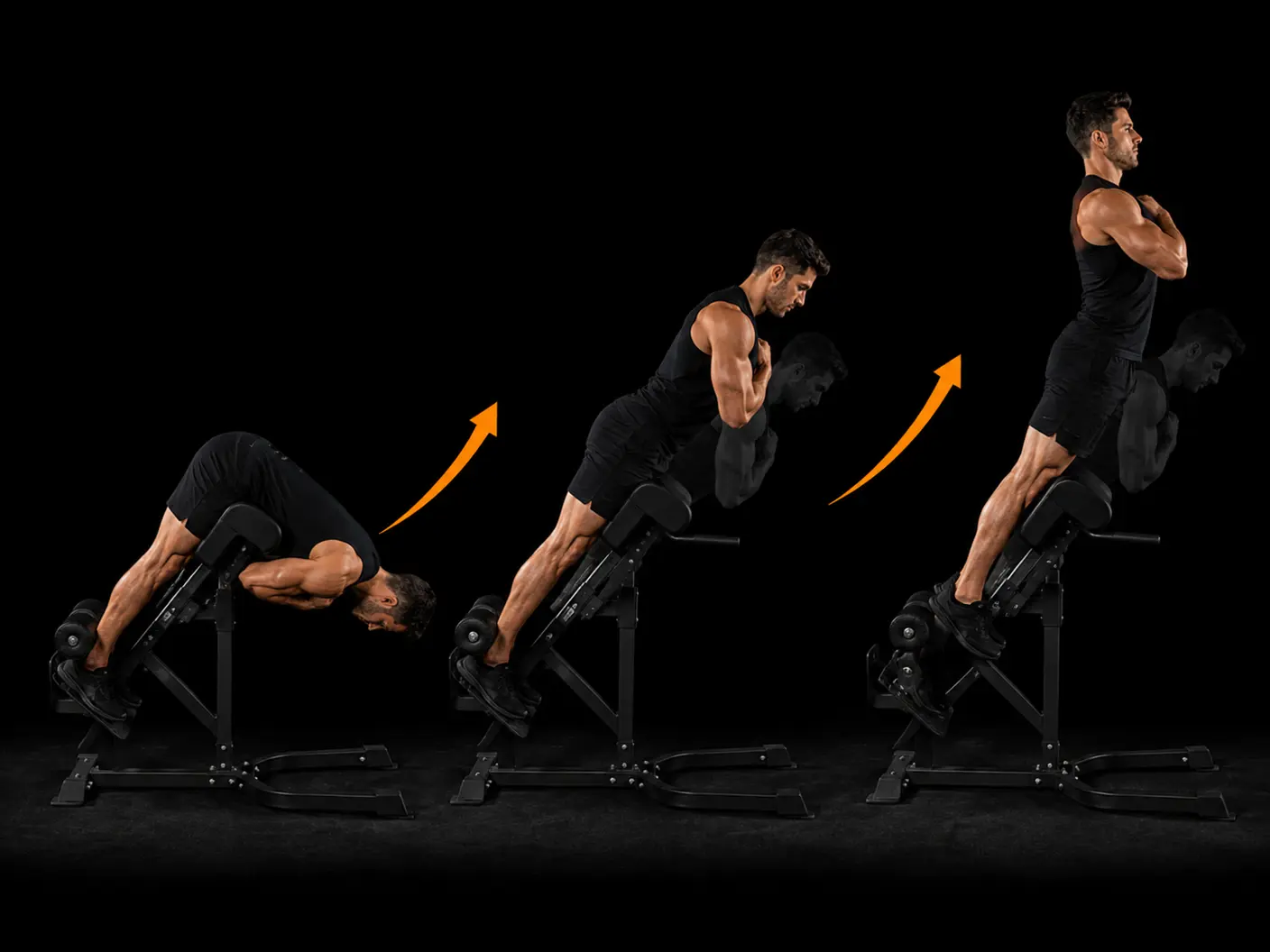
The glute-ham raise back extension is a hip-hinge movement performed on a glute-ham developer (GHD), where the legs remain straight throughout and the torso lowers and rises by hinging at the hips rather than flexing at the knee. It places sustained demand on the erector spinae, glutes, and hamstrings, making it a compound posterior-chain exercise suited to intermediate trainees who have already established sound hinge mechanics. It is a useful addition to hypertrophy and strength programmes where direct posterior-chain volume is a priority.
How to do it
Set up on a GHD. Hook feet. Rather than a knee-flexion GHR, perform a back extension — hinge at the hips with legs held straight, lowering the torso. Drive the hips into the pad to return to horizontal. Do not hyperextend.
Coaching cues
- Hinge from the hips
- Keep the legs straight
- No hyperextension
- Long spine finish
Why train it
- It trains the erector spinae, glutes, and hamstrings simultaneously through a controlled range of motion, making it an efficient compound stimulus for the entire posterior chain.
- The fixed foot position of the GHD allows the hamstrings to work under load at a long muscle length, which is a reliable driver of hypertrophy when progressive overload is applied over time.
- Keeping the legs straight and hinging from the hips reinforces the same movement pattern required in deadlift and Romanian deadlift variations, supporting technical carry-over to those lifts.
- The movement demands sustained engagement of the core as a stabilising unit throughout the rep, contributing secondary training volume without requiring a separate isolation exercise.
Common mistakes
- Bending the knees during the movement — keep the legs straight throughout so the load stays on the hamstrings and posterior chain rather than shifting into a knee-flexion pattern.
- Hyperextending at the top of the rep — finish with a long, neutral spine at horizontal and avoid arching the lower back beyond that position, as the coaching cue is a controlled finish, not a loaded extension.
- Losing spinal alignment on the way down — maintain a long spine from head to tailbone rather than rounding through the lumbar or thoracic segments as fatigue accumulates.
- Using momentum to drive the return — the hips should press deliberately into the pad to initiate the ascent, keeping the movement under muscular control rather than swinging back up.
Primary: Erector Spinae, Gluteus Maximus, Hamstrings.
Secondary: Rectus Abdominis.
Equipment
Good for
Easier variation
45° back extension — simpler setup.
Similar movements
Frequently asked
- What muscles does the glute-ham raise back extension work?
- The primary muscles are the erector spinae, glutes, and hamstrings. The core musculature works as a secondary stabiliser throughout the movement.
- How many sets and reps should I do for the glute-ham raise back extension?
- For hypertrophy, three to four sets of eight to fifteen reps with a controlled tempo is a common and effective range. For strength-focused work, three to five sets of five to eight reps with added load where appropriate will suit most intermediate programmes.
- What is the difference between a glute-ham raise back extension and a standard glute-ham raise?
- A standard glute-ham raise uses knee flexion as the primary movement, working the hamstrings as knee flexors. The back extension variation keeps the legs straight and hinges at the hip instead, shifting the emphasis towards the erector spinae and glutes alongside the hamstrings.
- Is this exercise suitable for beginners?
- It is rated as an intermediate movement because it requires established hip-hinge mechanics and adequate posterior-chain strength to maintain a long spine under load. Beginners would benefit from developing their hinge pattern with less demanding exercises before progressing to GHD variations.
- What are good alternatives if I do not have access to a GHD?
- The Romanian deadlift and the 45-degree back extension bench both train a similar hip-hinge pattern with posterior-chain emphasis and are widely available alternatives. The specific setup and loading mechanics differ, but the fundamental movement demand is comparable.
Want this movement in a plan built for you?
Adaptiv programmes the right exercises for your goal, equipment and experience — then adapts them as you train.
Build my programme