Reverse Hyperextension
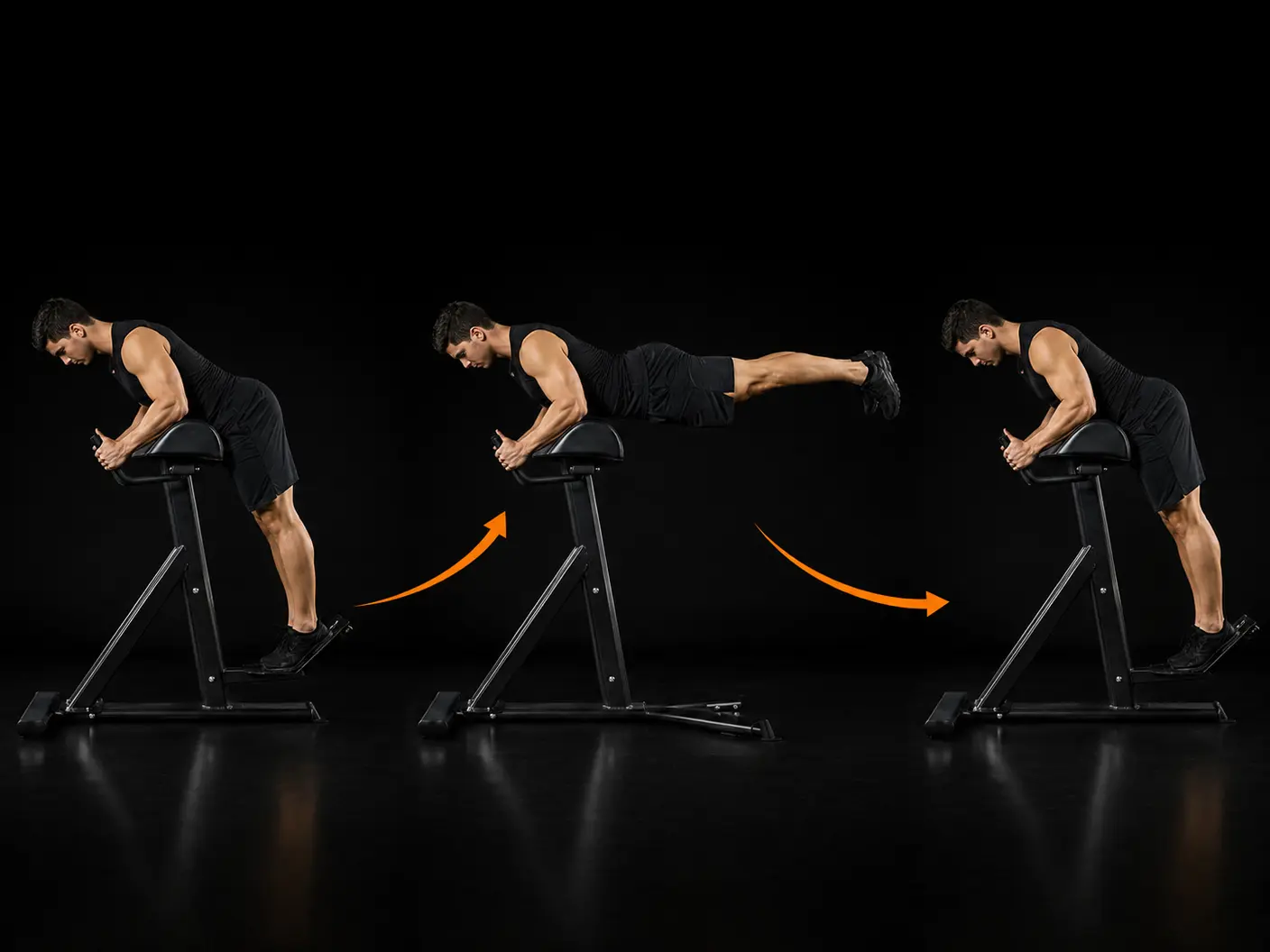
The reverse hyperextension is a prone hinge movement performed on a reverse hyper machine or glute-ham raise apparatus, in which the torso remains fixed while the legs are raised and lowered under load. It trains the posterior chain — glutes, hamstrings, and erector spinae — through a range of motion that is difficult to replicate with conventional hinge patterns. Its foundational classification makes it accessible to a wide range of trainees, from those building an initial base of posterior-chain strength to more advanced lifters using it as a supplementary movement.
How to do it
Lie face-down on the machine, hands gripping the handles. Hook the feet into the strap. Let the legs hang fully. Squeeze the glutes to raise the legs until they are in line with the torso — no hyperextension. Lower under control with a long eccentric.
Coaching cues
- Squeeze glutes
- No lumbar hyperextension
- Long eccentric
- Straight line finish
Why train it
- It develops the glutes, hamstrings, and erector spinae simultaneously, making it an efficient choice for posterior-chain development within a programme.
- The fixed torso position reduces compressive spinal load compared to many loaded hinge alternatives, making it a practical option when managing training volume.
- The emphasis on a controlled eccentric phase places the hamstrings and glutes under prolonged tension, which is a reliable stimulus for hypertrophy.
- It reinforces the motor pattern of hip extension with a neutral spine, a skill that carries over directly to deadlifts, Romanian deadlifts, and other hinge-based lifts.
Common mistakes
- Hyperextending the lumbar spine at the top — stop the movement when the legs reach alignment with the torso, not beyond it.
- Rushing the lowering phase — take a deliberate, slow eccentric to maximise time under tension and maintain control throughout the range.
- Failing to engage the glutes at initiation — focus on squeezing the glutes to drive the movement rather than relying on momentum or lower-back recruitment.
- Allowing the hips to shift or the body to rock — keep the torso pressed firmly into the pad and use the handles to stabilise throughout every repetition.
Primary: Gluteus Maximus, Hamstrings, Erector Spinae.
Secondary: Rectus Abdominis.
Equipment
Good for
Easier variation
Bird-dog or prone hip extension — same pattern without equipment.
Similar movements
Frequently asked
- What muscles does the reverse hyperextension work?
- The primary muscles are the glutes, hamstrings, and erector spinae. The core musculature acts as a secondary stabiliser throughout the movement.
- How many sets and reps should I do for the reverse hyperextension?
- For hypertrophy, three to four sets of ten to fifteen repetitions works well, with particular attention to the eccentric phase. For general fitness and posterior-chain conditioning, two to three sets of twelve to fifteen repetitions at a moderate load is a sensible starting point.
- Can I do the reverse hyperextension without a dedicated machine?
- The movement is designed for a reverse hyper machine or a glute-ham raise unit, both of which allow the legs to hang freely and move through a full range. Improvised set-ups on a flat bench do not replicate the same movement quality and should not be treated as direct substitutes.
- Is the reverse hyperextension suitable for beginners?
- Yes — it is classified as a foundational movement, meaning the mechanics are learnable at an early stage of training. Focus on mastering the range of motion and the glute squeeze before adding load.
- How does the reverse hyperextension differ from a Romanian deadlift?
- In a Romanian deadlift the legs remain relatively fixed while the torso hinges; in the reverse hyperextension the torso is fixed and the legs move. This reversal means spinal compressive forces are lower, and the glutes and hamstrings are challenged from a different angle, making the two movements complementary rather than interchangeable.
Want this movement in a plan built for you?
Adaptiv programmes the right exercises for your goal, equipment and experience — then adapts them as you train.
Build my programme