Glute Bridge
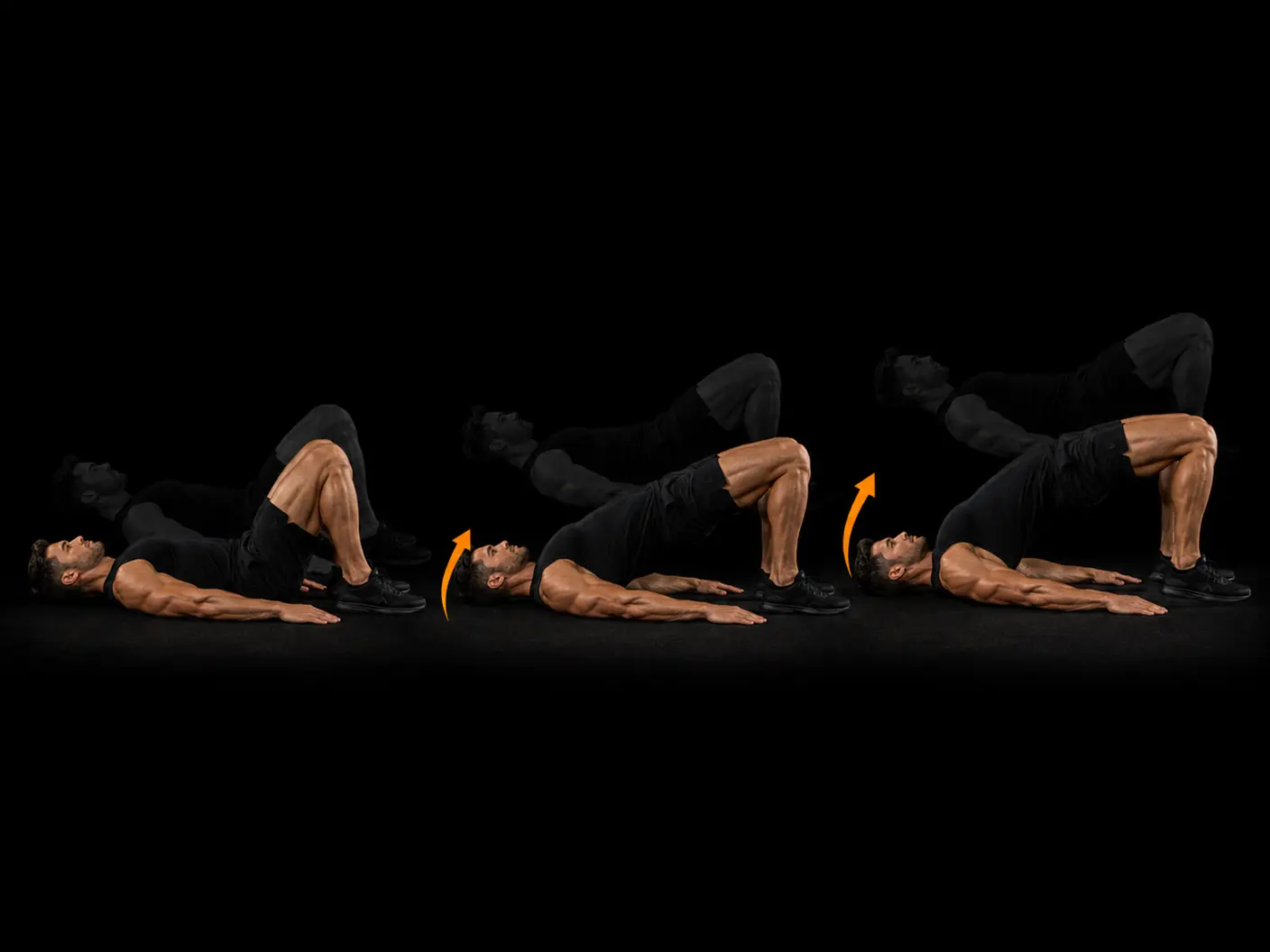
The glute bridge is a supine hinge-pattern exercise performed with bodyweight or a barbell across the hips, driving the pelvis upward from a floor-based position. It trains the posterior chain — primarily the glutes — through a controlled range of hip extension, making it accessible without requiring significant mobility or balance demands. It suits beginners building foundational strength, those reintroducing lower-body training, and more advanced lifters using it as a dedicated glute-loading movement within a hypertrophy programme.
How to do it
Lie on your back, knees bent, heels close to the hips. Arms flat at the sides. Drive through the heels to lift the hips until the torso is flat from shoulders to knees. Squeeze the glutes at the top for 1–2 seconds. Lower under control without letting the lower back collapse.
Coaching cues
- Drive through the heels
- Ribs down
- Squeeze at the top
- Control the descent
Why train it
- It places the glutes under direct load through hip extension, making it one of the more targeted exercises for developing glute strength and size.
- The floor-based position provides stability that allows a lifter to focus entirely on posterior chain engagement without the balance demands of standing hinge variations.
- It scales readily from bodyweight to a barbell, meaning the same movement pattern can serve both early-stage conditioning and progressive overload goals.
- The short setup and low technical barrier make it a practical inclusion in warm-up sequences, accessory blocks, or rehabilitation-adjacent conditioning work.
Common mistakes
- Pushing through the toes rather than the heels — anchor the heels firmly into the floor before driving, which shifts load away from the quads and into the glutes and hamstrings.
- Overextending the lower back at the top — keep the ribs down and think of posteriorly tilting the pelvis so the torso forms a flat line from shoulders to knees, not an arch.
- Failing to pause or squeeze at the top — hold the peak position for one to two seconds with an active glute contraction rather than bouncing through the range of motion.
- Lowering the hips too quickly — control the descent to maintain tension through the posterior chain and avoid the lower back collapsing onto the floor between reps.
Primary: Gluteus Maximus.
Secondary: Hamstrings, Rectus Abdominis.
Equipment
Good for
Easier variation
Feet-elevated glute bridge — shorter range; easier entry.
Similar movements
Frequently asked
- What muscles does the glute bridge work?
- The primary muscle trained is the gluteus maximus, with the hamstrings and core contributing as secondary stabilisers throughout the movement. Driving through the heels and pausing at the top maximises glute involvement.
- How many sets and reps should I do for the glute bridge?
- For general fitness and foundational strength, three sets of ten to fifteen reps with a one-to-two second squeeze at the top is a practical starting point. For hypertrophy, working in the eight-to-fifteen rep range with progressive load — adding a barbell or resistance band — is appropriate.
- What is the difference between a glute bridge and a hip thrust?
- The glute bridge is performed with the upper back flat on the floor, whereas the hip thrust has the upper back elevated on a bench, which increases the range of hip extension. The hip thrust generally allows heavier loading and a greater stretch at the bottom, but the glute bridge is the more accessible starting point for learning the pattern.
- Is the glute bridge suitable for beginners?
- Yes — it is classified as a foundational movement precisely because it requires no significant mobility, balance, or prior training experience. It is a sound starting point for anyone learning to engage the posterior chain before progressing to more demanding hinge variations.
- Can I do the glute bridge if I have lower back discomfort?
- The glute bridge is often used in rehabilitation-adjacent contexts because it loads the glutes without placing the spine under axial compression, but if you are managing a specific lower back condition you should check with a qualified professional before adding any loaded movement to your programme.
Want this movement in a plan built for you?
Adaptiv programmes the right exercises for your goal, equipment and experience — then adapts them as you train.
Build my programme