Barbell Hip Thrust
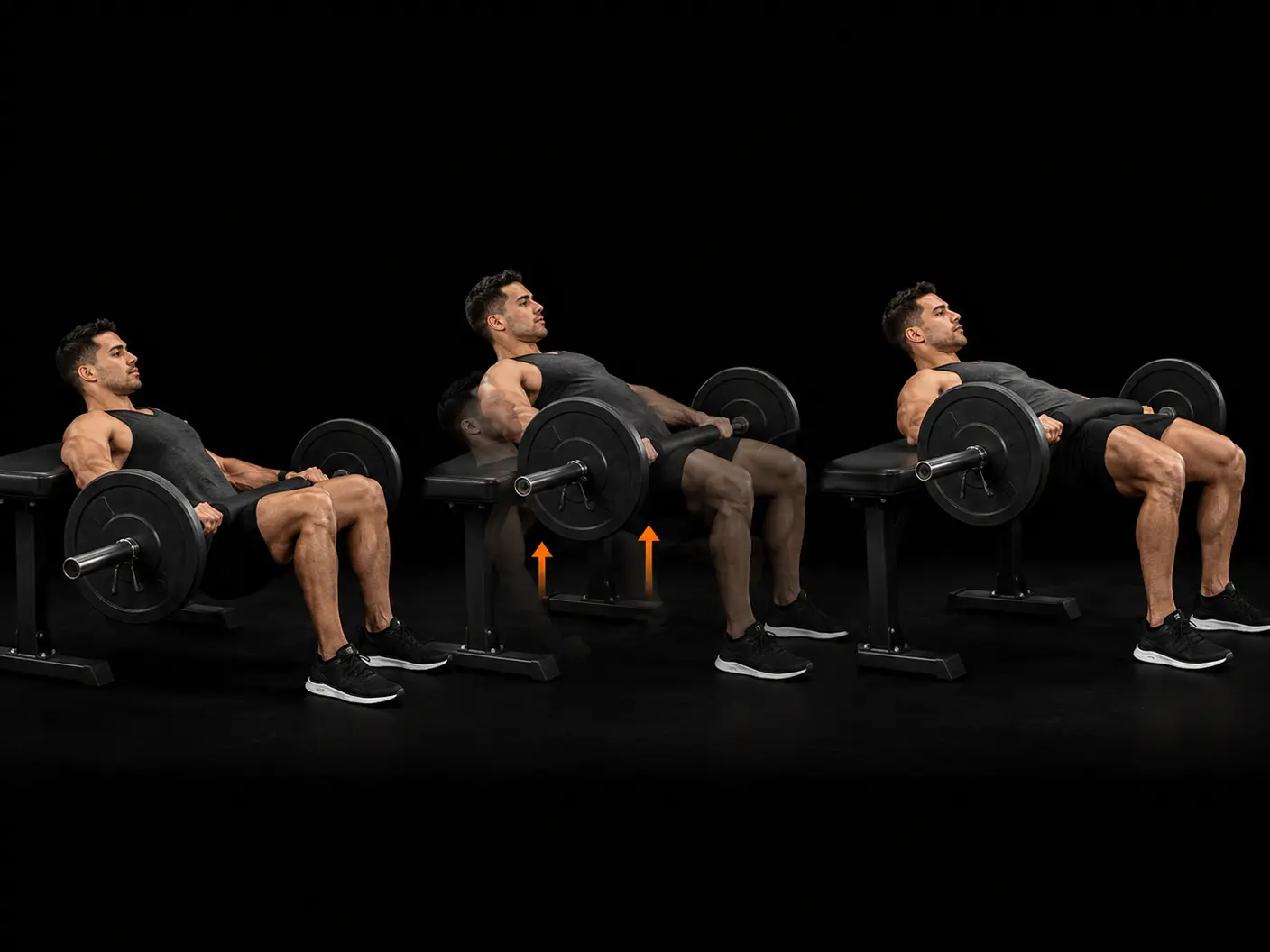
The barbell hip thrust is a loaded hinge-pattern exercise performed with the upper back elevated on a bench and a barbell across the hip crease. It places the gluteus maximus under direct, heavy load through a range of motion that few other compound movements can replicate, making it a staple for both strength and hypertrophy goals. It suits intermediate lifters who have established a basic strength foundation and are ready to train the posterior chain with greater specificity.
How to do it
Sit on the floor with upper back against a bench, bar in the hip crease (pad the bar). Feet shoulder-width, heels 12–15 inches from the hips. Drive through the heels and lift the hips until the torso is parallel to the floor — shins vertical at lockout. Squeeze the glutes hard for 1–2 seconds. Lower under control; do not let the hips rest between reps.
Coaching cues
- Ribs down
- Chin tucked
- Shins vertical at top
- Squeeze the glutes
Why train it
- The exercise isolates the gluteus maximus more directly than squats or deadlifts, creating a strong stimulus for hypertrophy in the posterior chain.
- Driving through the heels at high loads develops hip extension strength that transfers directly to sprinting, jumping, and change-of-direction tasks.
- The supported upper back position allows most lifters to manage heavier loads than single-joint alternatives, making progressive overload straightforward to apply.
- Secondary involvement of the hamstrings, adductors, and core means the movement builds stability and co-ordination across the entire lower body in a single exercise.
Common mistakes
- Flaring the ribs at the top — keep the ribs down throughout the lift to maintain a neutral spine and ensure the glutes, rather than the lower back, complete the movement.
- Allowing the chin to rise and the head to hyperextend — tuck the chin slightly so the head stays in line with the torso at lockout.
- Shins angled forward past vertical at the top — position the feet so the shins are as close to vertical as possible at full hip extension, which maximises glute activation and reduces knee stress.
- Resting the hips on the floor between reps — maintain tension throughout the set by lowering under control and reversing the movement before contact, keeping the glutes loaded consistently.
Primary: Gluteus Maximus.
Secondary: Hamstrings, Rectus Abdominis, Adductors.
Equipment
Good for
Easier variation
Glute bridge (no bench) — smaller range of motion, easier to set up.
Similar movements
Frequently asked
- What muscles does the barbell hip thrust work?
- The primary mover is the gluteus maximus, with meaningful secondary contributions from the hamstrings, adductors, and core musculature. The core works throughout to stabilise the pelvis and prevent excessive spinal extension at the top.
- How many sets and reps should I do for the barbell hip thrust?
- For hypertrophy, 3–4 sets of 8–12 reps with a 1–2 second squeeze at the top is a well-supported starting point. For strength, working in the 4–6 rep range with heavier loads and full recovery between sets is appropriate.
- What is the difference between a barbell hip thrust and a glute bridge?
- A glute bridge is performed flat on the floor with no elevation of the upper back, which limits the range of motion available to the hips. The hip thrust's bench-supported position creates a greater range of motion and allows the glutes to work through a longer stroke under load.
- Do I need a barbell pad for the hip thrust?
- Padding the barbell is strongly recommended — without it, the pressure of a loaded bar directly on the hip crease becomes the limiting factor long before the glutes are adequately fatigued. A purpose-made barbell pad or a folded mat works well.
- Is the barbell hip thrust suitable for athletic performance goals?
- Yes — hip extension power is fundamental to sprinting, jumping, and most field sport movements, and the hip thrust develops that quality under load in a pattern that closely mirrors those demands. It is commonly programmed alongside squats and deadlifts in athletic development work rather than as a replacement for them.
Want this movement in a plan built for you?
Adaptiv programmes the right exercises for your goal, equipment and experience — then adapts them as you train.
Build my programme