Single-Leg Hip Thrust
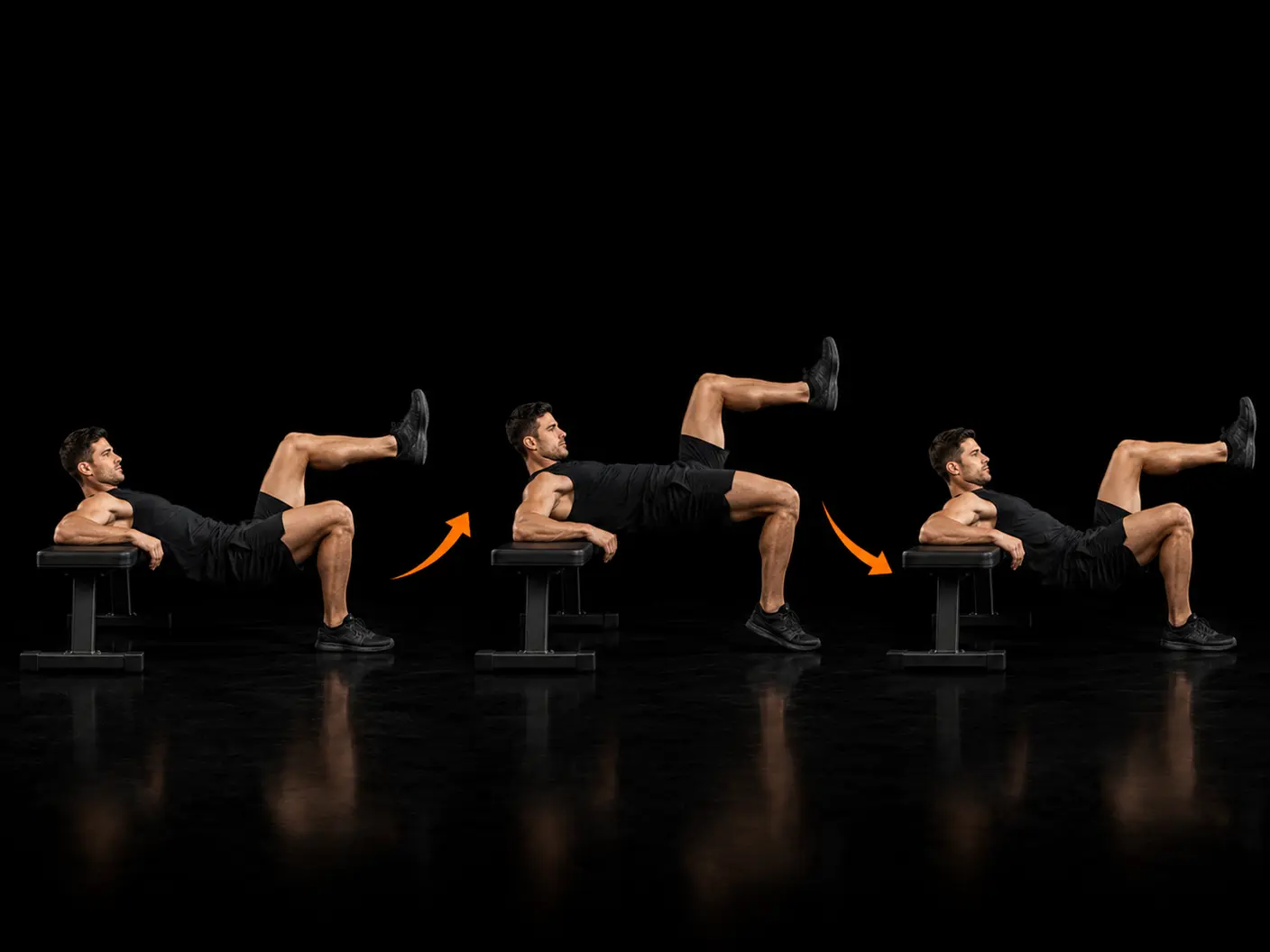
The single-leg hip thrust is a unilateral hinge pattern performed with the upper back braced against a bench and one foot flat on the floor, driving the hips to full extension against bodyweight or a dumbbell placed over the hip. Removing one leg from the equation demands greater contribution from the glutes and hamstrings of the working side, while the core and gluteus medius work to keep the pelvis level throughout. It suits intermediate trainees who have a solid foundation in the bilateral hip thrust and want to address side-to-side asymmetries or increase the training stimulus without always adding external load.
How to do it
Set up as a hip thrust but with one leg. The working foot is flat on the floor; the other leg is extended or bent with the foot off the floor. Hold a dumbbell over the hips or work bodyweight. Drive through the working heel to lift the hips; torso level at the top. Squeeze the glute. Lower under control.
Coaching cues
- Drive through the working heel
- Hips stay level
- Squeeze hard
- Ribs down
Why train it
- Isolates each side independently, making it a reliable tool for identifying and correcting strength imbalances between the left and right glute.
- The unilateral demand places significant stress on the gluteus medius to resist pelvic drop, reinforcing hip stability that carries over to running, jumping, and change-of-direction tasks.
- Because load is concentrated through a single limb, meaningful training stimulus can be achieved at lower absolute weights, reducing spinal loading compared with bilateral barbell variations.
- The controlled eccentric lowering phase provides a consistent stretch-and-contract cycle for the hamstrings, supporting hypertrophy adaptations alongside the glute work.
Common mistakes
- Allowing the hips to rotate or drop on the non-working side — brace the core and actively hold the pelvis level throughout the entire range of motion.
- Pushing through the toes rather than the heel — consciously drive through the working heel to preferentially recruit the glute and hamstring rather than the quadriceps.
- Hyperextending the lower back at the top position — keep the ribs down and think of posterior pelvic tilt at lockout so the glute does the work rather than the lumbar spine.
- Rushing the descent — lower the hips under deliberate control to maintain tension in the working muscles and protect the integrity of each repetition.
Primary: Gluteus Maximus, Hamstrings.
Secondary: Rectus Abdominis, Gluteus Medius.
Equipment
Good for
Easier variation
Shoulders-elevated single-leg glute bridge — same pattern, feet on floor, smaller ROM.
Similar movements
Frequently asked
- What muscles does the single-leg hip thrust work?
- The primary muscles are the glutes and hamstrings of the working leg. The core and gluteus medius act as secondary stabilisers, resisting pelvic rotation and lateral drop throughout the movement.
- How many sets and reps should I do for hypertrophy?
- For muscle growth, three to four sets of eight to fifteen repetitions per side works well for most intermediate trainees. Rest sixty to ninety seconds between sides and prioritise a controlled eccentric and a strong glute squeeze at the top over simply moving through the range of motion quickly.
- Do I need a dumbbell or can I do this bodyweight?
- Bodyweight is a perfectly valid starting point, particularly when you are first learning to keep the hips level with one leg raised. Once you can complete twelve or more controlled repetitions with good form, adding a dumbbell over the hip will provide sufficient progressive overload for continued adaptation.
- What is a good alternative if I find this too difficult?
- Return to the bilateral hip thrust to build baseline glute strength and pelvic control, then progress to the single-leg variation once you can perform the two-leg version consistently with sound technique. A foot-elevated single-leg glute bridge on the floor is another stepping stone that reduces the balance and stability demand.
- Is the single-leg hip thrust useful for athletic performance or just aesthetics?
- It is well-suited to both goals. The unilateral loading pattern closely mimics the single-leg hip extension demands of sprinting and jumping, making it a practical addition to an athletic performance programme. At the same time, the isolated stimulus to the glute and hamstring makes it an effective hypertrophy exercise when programmed with appropriate volume and load.
Want this movement in a plan built for you?
Adaptiv programmes the right exercises for your goal, equipment and experience — then adapts them as you train.
Build my programme