Cable Pull-Through
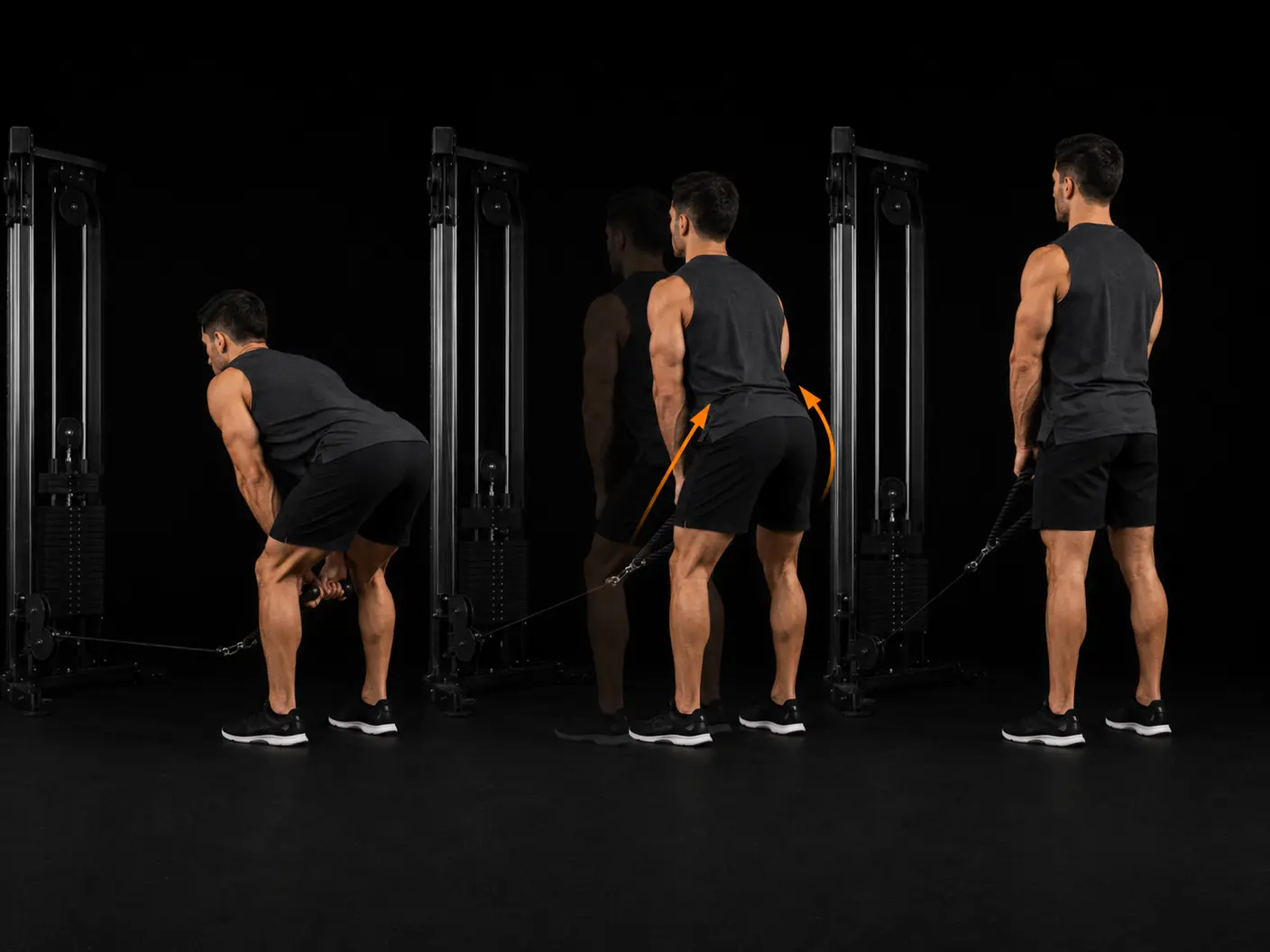
The cable pull-through is a foundational hip-hinge movement performed facing away from a low cable stack with a rope attachment threaded between the legs. It trains the posterior chain — primarily the glutes and hamstrings — through a controlled hinge pattern with constant cable tension throughout the range of motion. It suits beginners learning hip-hinge mechanics as well as more experienced lifters looking to isolate the posterior chain with reduced spinal loading.
How to do it
Set a rope low on a cable stack. Face away from the stack, rope between the legs. Step forward until the cable is taut. Hinge at the hips, bringing the rope between the thighs. Drive the hips forward to stand tall, squeezing the glutes at lockout. Keep the arms passive — this is a hip movement, not an arm movement.
Coaching cues
- Arms are ropes
- Hips drive
- Squeeze glutes at lockout
- Long spine
Why train it
- The constant tension provided by the cable makes it effective for targeting glute and hamstring hypertrophy across the full range of the hinge, including the lengthened position.
- Because the load pulls horizontally rather than compressing the spine vertically, it is a useful option for building posterior chain strength with less axial loading than a barbell deadlift variation.
- The movement reinforces sound hip-hinge mechanics — a skill that transfers directly to deadlifts, Romanian deadlifts, and kettlebell swings — making it a practical teaching tool early in a programme.
- The rope attachment and cable stack allow straightforward load adjustment, making progressive overload easy to manage across a hypertrophy or general fitness block.
Common mistakes
- Pulling with the arms rather than driving with the hips — keep the arms entirely passive, treating them as ropes attached to the cable, and focus all effort on the hip extension.
- Rounding the lower back during the hinge — maintain a long spine from tailbone to crown throughout the movement, hinging from the hips rather than flexing through the lumbar spine.
- Standing too close to the cable stack — step far enough forward so that the cable remains taut at the top of the movement and provides resistance through the full range of motion.
- Failing to reach full hip extension at lockout — drive the hips fully forward and squeeze the glutes firmly at the top of each rep to complete the movement and maximise posterior chain activation.
Primary: Gluteus Maximus, Hamstrings.
Secondary: Erector Spinae, Rectus Abdominis.
Equipment
Good for
Easier variation
Banded hip thrust — similar glute-focused hip extension at lower complexity.
Similar movements
Frequently asked
- What muscles does the cable pull-through work?
- The primary muscles worked are the glutes and hamstrings. The erectors and core contribute as secondary stabilisers to maintain a long spine throughout the hinge.
- How many sets and reps should I do for the cable pull-through?
- For hypertrophy, three to four sets of ten to fifteen repetitions works well, with a controlled tempo on the way down to maximise time under tension. For general fitness or technique practice, two to three sets of eight to twelve reps at a moderate load is a sensible starting point.
- What is a good alternative to the cable pull-through?
- The kettlebell swing and Romanian deadlift train a similar hip-hinge pattern and target the same primary muscles. The cable pull-through is often preferred when learning the hinge pattern because the horizontal cable pull makes it easier to feel and own the hip drive.
- Is the cable pull-through suitable for beginners?
- Yes — it is classified as a foundational movement precisely because the cable provides feedback that helps beginners learn to hinge at the hips rather than squatting or rounding the back. Starting light and focusing on the coaching cues will build a solid movement pattern quickly.
- Where in my programme should I place the cable pull-through?
- It works well as a main posterior chain movement in a lower-body or full-body session, or as an accessory exercise after a primary hinge such as a deadlift variation. Its relatively low axial load also makes it suitable towards the end of a session when fatigue is higher.
Want this movement in a plan built for you?
Adaptiv programmes the right exercises for your goal, equipment and experience — then adapts them as you train.
Build my programme