Romanian Deadlift (RDL)
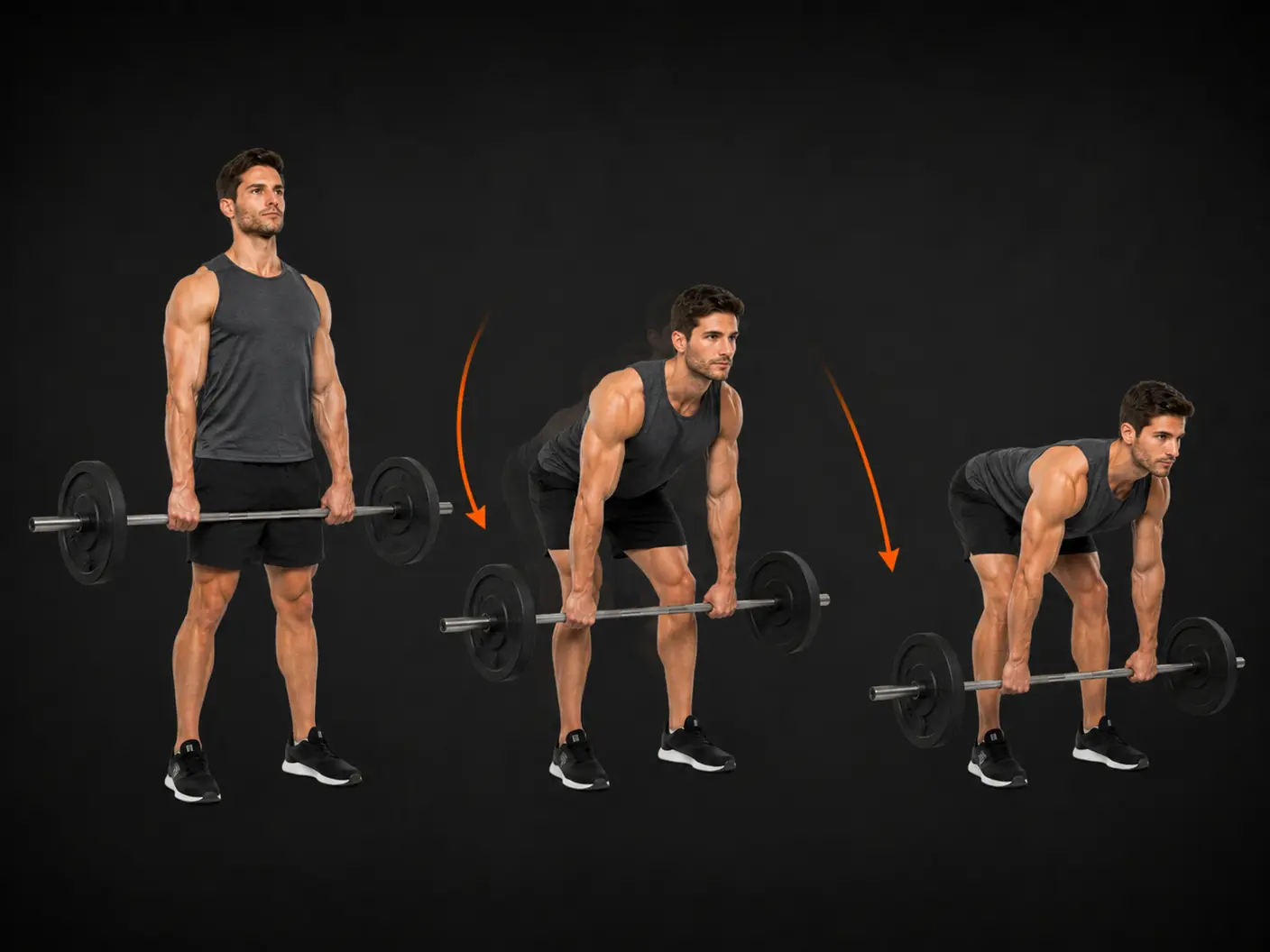
The Romanian deadlift is a barbell or dumbbell hinge movement that trains the posterior chain through a controlled hip-push-back pattern, keeping a fixed knee bend throughout. Unlike a conventional deadlift, the bar begins from a standing position and the load never contacts the floor, placing sustained tension on the hamstrings and glutes across the full range. It sits at an intermediate difficulty level, making it well suited to lifters who have a solid hinge foundation and are looking to build posterior chain strength, size, or athletic capacity.
How to do it
Stand with feet hip-width, grip the bar just outside the thighs. Pack the shoulders, engage the lats, set a 15–20° fixed knee bend. Take a breath and brace. Push the hips straight back (hinge) while the bar slides down the thighs. Descend until a strong hamstring stretch is felt — usually mid-shin — without lumbar rounding. Keep the bar in contact with the legs throughout. Drive the hips forward squeezing glutes to return. Use a 2–3 second controlled eccentric.
Coaching cues
- Hips back not down
- Long spine
- Bar stays on the legs
- Controlled eccentric
Why train it
- The sustained hamstring stretch under load during the eccentric phase creates a strong stimulus for hypertrophy in the hamstrings and glutes.
- The fixed knee angle and hip-hinge pattern closely mirrors the mechanics of sprinting, jumping, and change-of-direction, making it a practical choice for athletic performance programming.
- Secondary involvement of the erectors, lats, and adductors means the movement also reinforces spinal bracing habits and lat engagement that carry over to heavier compound lifts.
- The prescribed 2–3 second eccentric demands deliberate control, developing the kind of deceleration strength that underpins injury resilience in sport and general training.
Common mistakes
- Pushing the hips down rather than back — think of reaching your hips straight toward the wall behind you to maintain the hinge pattern and keep the shins close to vertical.
- Allowing the lower back to round as the bar descends — brace the core before you move and stop the descent at the point where a strong hamstring stretch is felt, even if that is above mid-shin.
- Letting the bar drift away from the legs — keep it in contact with the thighs throughout the descent, as any gap dramatically increases the moment arm on the lumbar spine.
- Rushing the lowering phase — use a deliberate 2–3 second eccentric on every repetition, since the controlled stretch is where much of the posterior chain stimulus is generated.
Primary: Hamstrings, Gluteus Maximus.
Secondary: Erector Spinae, Latissimus Dorsi, Adductors, Forearm Flexors.
Equipment
Good for
Easier variation
Dumbbell RDL or cable pull-through — teaches the hinge without axial spinal loading.
Similar movements
Frequently asked
- What muscles does the Romanian deadlift work?
- The primary muscles are the hamstrings and glutes, which work eccentrically to control the descent and concentrically to drive the hips forward on the return. The erectors, lats, adductors, and forearms contribute as stabilisers throughout the lift.
- How many sets and reps should I do for the Romanian deadlift?
- For hypertrophy, 3–4 sets of 8–12 repetitions with a controlled eccentric is a well-established range. For strength or athletic performance goals, working in the 4–6 repetition range with heavier loading is appropriate, provided technique remains sound.
- What is the difference between a Romanian deadlift and a conventional deadlift?
- The conventional deadlift starts from the floor and involves significantly more knee flexion, spreading the load across the quads, hamstrings, and glutes. The Romanian deadlift begins from standing, uses a fixed shallow knee bend, and keeps the bar off the floor — placing far greater emphasis on the hamstrings and posterior chain through a longer time under tension.
- Can I do the Romanian deadlift with dumbbells instead of a barbell?
- Yes — dumbbells are a valid option and can be useful when barbell access is limited or when a lifter is learning the movement, as they allow a more natural hand position. The same mechanics apply: shoulders packed, hips pushed back, and a controlled descent with the weights tracking close to the legs.
- Is the Romanian deadlift suitable for building glute size?
- It is one of the more effective movements for glute hypertrophy because it loads the glutes through a substantial range and requires an active squeeze at the top of each repetition. For best results, pair it with exercises that load the glutes at a shorter range, such as hip thrusts, to cover the full strength curve.
Want this movement in a plan built for you?
Adaptiv programmes the right exercises for your goal, equipment and experience — then adapts them as you train.
Build my programme