Conventional Deadlift
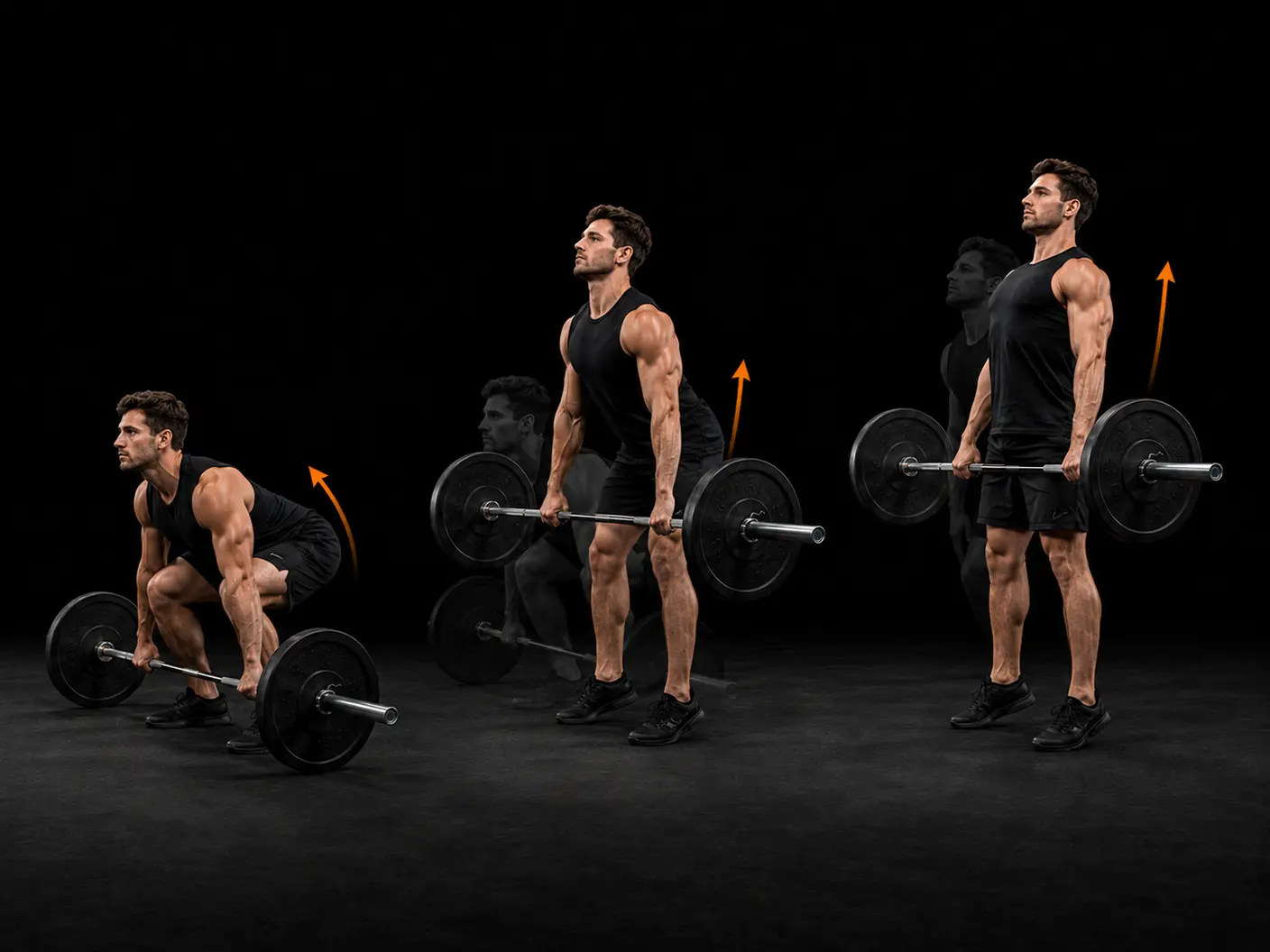
The conventional deadlift is a barbell hinge pattern that requires the lifter to pull a loaded bar from the floor to full hip extension, coordinating nearly every major muscle group in the process. It trains posterior chain strength — glutes, hamstrings, and erectors — while demanding active contribution from the lats, traps, rhomboids, core, and forearms to maintain a safe and efficient bar path. As an advanced compound lift, it suits experienced trainees who have established solid hip-hinge mechanics and spinal control under load.
How to do it
Stand with mid-foot under the bar, feet hip-width, toes slightly out. Hinge and grip just outside the knees. Drop the hips until the shins touch the bar. Chest proud, lats engaged, neutral spine. Big breath, brace 360°, pull slack out of the bar — the 'wedge'. Drive through mid-foot; the bar travels vertically along the shins. Hips and shoulders rise at the same rate. Lock out with full hip extension and squeezed glutes — no lumbar hyperextension. Reverse: push hips back first, then bend the knees once the bar passes them.
Coaching cues
- Squeeze oranges in armpits
- Bar stays on legs
- Hips and shoulders rise together
- Push the floor
Why train it
- The deadlift places direct, heavy demand on the glutes, hamstrings, and erectors simultaneously, making it one of the most efficient ways to develop posterior chain strength.
- Because it requires the lats, traps, rhomboids, and core to stabilise the trunk and control the bar, a single working set accumulates meaningful volume across multiple muscle groups at once.
- The pattern of producing force through the floor while maintaining a rigid, braced torso transfers directly to athletic tasks that involve acceleration, jumping, and change of direction.
- Progressive loading on the conventional deadlift provides a clear, measurable stimulus for hypertrophy across both the posterior chain and the upper back musculature.
Common mistakes
- Letting the bar drift away from the body — keep the bar in contact with the shins throughout the pull so the load stays mechanically close to the hip joint.
- Allowing the hips to rise faster than the shoulders out of the bottom position — brace hard before initiating the pull and think of driving the floor away so the torso angle remains constant through the first phase.
- Failing to engage the lats before the bar leaves the floor — squeeze your armpits as though pinching something in them to create upper back tension and protect the lower back from rounding.
- Hyperextending the lumbar spine at lockout — finish the lift by squeezing the glutes and achieving full hip extension, not by leaning back past vertical.
Primary: Gluteus Maximus, Hamstrings, Erector Spinae.
Secondary: Quadriceps, Latissimus Dorsi, Trapezius, Rhomboids, Rectus Abdominis, Forearm Flexors.
Equipment
Good for
Easier variation
Trap-bar (hex-bar) deadlift — reduced lumbar shear, more upright torso.
Similar movements
Frequently asked
- What muscles does the conventional deadlift work?
- The primary movers are the glutes, hamstrings, and spinal erectors. The quadriceps, lats, traps, rhomboids, core, and forearms all contribute as secondary muscles, making this a near-total-body compound movement.
- How many sets and reps should I do for the conventional deadlift?
- For strength, three to five sets of one to five reps with heavy loading and full recovery between sets is a well-established approach. For hypertrophy, three to four sets of five to eight reps at a moderate-to-high intensity allows sufficient mechanical tension without excessive fatigue accumulating across the session.
- What are good alternatives to the conventional deadlift?
- If the conventional stance does not suit your proportions, the sumo deadlift alters the hip angle and grip width while keeping the barbell hinge pattern intact. The Romanian deadlift removes the floor contact and emphasises hamstring length under load, making it a useful accessory for those targeting the posterior chain with less spinal loading.
- Is the conventional deadlift suitable for building muscle as well as strength?
- Yes — the lift is listed under both hypertrophy and strength as primary goals. The volume of muscle mass involved and the capacity to load the movement progressively make it a reliable stimulus for both qualities, though programming variables such as rep range and rest periods will shift the emphasis.
- How do I know if my form is good enough to deadlift heavy?
- You should be able to achieve a neutral spine from setup through lockout, keep the bar tracking vertically along the shins, and have the hips and shoulders rise at the same rate out of the bottom. If you are uncertain about your technical baseline or have an existing back concern, seek an assessment from a qualified coach or physiotherapist before adding significant load.
Want this movement in a plan built for you?
Adaptiv programmes the right exercises for your goal, equipment and experience — then adapts them as you train.
Build my programme