Trap Bar Deadlift
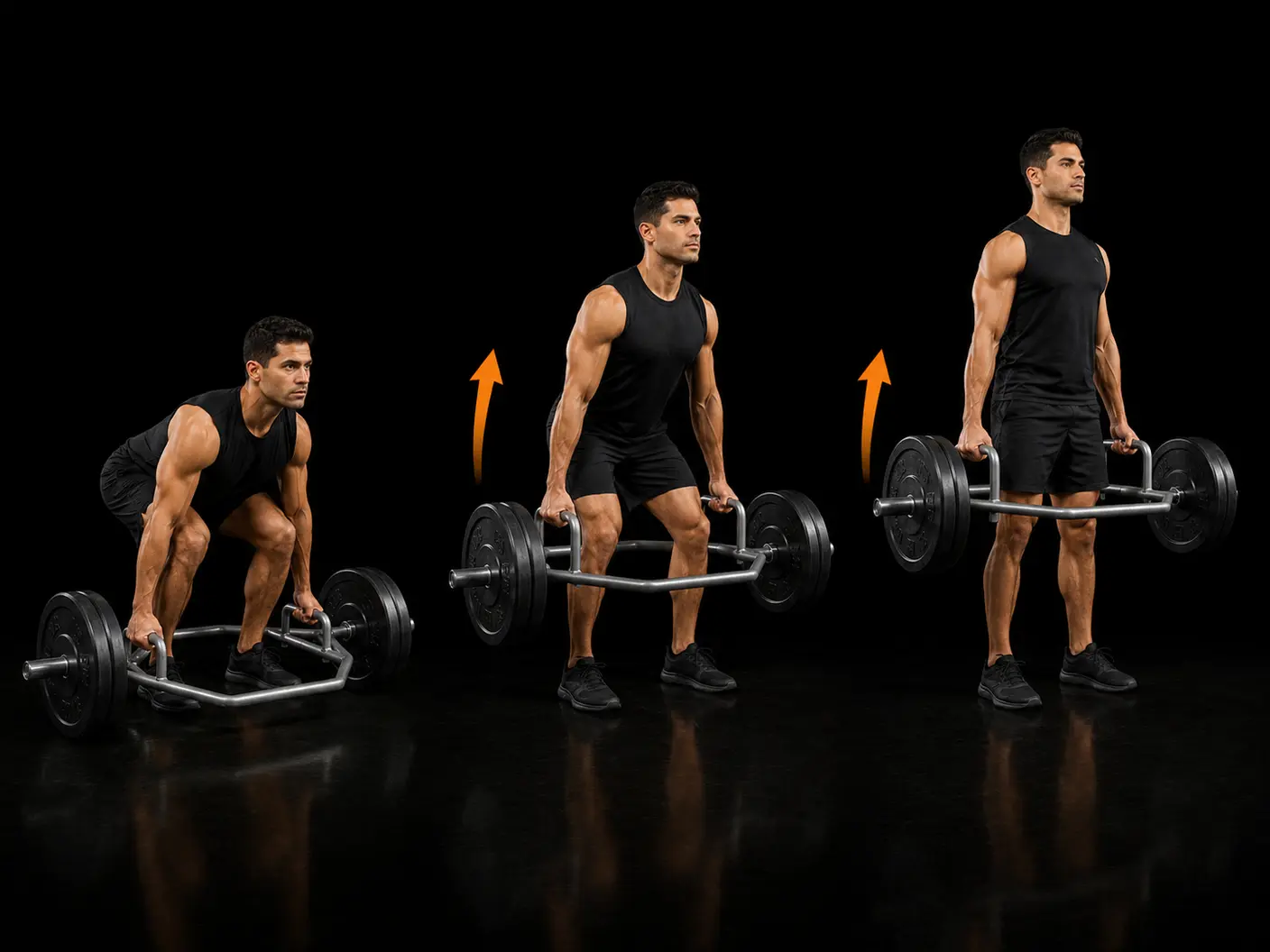
The trap bar deadlift is a hinge-pattern compound movement performed inside a hexagonal or diamond-shaped bar, which places the load in line with the centre of mass rather than in front of it. This geometry reduces the moment arm at the lumbar spine and allows a more upright torso position than a conventional barbell deadlift, making it an effective choice for developing strength and lower-body mass with a relatively forgiving learning curve. It suits a wide range of trainees, from those new to heavy pulling to experienced athletes seeking a deadlift variation that transfers well to sport.
How to do it
Step inside the trap bar, feet hip-width. Hinge to grip the neutral handles. Chest up, lats engaged, hips slightly higher than conventional. Brace hard. Drive through mid-foot; the load tracks vertically around the centre of mass. Stand tall with full hip extension. Reverse by pushing hips back.
Coaching cues
- Chest up
- Push the floor
- Stand tall
- Hips back to reverse
Why train it
- The neutral-grip handles and centred load reduce shear stress on the lower back, allowing heavier training loads to be accumulated over time with less spinal fatigue.
- Simultaneous demand on the glutes, quadriceps, and hamstrings makes this one of the most efficient single exercises for whole lower-body strength and hypertrophy.
- The movement pattern transfers directly to athletic qualities such as jumping, sprinting, and change of direction, making it a practical choice within performance-focused programmes.
- The upright torso and intuitive set-up lower the technical barrier compared with the conventional deadlift, so trainees can reach meaningful training intensities sooner.
Common mistakes
- Starting with the hips too low — this turns the pull into a squat and compromises vertical bar path; set the hips slightly higher than a conventional deadlift and hinge decisively before initiating the drive.
- Losing lat engagement at the set-up — allowing the upper back to round reduces spinal stiffness; cue yourself to protect your armpits and keep the chest up before the bar leaves the floor.
- Rising chest-first rather than driving through the mid-foot — when the hips shoot up ahead of the torso the load shifts excessively onto the lower back; think 'push the floor away' to keep hips and shoulders rising together.
- Neglecting full hip extension at the top — cutting the rep short by not standing completely tall reduces glute involvement; finish each rep with the hips fully locked out before reversing the movement.
Primary: Gluteus Maximus, Quadriceps, Hamstrings.
Secondary: Erector Spinae, Trapezius, Forearm Flexors, Rectus Abdominis.
Equipment
Good for
Easier variation
Kettlebell deadlift — same upright torso pattern at lower load.
Similar movements
Frequently asked
- What muscles does the trap bar deadlift work?
- The primary movers are the glutes, quadriceps, and hamstrings, which work together to extend the hips and knees through the lift. The erectors, traps, core, and forearms all contribute as stabilisers and are classified as secondary muscles for this movement.
- How many sets and reps should I do for the trap bar deadlift?
- For strength, three to five sets of three to six reps at high relative intensity works well. For hypertrophy or general fitness, three to four sets of six to ten reps with controlled tempo is a practical starting point. Rest periods of two to three minutes between sets allow sufficient recovery for compound work of this demand.
- Is the trap bar deadlift easier on the lower back than a conventional deadlift?
- The centred load reduces the horizontal distance between the bar and your lumbar spine, which lowers the mechanical demand on the lower back compared with a barbell placed in front of the body. This does not mean it is risk-free — bracing, lat engagement, and correct hip position remain essential. If you have an existing back concern, consult a qualified professional before programming either variation.
- Can the trap bar deadlift replace the conventional deadlift in a programme?
- It can serve as a primary pulling movement for most general fitness, hypertrophy, and athletic performance goals, as its muscle recruitment and loading potential are comparable to the conventional deadlift. Where a conventional pull is specifically required — for powerlifting competition or sport-specific reasons — the two movements are best treated as complementary rather than interchangeable.
- What are good alternatives if I don't have access to a trap bar?
- The Romanian deadlift and dumbbell deadlift both train the same hinge pattern using more accessible equipment. The Romanian deadlift places greater emphasis on the hamstrings and erectors, while the dumbbell deadlift offers a similar neutral-grip position and relatively upright torso, making it a reasonable substitute when a trap bar is unavailable.
Want this movement in a plan built for you?
Adaptiv programmes the right exercises for your goal, equipment and experience — then adapts them as you train.
Build my programme