Deficit Deadlift
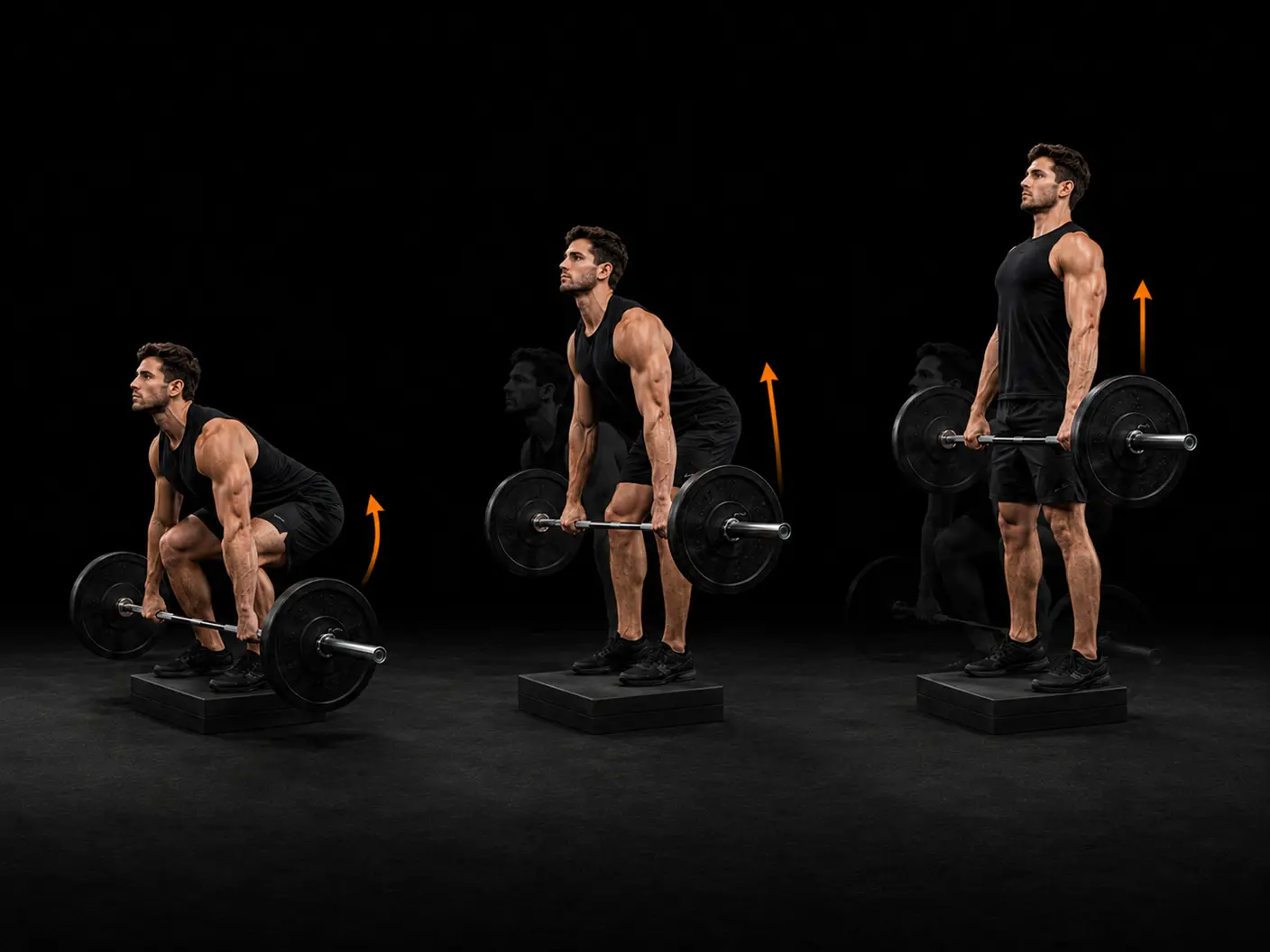
The deficit deadlift is a barbell hinge movement performed while standing on a 1–3 inch platform, deliberately increasing the range of motion compared to a conventional pull from the floor. The elevated stance forces the hips lower and the torso flatter at the start position, placing greater demand on the quads, glutes, and hamstrings through a longer pull. It suits intermediate to advanced lifters who have already established sound conventional deadlift mechanics and are looking to develop strength through a more challenging range.
How to do it
Stand on a 1–3 inch platform. Set up as a conventional deadlift from this elevated stance. Increased ROM puts the hips lower and the back flatter. Execute the pull as normal. Return to the starting position; reset on each rep.
Coaching cues
- Low hips
- Chest proud
- Bar against legs
- Full range
Why train it
- The extended range of motion increases time under tension for the glutes and hamstrings, making it a productive option for lower-body hypertrophy work.
- Starting with the hips lower trains the lifter to maintain positional strength from a weaker point in the pull, directly carrying over to a stronger conventional deadlift off the floor.
- The movement reinforces a flat back and proud chest position under load, reinforcing disciplined spinal mechanics that transfer across all hinge-pattern lifts.
- Secondary engagement of the upper back, lats, and forearms means the lift also develops the supporting musculature required to keep the bar close and the torso braced throughout a long pull.
Common mistakes
- Setting the platform too high — limit elevation to 1–3 inches; excessive height compromises lumbar position and places disproportionate stress on the lower back.
- Letting the bar drift away from the legs — keep the barbell in contact with the shins and thighs throughout the pull, as any forward drift increases the mechanical disadvantage on the lower back.
- Rising with the hips before the chest — drive the floor away by pushing through the feet so the hips and shoulders rise at the same rate, preventing the lift from collapsing into a stiff-leg variation.
- Skipping the reset between reps — return the bar fully to the platform and re-establish your hip position and brace before each rep, rather than bouncing or rushing through touch-and-go repetitions.
Primary: Gluteus Maximus, Hamstrings, Erector Spinae, Quadriceps.
Secondary: Rhomboids, Latissimus Dorsi, Forearm Flexors.
Equipment
Good for
Easier variation
Conventional deadlift — remove the deficit for standard ROM.
Similar movements
Frequently asked
- What muscles does the deficit deadlift work?
- The primary muscles are the glutes, hamstrings, spinal erectors, and quads. The upper back, lats, and forearms work as secondary stabilisers to keep the bar close and the torso rigid throughout the lift.
- How many sets and reps should I do for the deficit deadlift?
- For strength development, 3–5 sets of 3–5 reps with heavy loading is a common approach. For hypertrophy, 3–4 sets in the 6–10 rep range with controlled execution tends to be more appropriate. Because the range of motion is longer than a standard pull, err on the side of moderate loads until technique is consistent.
- How much of a deficit should I use?
- A 1–3 inch elevation is the standard range and sufficient to meaningfully increase the range of motion. Going higher than this typically compromises the lifter's ability to maintain a flat back and is not generally recommended.
- Is the deficit deadlift suitable for beginners?
- This variation is classed as an advanced movement and is best reserved for lifters who already demonstrate clean mechanics on the conventional deadlift. Beginners would benefit more from building positional strength and familiarity with the standard pull before adding a deficit.
- What is a good alternative to the deficit deadlift?
- The conventional deadlift is the most direct alternative and should underpin your training before attempting a deficit. Romanian deadlifts and stiff-leg deadlifts also emphasise the hamstrings and glutes through a longer range, and may suit those who lack the hip mobility to hold a flat back from a raised platform.
Want this movement in a plan built for you?
Adaptiv programmes the right exercises for your goal, equipment and experience — then adapts them as you train.
Build my programme