Sumo Deadlift
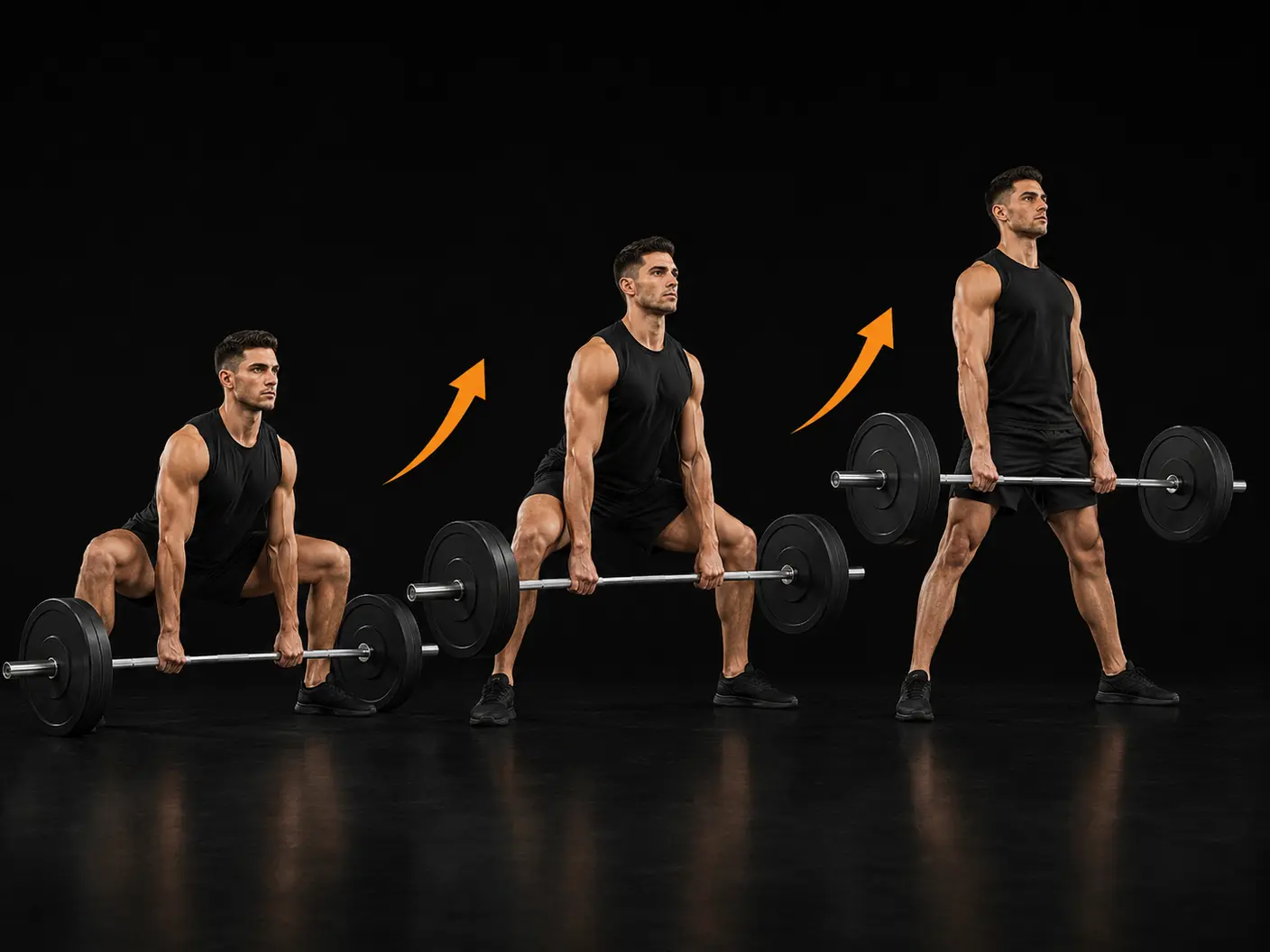
The sumo deadlift is a barbell hinge movement performed with a wide stance and the grip taken inside the legs, placing the hips lower and the torso more upright than a conventional pull. This stance distributes load heavily across the glutes, adductors, and quadriceps while reducing the demand on the lower back, making it a distinct mechanical alternative rather than simply a variation. It suits intermediate to advanced lifters pursuing maximal strength, hypertrophy, or sport-specific power who want to develop the posterior chain with a different loading emphasis.
How to do it
Set feet 1.5–2x shoulder-width, toes pointed out ~30–45°. Shins near vertical, grip inside the legs. Chest up, lats packed, hips lower than conventional. Big brace. Drive the knees out and push the floor away with the whole foot; the bar rises vertically. Finish with full hip extension and squeezed glutes. Reverse by pushing hips back.
Coaching cues
- Knees out
- Chest up
- Bar against legs
- Push the floor
Why train it
- The wide stance directly loads the adductors and glutes through a demanding range of motion, making it an efficient compound stimulus for lower-body mass and strength.
- The more upright torso position reduces the moment arm at the lumbar spine compared with a conventional deadlift, which can allow higher training volumes for some lifters.
- Because the bar travels a shorter vertical distance than in a conventional pull, the sumo deadlift is frequently used in strength sport to express maximal load on the platform.
- The pattern reinforces full hip extension under load, a quality that transfers directly to sprinting, jumping, and other athletic movements requiring powerful hip drive.
Common mistakes
- Letting the knees collapse inward at the start of the pull — actively drive them out in line with the toes throughout the entire lift to maintain structural integrity and transfer force efficiently.
- Allowing the chest to drop and the hips to rise first, turning the lift into a stiff-leg pull — brace hard before the bar leaves the floor and think of pushing the floor away rather than pulling the bar up.
- Letting the bar drift forward away from the legs — keep it in contact with the shins and thighs throughout the ascent, as any forward drift lengthens the moment arm and leaks force.
- Failing to achieve full hip extension at lockout — finish the rep by driving the hips fully through and squeezing the glutes at the top rather than hyperextending the lumbar spine to manufacture the appearance of lockout.
Primary: Gluteus Maximus, Adductors, Quadriceps.
Secondary: Hamstrings, Erector Spinae, Latissimus Dorsi, Trapezius, Forearm Flexors.
Equipment
Good for
Easier variation
Sumo deadlift from blocks (2–4 inch rise) — shortens range of motion.
Similar movements
Frequently asked
- What muscles does the sumo deadlift work?
- The primary muscles are the glutes, adductors, and quadriceps, which are loaded more heavily than in a conventional deadlift due to the wide stance and lower hip position. The hamstrings, spinal erectors, lats, traps, and forearms all contribute as secondary stabilisers and force transmitters throughout the lift.
- How many sets and reps should I do for the sumo deadlift?
- For strength, 3–5 sets of 1–5 reps at 80–90% of your one-rep max is a well-established approach, with full recovery between sets. For hypertrophy, 3–4 sets of 4–8 reps with controlled technique serves well, though the deadlift is typically kept to lower rep ranges than isolation work given the systemic fatigue it produces.
- What is the difference between sumo and conventional deadlift?
- The sumo deadlift uses a wider foot placement with toes pointed out and the grip inside the legs, producing a lower hip position, more upright torso, and shorter bar path. The conventional deadlift has a narrower stance with the grip outside the legs, placing greater demand on the hamstrings and lower back and requiring a more horizontal torso angle.
- Is the sumo deadlift suitable for building leg size as well as strength?
- Yes — the quadriceps and adductors are placed under meaningful mechanical load through a significant range of motion, which provides a genuine hypertrophy stimulus alongside the strength adaptation. Pairing the sumo deadlift with accessory work such as leg press or Romanian deadlifts will produce a more complete lower-body programme.
- What are good alternatives if I cannot yet perform the sumo deadlift with good form?
- Romanian deadlifts and trap bar deadlifts develop the hinge pattern and posterior chain strength needed to progress toward the sumo pull. Wide-stance goblet squats and sumo stance kettlebell deadlifts can also help a newer lifter develop familiarity with the foot position and adductor engagement before loading a barbell.
Want this movement in a plan built for you?
Adaptiv programmes the right exercises for your goal, equipment and experience — then adapts them as you train.
Build my programme