Stiff-Leg Deadlift
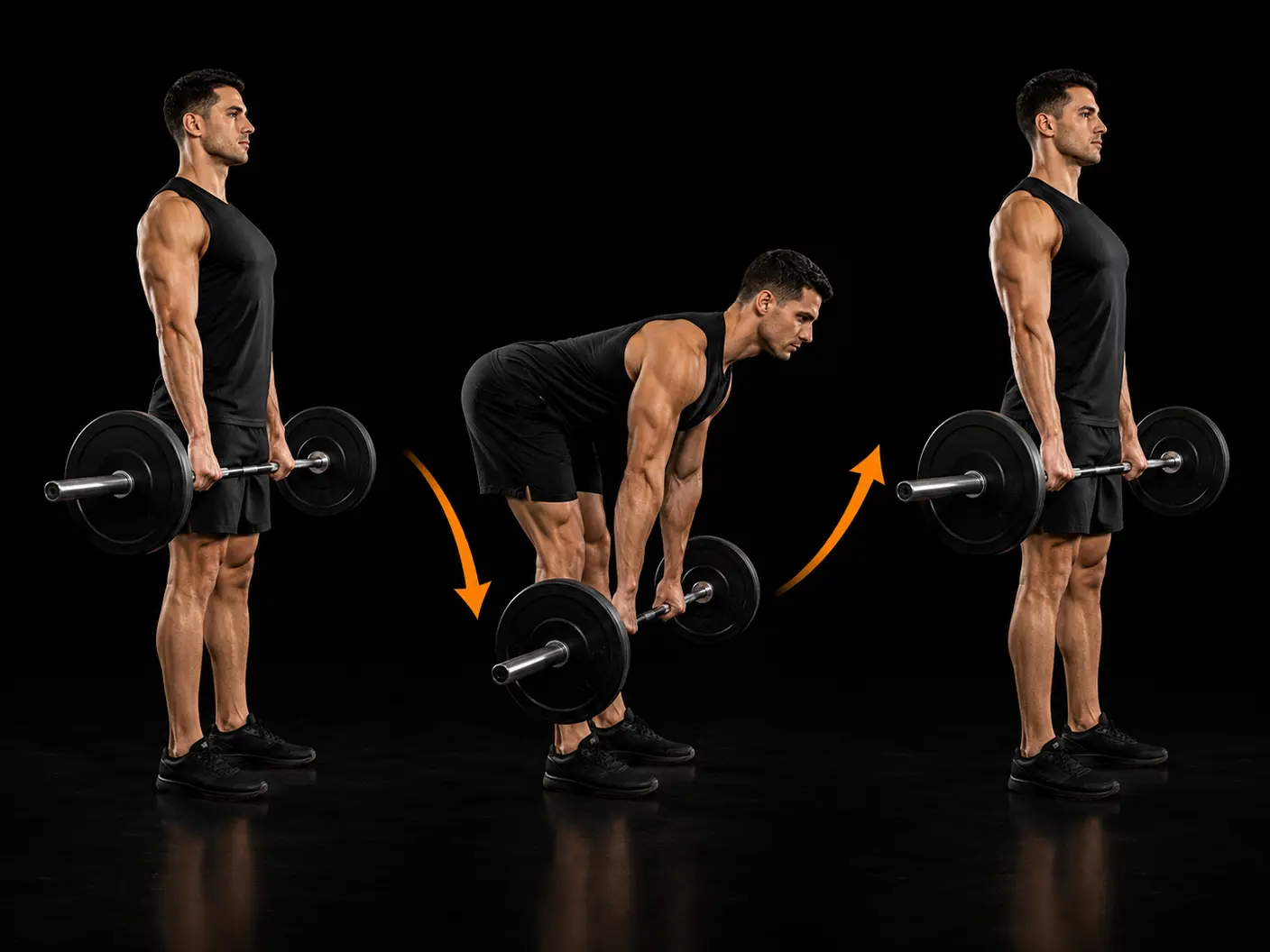
The stiff-leg deadlift is a barbell hinge movement performed with near-straight knees, placing the hamstrings and glutes under a pronounced stretch throughout the lift. By limiting knee flexion, the load is concentrated on the posterior chain rather than distributed across the quads, making it a deliberate hypertrophy and performance tool rather than a maximal strength movement. It suits intermediate to advanced lifters who already possess solid hip-hinge mechanics and sufficient hamstring flexibility to maintain a long spine under load.
How to do it
Stand over the bar, feet hip-width. Hinge with minimal knee bend — knees are soft but nearly straight. Grip the bar, pack the lats. Drive the floor to lift, hips and shoulders rising together. Lower by pushing the hips back; bar slides down the legs. Stop when hamstring tension peaks or the back begins to round.
Coaching cues
- Near-straight legs
- Long spine
- Bar on the legs
- Chase hamstring stretch
Why train it
- The near-straight knee position maximises the stretch placed on the hamstrings, creating the mechanical tension that drives posterior-chain hypertrophy.
- Driving the hips back while keeping the bar close to the legs reinforces sound hinge patterning, which transfers directly to athletic movements such as sprinting and jumping.
- The lats and erectors work isometrically to preserve spinal position throughout the rep, building the trunk stability that supports heavier compound lifts.
- Because load is managed through range rather than maximised, the stiff-leg deadlift allows meaningful training stimulus with submaximal weights, reducing cumulative fatigue across a programme.
Common mistakes
- Rounding the lower back as the bar descends — stop the range of motion at the point where hamstring tension peaks and spinal position can still be maintained, rather than chasing depth beyond your current mobility.
- Allowing the bar to drift away from the legs — keep it in contact with the shins and thighs throughout the lift to minimise the moment arm and protect the lower back.
- Bending the knees excessively — if the movement resembles a conventional deadlift, focus on the cue of pushing the hips back while keeping the knees soft but nearly straight.
- Jerking the bar off the floor — initiate each rep with controlled tension by taking the slack out of the bar before the hips and shoulders rise together.
Primary: Hamstrings, Gluteus Maximus.
Secondary: Erector Spinae, Latissimus Dorsi, Forearm Flexors.
Equipment
Good for
Easier variation
Romanian deadlift — allows more knee bend and is easier on the lower back.
Similar movements
Frequently asked
- What muscles does the stiff-leg deadlift work?
- The primary muscles are the hamstrings and glutes, which are loaded under a stretch due to the minimal knee bend. The erectors, lats, and forearms work as secondary muscles, stabilising the spine and securing the grip throughout the movement.
- How many sets and reps should I do for the stiff-leg deadlift?
- For hypertrophy, three to four sets of eight to twelve reps with a controlled lowering phase is a practical starting point. For athletic performance, four to five sets of five to six reps with moderate load allows quality of movement to be maintained across all reps.
- What is the difference between a stiff-leg deadlift and a Romanian deadlift?
- Both are hinge variations that emphasise the hamstrings, but the stiff-leg deadlift uses a flatter back angle and allows the bar to travel closer to the floor, creating a greater hamstring stretch. The Romanian deadlift typically involves a more upright torso and stops the bar around mid-shin, making it slightly more accessible for lifters still developing flexibility.
- Is the stiff-leg deadlift suitable for building glutes?
- Yes — the glutes are listed as a primary muscle and are heavily involved in the hip extension required to return to standing. Combining the stretch-loaded hamstring work with glute-driven lockout makes it a useful accessory movement in a hypertrophy programme targeting the posterior chain.
- Do I need a lot of hamstring flexibility to perform this exercise?
- A meaningful degree of hamstring flexibility is required to hinge with near-straight knees while maintaining a long spine, which is why the movement is classified as advanced. If you find your lower back rounds before achieving a useful range of motion, address hamstring mobility first or work with a qualified coach to assess your readiness for this variation.
Want this movement in a plan built for you?
Adaptiv programmes the right exercises for your goal, equipment and experience — then adapts them as you train.
Build my programme