Good Morning
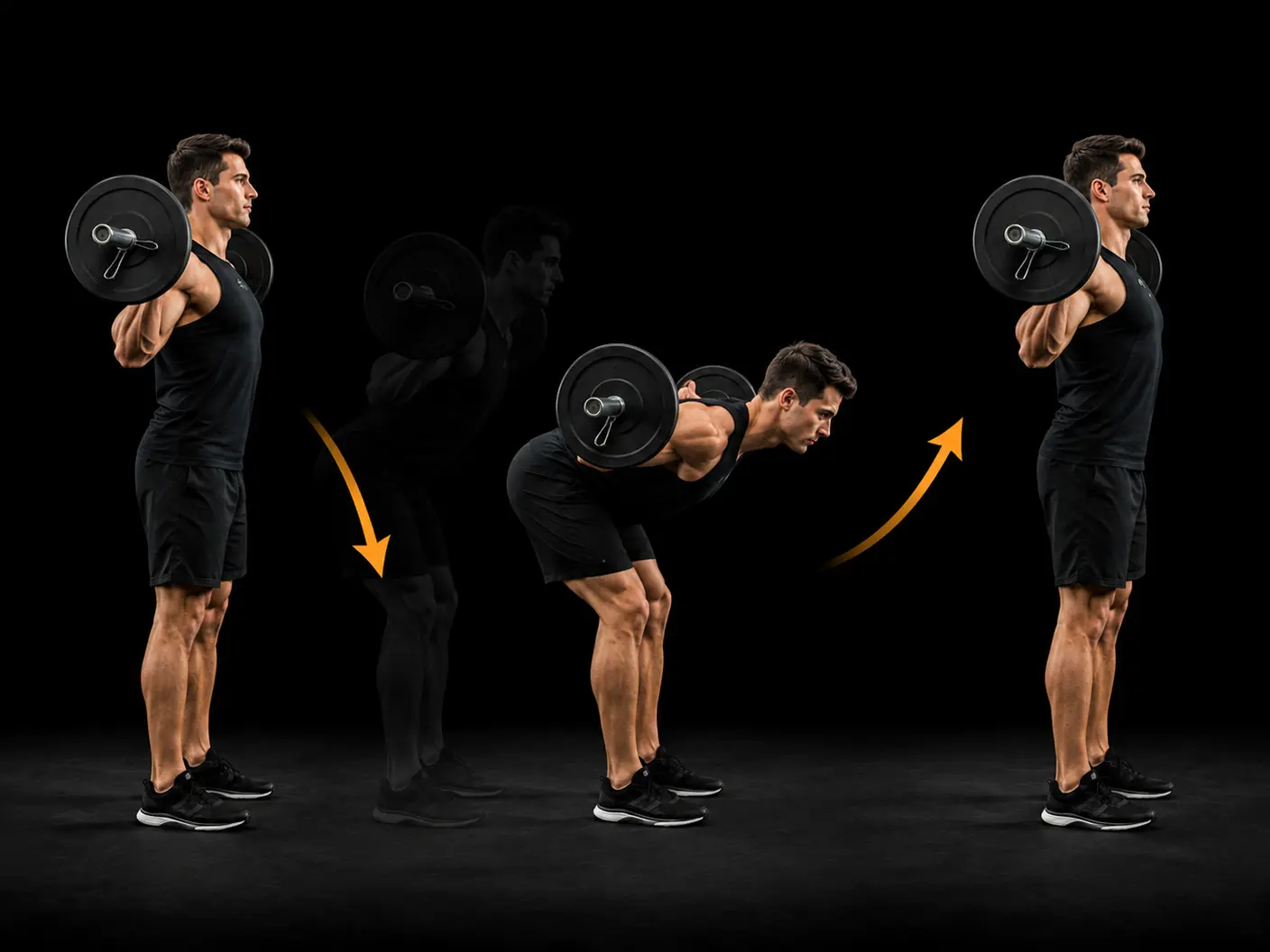
The good morning is a barbell hinge movement that loads the posterior chain through a controlled forward lean of the torso, with the bar carried on the upper back in a low-bar position. It trains the hamstrings, glutes, and spinal erectors under significant hip-hinge demand, making it one of the more technically exacting exercises in a strength programme. It suits intermediate-to-advanced lifters who have already established sound hinge mechanics and adequate posterior-chain strength.
How to do it
Rack the bar on the upper back as in a low-bar squat. Step back, feet hip-to-shoulder-width. Soft knee bend. Push the hips straight back while lowering the torso toward parallel. Keep the spine long and the bar glued to the back. Drive the hips forward to return; finish tall with squeezed glutes.
Coaching cues
- Hips back
- Long spine
- Slight knee bend
- Drive hips to finish
Why train it
- It develops the hamstrings through a long range of motion, building both strength and hypertrophy across the hip and knee.
- Loading the erectors isometrically under a forward-leaning torso builds the spinal resilience that transfers directly to heavier squats and deadlifts.
- The movement reinforces strict hip-hinge mechanics — hips back, spine long — that carry over to nearly every athletic and barbell pattern.
- Because the lats and core must brace throughout to keep the bar fixed to the back, it trains trunk stability as an integrated component rather than an afterthought.
Common mistakes
- Rounding the lower back — brace the core firmly before the descent and maintain a long, neutral spine throughout the entire range of motion.
- Allowing the knees to straighten completely — keep a consistent soft bend so the hamstrings can load properly without placing undue stress on the joint.
- Leaning the torso too far beyond parallel — control the depth to the point where a neutral spine can be held, and build range only as flexibility and strength allow.
- Losing lat engagement and letting the bar drift away from the back — actively pull the bar into the upper back throughout, keeping the shoulder blades set and the chest up.
Primary: Hamstrings, Gluteus Maximus, Erector Spinae.
Secondary: Latissimus Dorsi, Rectus Abdominis.
Equipment
Good for
Easier variation
Seated good morning — removes the hamstring length requirement and isolates the spinal erectors.
Similar movements
Frequently asked
- What muscles does the good morning work?
- The primary muscles are the hamstrings, glutes, and spinal erectors, which work together to control the forward lean and drive the hips back to standing. The lats and core act as secondary stabilisers, maintaining bar position and a rigid torso throughout the lift.
- How many sets and reps should I do for the good morning?
- For strength and posterior-chain development, three to four sets of five to eight reps works well, using a load that allows full control of both the descent and the return. Because form breakdown under fatigue carries real consequences here, err on the side of fewer reps with better quality rather than pushing for high-rep sets.
- Is the good morning suitable for beginners?
- It is rated advanced and is best approached after a lifter has developed reliable hinge mechanics through exercises such as the Romanian deadlift and has adequate hamstring flexibility to hold a neutral spine at depth. Beginners should build those foundations first before adding a barbell across the back in this pattern.
- What are good alternatives to the good morning?
- The Romanian deadlift trains a very similar hip-hinge pattern with the load in the hands rather than on the back, making it a more accessible option. Barbell or dumbbell stiff-leg deadlifts and cable pull-throughs also target the posterior chain through comparable ranges of motion.
- How does the good morning differ from the Romanian deadlift?
- The principal difference is bar placement — the good morning carries the load on the upper back, which shifts the mechanical demand and lever arm considerably compared with holding the bar in the hands during an RDL. This makes the good morning more demanding on the spinal erectors and requires greater trunk rigidity, which is why it sits at a higher difficulty level.
Want this movement in a plan built for you?
Adaptiv programmes the right exercises for your goal, equipment and experience — then adapts them as you train.
Build my programme