Nordic Hamstring Curl
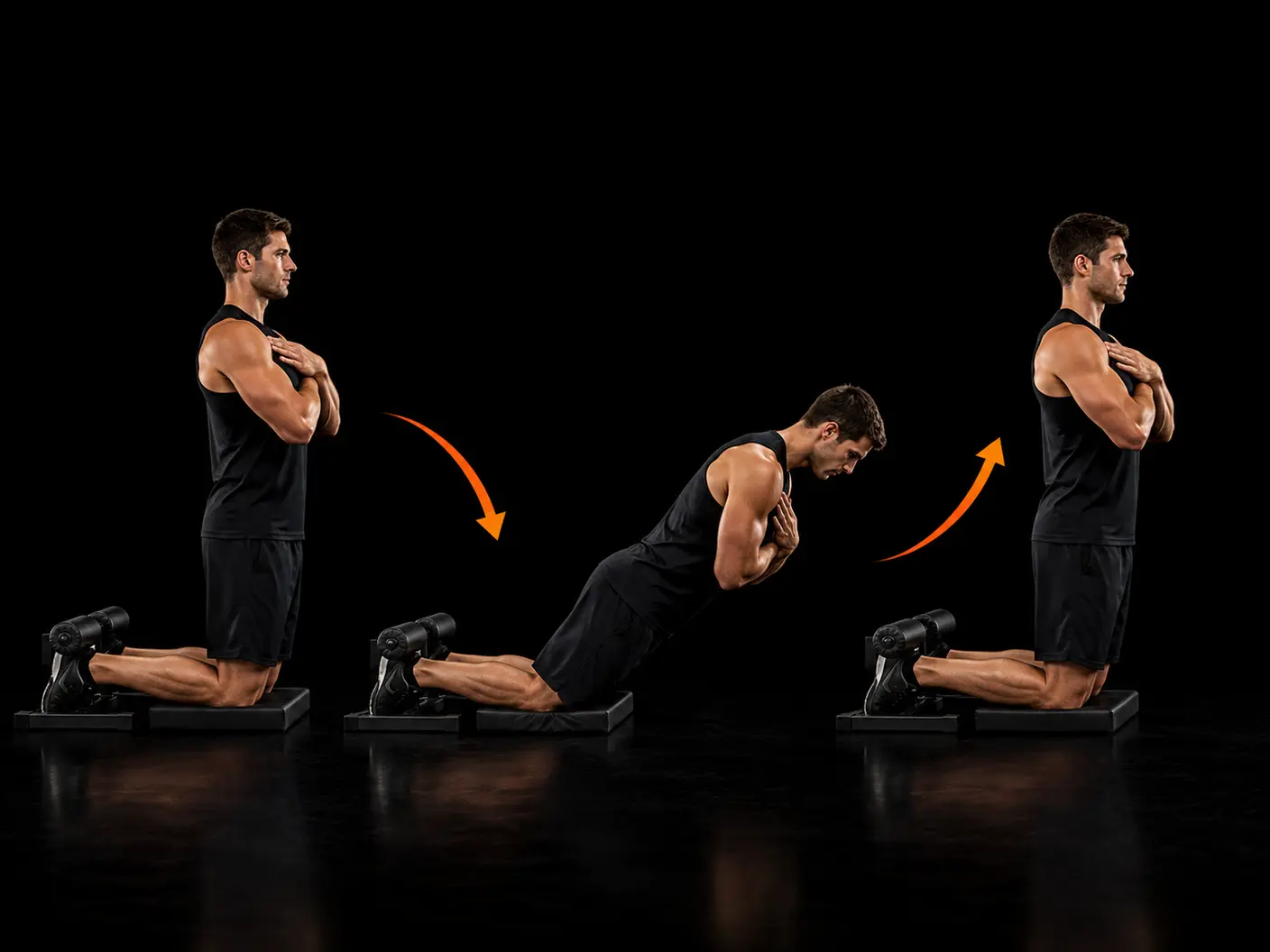
The Nordic hamstring curl is an advanced bodyweight isolation exercise that loads the hamstrings — with particular emphasis on the biceps femoris — through a demanding eccentric contraction. Kneeling with the ankles fixed, the lifter lowers their body toward the floor under muscular control, resisting gravity across the full range of motion. It suits intermediate to advanced trainees seeking to develop hamstring strength and size, and athletes looking to address posterior chain robustness.
How to do it
Kneel on a pad with ankles secured by a partner or loaded bar. Cross arms over the chest or extend them in front. Keep a straight line from knee to shoulder. Lower the body toward the floor under control — the hamstrings eccentrically resist gravity. Catch the fall with the hands at the bottom. Push back up with hands; work the eccentric only.
Coaching cues
- Straight line knee to shoulder
- Slow eccentric
- Catch with hands
- Fight gravity every inch
Why train it
- The pronounced eccentric overload places significant mechanical stress on the biceps femoris, making it an effective stimulus for hamstring hypertrophy.
- Requiring only a partner or anchor point alongside bodyweight, the exercise is accessible in a wide range of training environments without specialist machinery.
- The demand for a rigid trunk throughout the movement means the core musculature is recruited to maintain the knee-to-shoulder alignment, adding a secondary training stimulus.
- Its relevance to sprinting and change-of-direction mechanics makes it a well-established inclusion in athletic performance programmes.
Common mistakes
- Hinging at the hip — maintain a straight line from knee to shoulder throughout the descent rather than folding at the waist to reduce the load.
- Dropping too quickly in the early stages — control every inch of the eccentric; the value of the exercise is in resisting gravity, not surrendering to it.
- Using the push from the hands to drive the concentric return aggressively — the hands are there to catch the bottom position and assist the return, not to replace hamstring effort on the way down.
- Allowing the ankles to be secured too loosely — an unstable anchor shifts the emphasis away from the hamstrings and compromises the mechanics of the movement, so confirm a firm hold before each set.
Primary: Hamstrings.
Secondary: Gluteus Maximus, Rectus Abdominis.
Equipment
Good for
Easier variation
Razor curl or assisted Nordic with a band — reduces eccentric load.
Similar movements
Frequently asked
- What muscles does the Nordic hamstring curl work?
- The primary muscle trained is the hamstring group, with the biceps femoris receiving particular emphasis due to the eccentric nature of the loading. The glutes and core work as secondary stabilisers to keep the body rigid throughout the movement.
- How many sets and reps should I do for the Nordic hamstring curl?
- Because the eccentric demand is high and fatigue accumulates quickly, most trainees benefit from lower rep ranges — typically two to four sets of three to six controlled reps. Quality of each repetition matters considerably more than volume here, so prioritise a slow, deliberate descent over hitting a target number.
- Is the Nordic hamstring curl suitable for beginners?
- This exercise is classified as advanced and is not well suited to beginners. Trainees should first establish a solid foundation of hamstring strength through exercises such as the Romanian deadlift before progressing to the Nordic curl.
- What are good alternatives if I cannot perform a Nordic hamstring curl?
- If you lack the hamstring strength or anchor point required, Romanian deadlifts and lying leg curls are practical alternatives that train the same primary muscle group with greater control over load. These can serve as preparatory movements before attempting the Nordic variation.
- How does the Nordic hamstring curl fit into an athletic performance programme?
- The exercise is commonly used in athletic performance contexts due to its specificity to the eccentric hamstring demands of sprinting and deceleration. It is typically placed early in a session when the nervous system is fresh, and is often programmed one to two times per week to manage recovery demands.
Want this movement in a plan built for you?
Adaptiv programmes the right exercises for your goal, equipment and experience — then adapts them as you train.
Build my programme