Single-Arm Overhead Carry
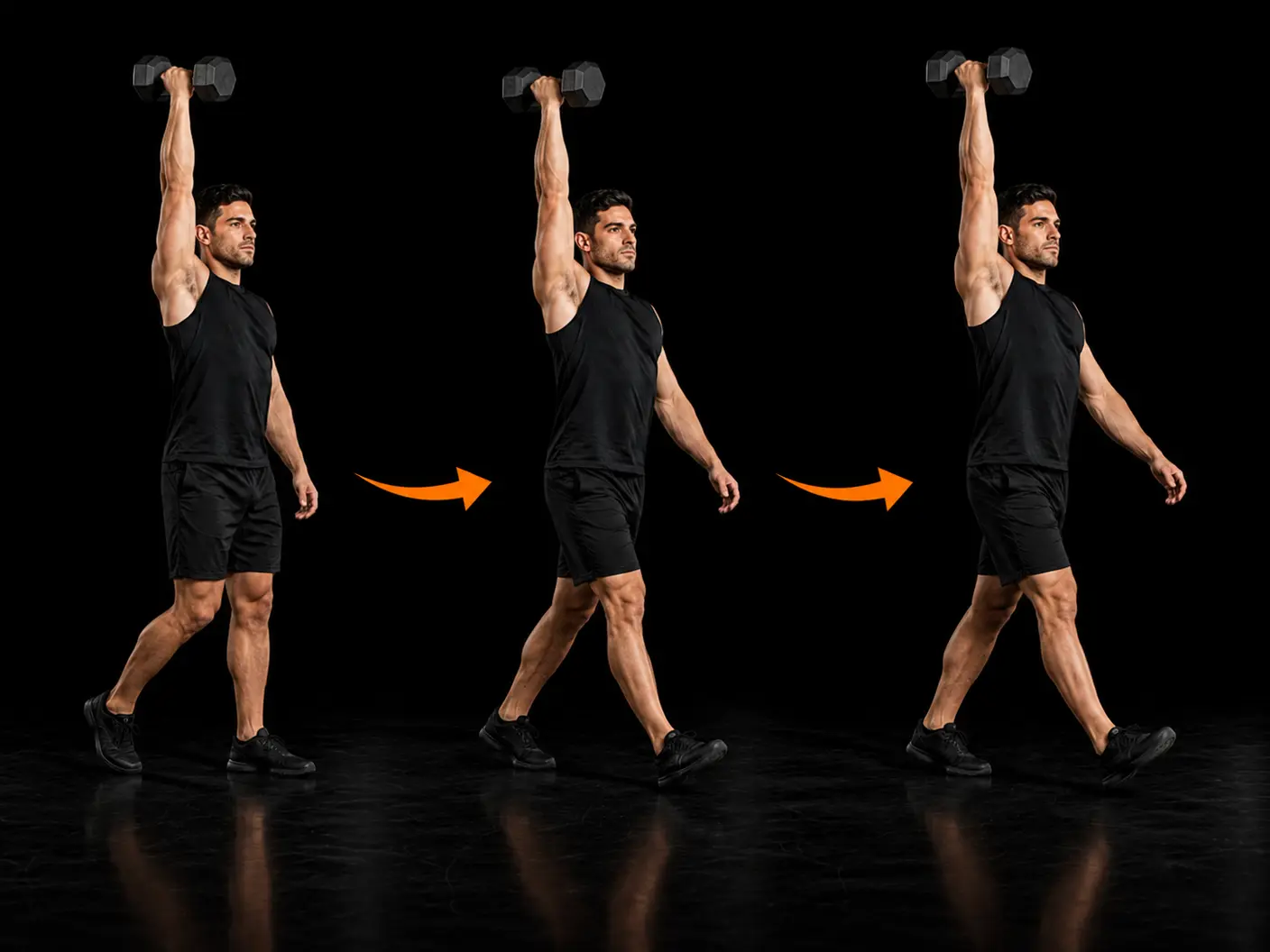
The single-arm overhead carry is a loaded locomotion drill in which you press a kettlebell or dumbbell overhead, lock the elbow out with the bicep by the ear, and walk for distance while resisting lateral trunk flexion. It trains the core across all planes simultaneously, with particular demand on the shoulder stabilisers to maintain a packed, vertical position throughout the gait cycle. It suits intermediate trainees looking to build functional overhead stability and unilateral core control for athletic performance or general fitness.
How to do it
Press a kettlebell or dumbbell overhead with one arm. Lock out the elbow with the bicep by the ear. Brace the core. Walk for distance; do not let the weight drift backward or forward or the torso lean. Switch sides.
Coaching cues
- Bicep by the ear
- Ribs down
- Strong shoulder packet
- Tall posture
Why train it
- Develops anti-lateral flexion strength by forcing the core to resist the asymmetrical load pulling the torso to the weighted side with every step.
- Reinforces a stable overhead position, training the shoulder stabilisers, traps, and rotator cuff to work continuously under sustained load rather than in a single explosive moment.
- Exposes and addresses left-to-right asymmetries, since each side must be completed independently and weaknesses are immediately apparent.
- Transfers directly to athletic and everyday demands that require simultaneous core bracing and overhead arm control, making it a high-value addition to general fitness and performance programmes.
Common mistakes
- Allowing the torso to lean away from the weight — brace the obliques and keep the ribcage down so the spine stays vertical throughout the walk.
- Letting the weight drift behind the ear — set the shoulder into a strong overhead packet at the start and maintain that bicep-by-the-ear position for the entire set.
- Flaring the ribcage upward — actively pull the ribs down before the first step and sustain that position to prevent excessive lumbar extension under load.
- Taking hurried or uneven strides — walk at a controlled, deliberate pace so that each step reinforces stable posture rather than masking a shaky overhead position with momentum.
Primary: Rectus Abdominis, Rotator Cuff.
Secondary: Obliques, Transverse Abdominis, Trapezius.
Equipment
Good for
Easier variation
Rack carry — hold at the shoulder instead of overhead.
Similar movements
Frequently asked
- What muscles does the single-arm overhead carry work?
- The primary demand falls on the core across all planes and the shoulder stabilisers. The obliques and transverse abdominis work hard to resist lateral lean, while the traps assist in maintaining the overhead position throughout the walk.
- How many sets and reps should I do for the single-arm overhead carry?
- Because the exercise is distance-based, a practical starting point is three to four sets of 20–30 metres per arm, resting 60–90 seconds between sides. As positional control improves, increase distance or load before adding both.
- What weight should I use for a single-arm overhead carry?
- Select a load that allows you to maintain a fully locked elbow, ribcage down, and upright torso for the full distance without any lateral lean. A weight that challenges your stability without compromising position is the correct starting point; form should dictate load, not the other way around.
- Is the single-arm overhead carry suitable for building shoulder stability?
- Yes — because the shoulder must hold an actively packed position under load for a prolonged period, the stabilising musculature around the shoulder is trained through sustained effort rather than brief moments of force. This makes it a practical choice for developing overhead resilience within a strength or conditioning programme.
- What are good alternatives to the single-arm overhead carry?
- The farmer's carry trains similar core and postural demands without the overhead component, making it a useful regression. The bottoms-up carry — holding the kettlebell inverted — increases the shoulder stability challenge at a lower absolute load and can serve as a useful progression or variation within the same movement pattern.
Want this movement in a plan built for you?
Adaptiv programmes the right exercises for your goal, equipment and experience — then adapts them as you train.
Build my programme